Disclosure: This post may contain affiliate links. As an Amazon Associate I earn from qualifying purchases.
The Marlin 7 is worth the extra money if you’ll be on trails every week, and the Marlin 4 is the better buy if you mostly ride paths, commute, or still aren’t sure mountain biking will stick.
In both bikes, you’ll get the same aluminum frame, so what you’re paying for is an air fork, a dropper post, tubeless-ready wheels, and 12 gears instead of 8.
As of now, 2026, you’ll pay $629.99 for the Marlin 4 and $1,399.99 for the Marlin 7, so the gap is about $770, although Trek changes prices with the model year, so I recommend you check the listing before you buy.
If you buy the 4 and add those four things later, you will spend a big part of that gap anyway, and you’ll still have the 4’s quick-release front axle holding you back.
So if you already know you’ll be on dirt most weekends, then you need to look at the 7 first.
However, if your rides are mostly smooth and flat, the 4 does that job well, and you won’t miss what the 7 has.
Both bikes use the same frame, so the parts decide everything
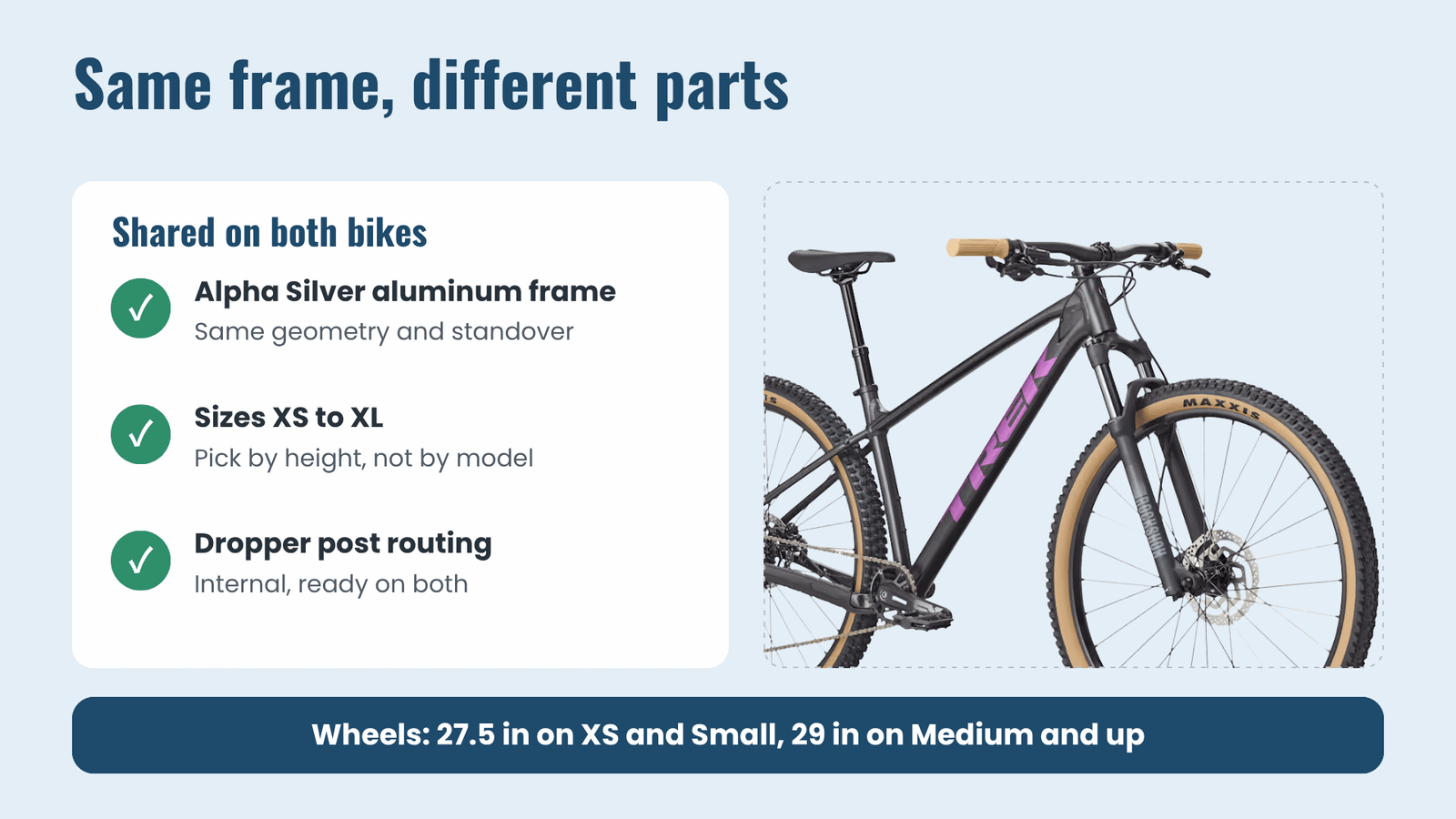
Trek builds the Marlin 4 and Marlin 7 on the same Alpha Silver aluminum frame, which means the geometry, the standover height, and the way the bike feels when you roll over a root are the same on both.
Frame sizes run from XS to XL on each bike, with 27.5 inch wheels on the XS and Small and 29 inch wheels on Medium and up, so your height won’t push you toward one model.
If you aren’t sure which size you need, the Trek Marlin size chart guide will sort that out in a minute.
Besides this, the frame has internal routing for a dropper post on both bikes, and the Marlin 4 comes with rack and kickstand mounts, so it suits you better if you plan to commute or carry a bag on it.
Because the frame is shared, the shape of the ride is the same, and every difference comes from what’s bolted on.
Where the two bikes differ, part by part
| Part | Marlin 4 Gen 3 | Marlin 7 Gen 3 |
|---|---|---|
| US list price | $629.99 | $1,399.99 |
| Fork | SR Suntour XCE 28, coil spring, preload only | RockShox Judy Silver, air spring, rebound adjustment and lockout |
| Fork travel | 80 mm to 100 mm, depending on frame size | 100 mm |
| Gears | Shimano ESSA, 8-speed, 11-45T cassette, 32T chainring | SRAM Eagle, 12-speed, 11-50T cassette, 30T chainring |
| Brakes | Tektro hydraulic disc | Shimano MT200 hydraulic disc |
| Wheels | Bontrager Connection, not tubeless ready | Bontrager Kovee, tubeless ready |
| Tires | Bontrager Montrose Comp, 2.40 inch | Maxxis Rekon EXO, 2.4 inch, tubeless ready |
| Dropper post | None | TranzX dropper, 31.6 mm |
On For fork You will Spend the Most Money
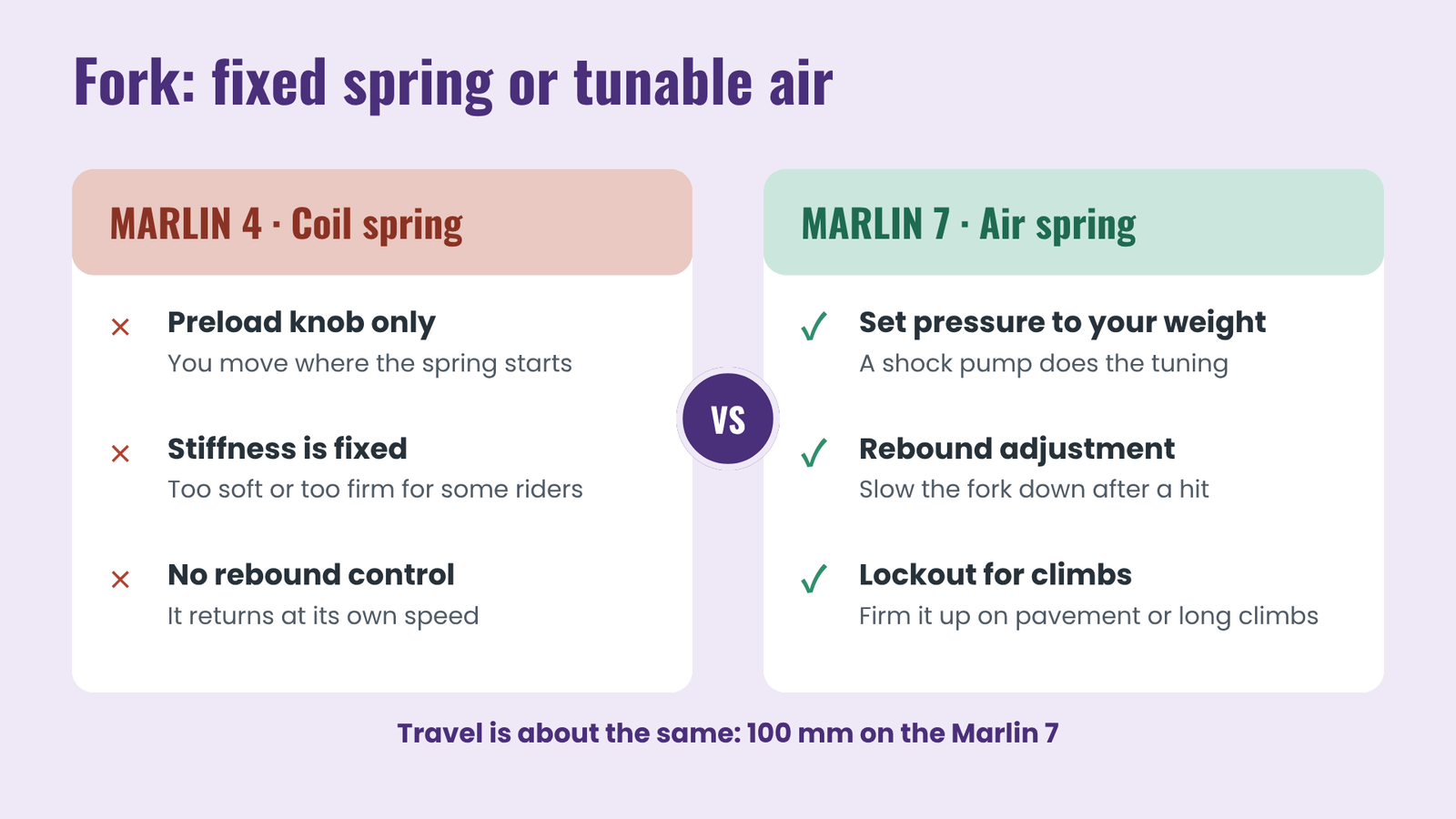
The Marlin 4 has a coil fork, which is a metal spring with a preload knob, so you can change where the spring starts, but you can’t change how stiff it is.
If you’re lighter or heavier than the rider that spring was picked for, then you will either feel every bump or keep bottoming the fork out, and you can’t really tune your way out of that without swapping the spring or the whole fork.
Besides this, a coil fork at this price is a heavy one, and it has no rebound adjustment, so it comes back up at whatever speed it wants.
The Marlin 7’s RockShox Judy Silver uses air instead of a spring, so you set the pressure with a shock pump to match your weight, and it also has rebound adjustment and a lockout.
That means you can slow the fork down after a hit, and you can firm it up for a long road climb or a paved stretch.
In fact, this is one of the things that makes the 7 feel like a different bike on rough trails, even though the travel is about the same, because an air spring can actually be fitted to you.
Tip: If you buy the 7, get a shock pump too, because air forks lose a little pressure over time and you will want to check it before a ride, otherwise the fork will feel soft or harsh and you won’t know why.
RockShox High-Pressure Fork & Shock Pump
300 psi pump for setting the Judy Silver air fork to your weight.
A dropper post is easy to add later, but you’ll pay for it
A dropper post lets you lower your saddle with a button while you descend, so it stays out of your way on steep or bumpy sections, and then you pop it back up for climbing.
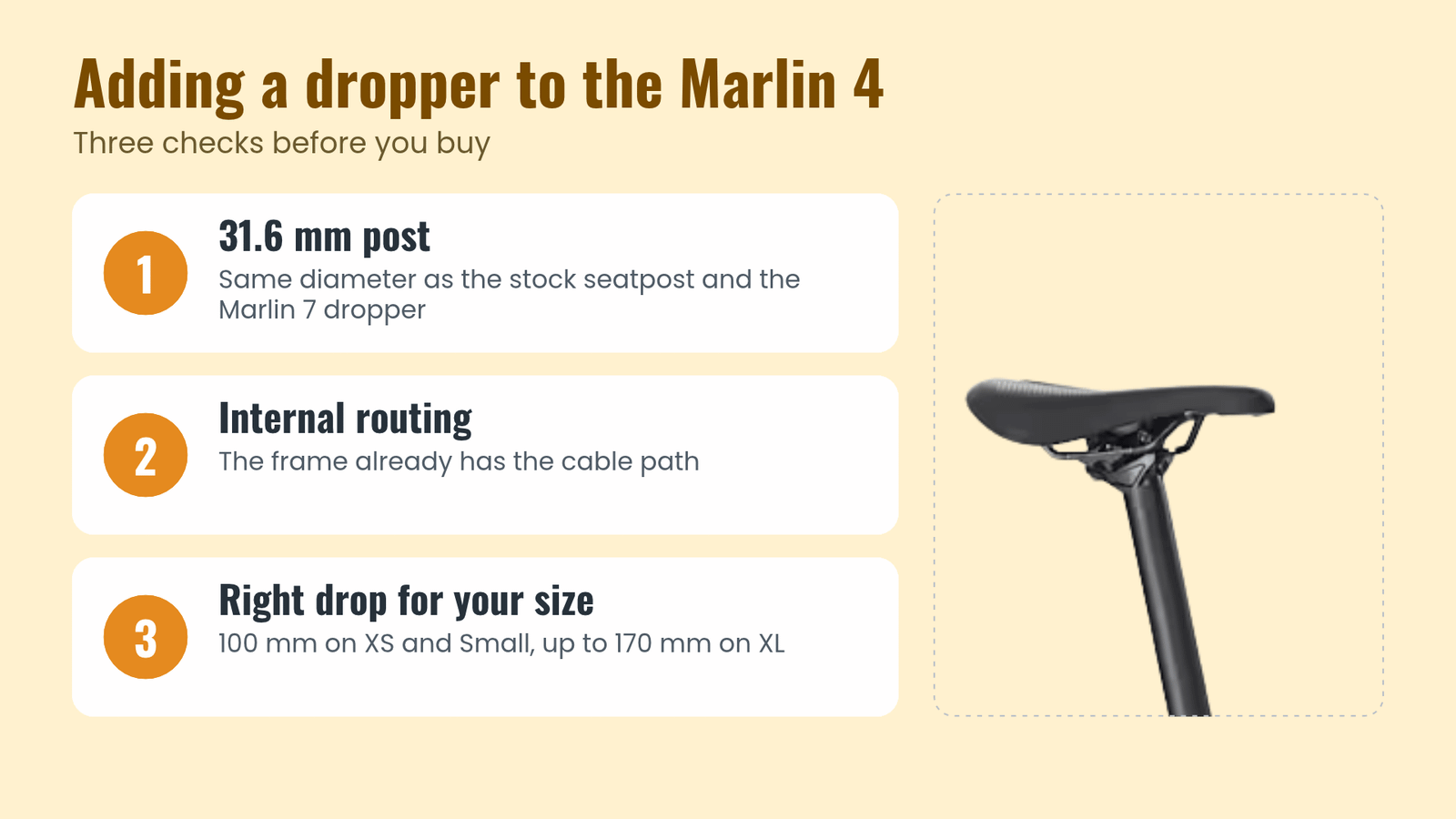
The Marlin 7 comes with a TranzX dropper, and the drop changes with frame size, from 100 mm on the XS and Small up to 170 mm on the XL.
The Marlin 4 doesn’t have one, but its frame has the internal routing, and the stock seatpost is 31.6 mm, which is the same diameter the 7’s dropper uses, so a 31.6 mm dropper will fit.
However, a dropper isn’t plug and play, because you need a length that works for your frame size, otherwise you either can’t get the saddle high enough or the post bottoms out in the frame.
31.6 mm Dropper Seatposts
Check the travel against your frame size before ordering.
My guide on dropper post size shows you how to pick the right one.
And if your rides are mostly flat paths, you can skip the dropper completely, since your saddle never needs to move.
Gearing shows up on every climb
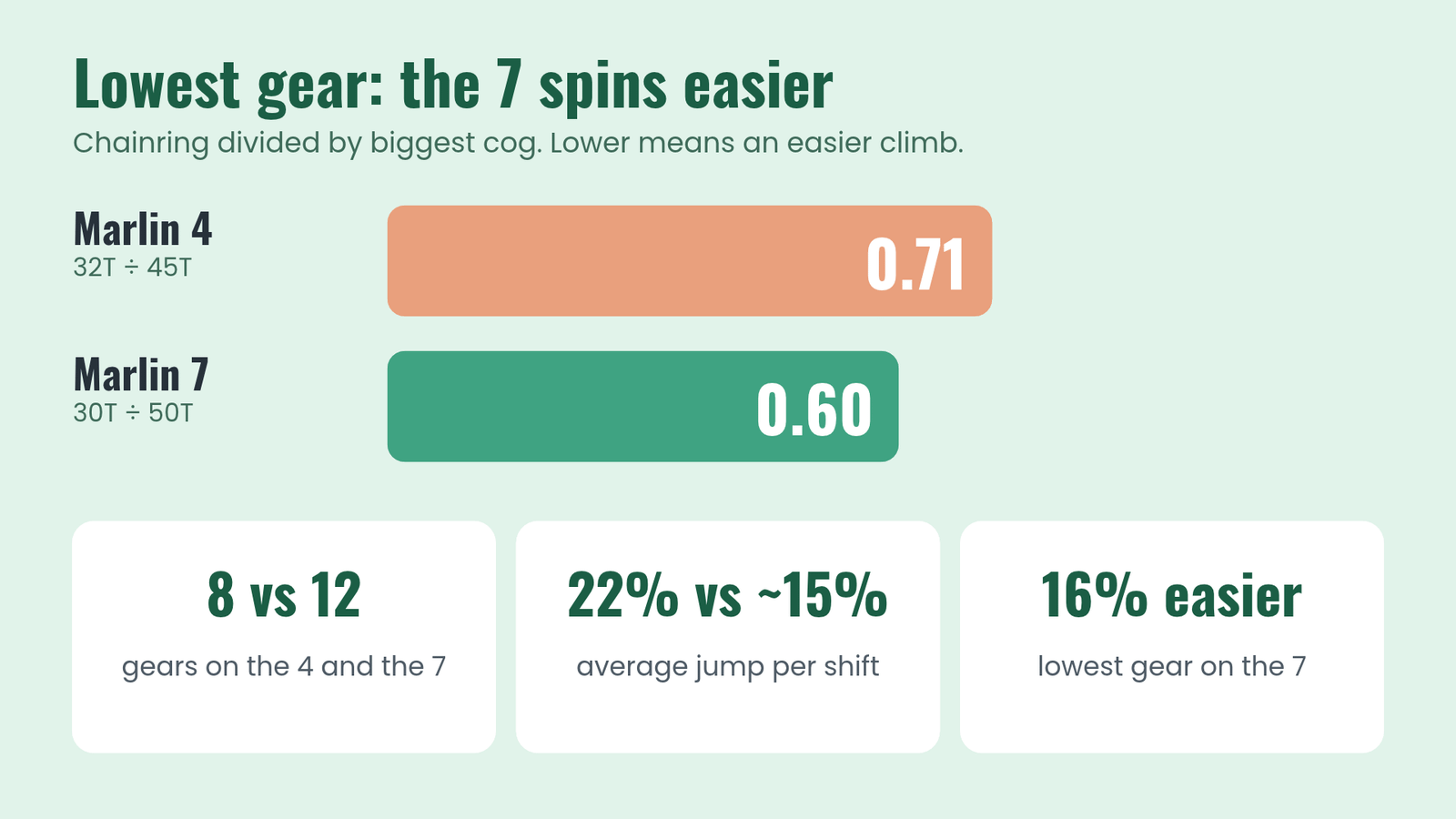
The Marlin 4’s easiest gear pairs a 32-tooth chainring with a 45-tooth cog on the cassette.
On the other hand, the Marlin 7 pairs a 30-tooth chainring with a 50-tooth cog.
Divide the chainring by the cog, and you get 0.71 on the 4 and 0.60 on the 7, which means the 7’s lowest gear is about 16 percent easier to turn, so on a steep climb you will be spinning instead of grinding.
Besides this, the 7 has 12 gears across that range, and the 4 has 8, so each shift on the 7 changes your gearing by about 15 percent on average, while on the 4 it’s closer to 22 percent.
That’s why on the 4 you will sometimes find that the gear you want sits between two.
However, if you ride flat paths, you’ll rarely reach for that easiest gear, so this is a difference you only feel when your rides have real hills.
Tubeless is simple on the 7 and awkward on the 4
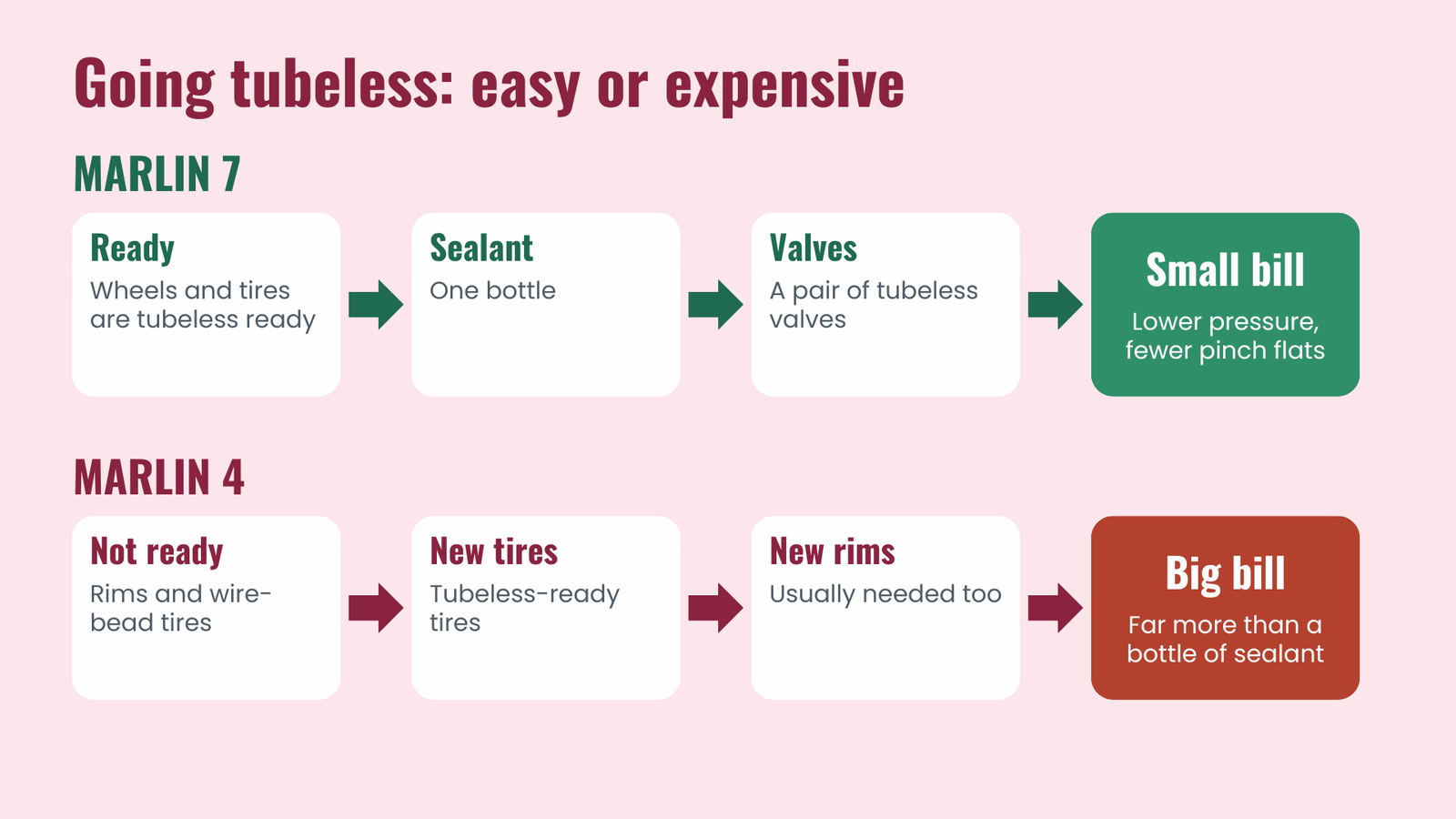
The Marlin 7’s wheels and tires are tubeless-ready, so going tubeless only needs sealant and tubeless valves, and then you can run lower pressure for more grip and fewer pinch flats.
Stan’s NoTubes Tire Sealant, 250 ml
Enough sealant to set up both tires tubeless.
Muc-Off Tubeless Valves V2, 44 mm
Presta tubeless valves, 44 mm, black.
The Marlin 4’s rims and wire-bead tires weren’t made for it, so a proper tubeless setup there means new tires and usually new rims, which is a much bigger bill than a bottle of sealant.
If you ride only on pavement and packed paths, you won’t care, but if you wanna ride rooty or rocky trails, you will care a lot, because pinch flats show up fast on those.
What neither bike lets you change easily
Both bikes have a 100 mm quick-release front axle and a 135 mm ThruSkew rear axle, which are older standards, so a lot of newer wheels and forks won’t fit them.
And any upgrade needs checking before you buy.
That’s one more reason I’d recommend the 7 if you know you’ll upgrade later, because the parts you would normally replace first, like the fork and the wheels, are already better on it.
Neither bike wants to be pointed down steep, rocky descents or off jumps, since both are 100 mm cross-country hardtails.
The 7 handles smooth, flowy trails and rougher dirt better because of the air fork and the dropper, but it’s still the same kind of bike.
Which one fits the way you ride
- Marlin 4 if: your rides are mostly bike paths, neighborhood streets, gravel roads, and smooth dirt, or you want a bike with rack and kickstand mounts for commuting, or you aren’t sure yet that mountain biking will stick and you don’t want to spend $1,400 to find out.
- Marlin 7 if: you plan to ride trails every week and your area has real climbs, and you want a bike that keeps up as you get better, because the air fork, the dropper, the easier gearing, and the tubeless wheels mean you won’t be buying parts after six months.
If you’re a first-time rider and the 7 fits your budget, it isn’t too much bike for a beginner, because the extra gears are no harder to use, and the only new thing to learn is setting the fork pressure with a pump. Also, you can check these 3 Specialized Mountain Bike Under $1000.
However, I’d rather see a beginner on a Marlin 4 they can afford than someone skipping rides because the 7 stretched the budget.
If the gap feels too big, look at the Marlin 5 and 6
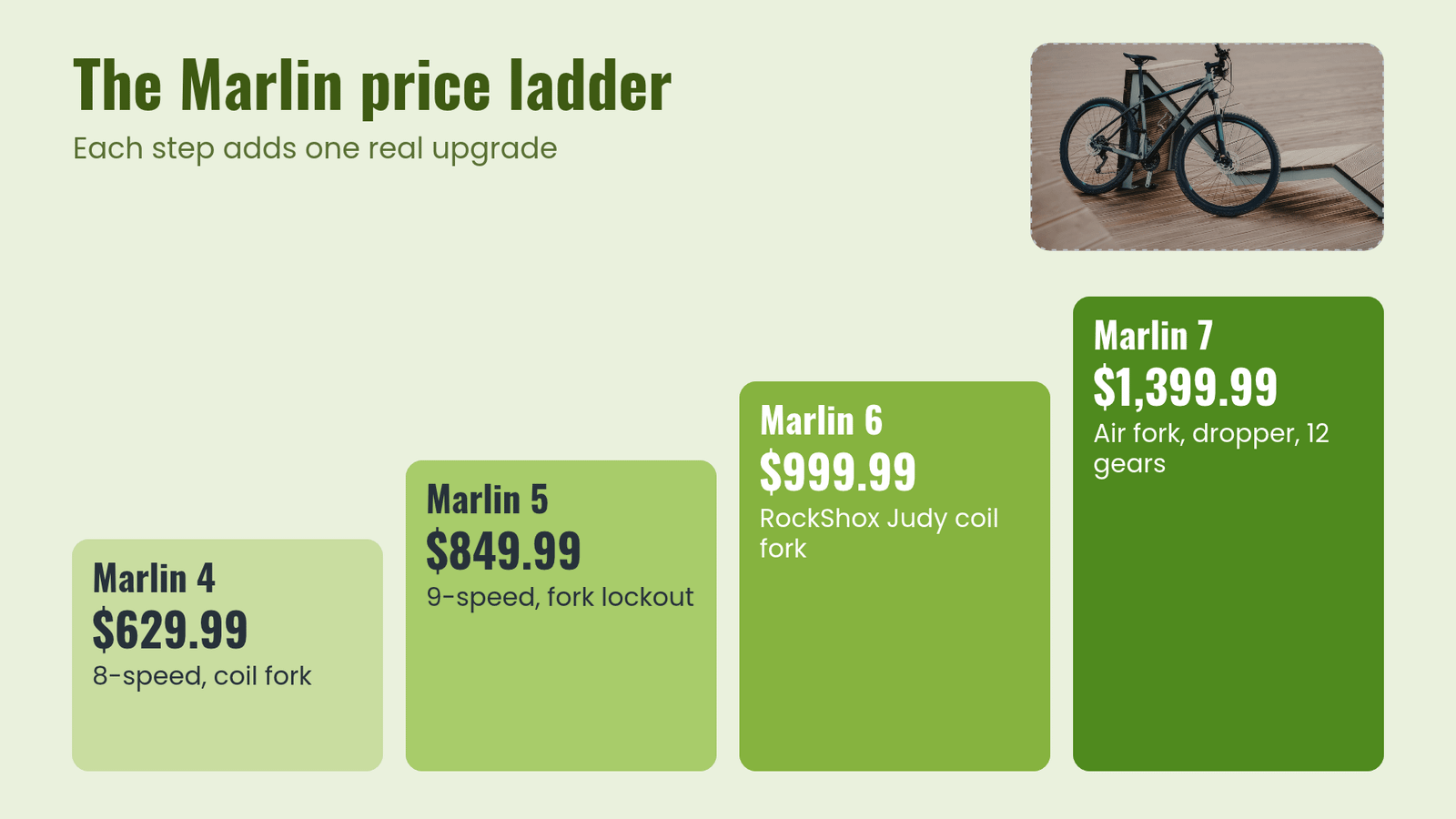
The Marlin 5 costs $849.99, and the Marlin 6 costs $999.99, so they fill in the space between.
The 5 moves up to 9-speed Shimano gearing and gets a fork with a hydraulic lockout, which is a modest step up from the 4.
The 6 steps up to a RockShox Judy fork, but it’s still a coil fork, so the air fork is what the 7 adds on top.
Trek has added new build options over the years, so check the exact spec on the listing, especially for the dropper, before you assume.
Our reviews of the Marlin 5 and the Marlin 6 go through each one, and the Marlin 7 review covers the top of the range.
Make sure the listing says Gen 3
Some stores still sell the Marlin 4 Gen 2 at a lower price, and that older bike has the previous frame, which gives you less tire clearance, no dropper routing, mechanical disc brakes, and an older drivetrain, so you lose some of what makes the 4 a good deal.
So when you compare prices, check that the listing says Gen 3 before you buy.
Tip: If you do buy the 4 and want to improve it step by step, start with the parts that work with the stock wheels and fork, because that keeps your money out of things you’d replace later, and I’ve discussed that in the Trek Marlin 4 upgrades guide.
If you end up with the 7, the best Marlin 7 upgrades are a different list, since it already comes with most of the big stuff.
Questions riders ask before choosing
How much rider weight can the Marlin 4 and Marlin 7 handle?
Both bikes are rated for 300 lb (136 kg) of total weight, and that number includes the bike and anything you carry, so you need to subtract the weight of the bike first.
A medium Marlin 4 weighs about 32.9 lb, which leaves around 267 lb for you and your gear, and the Marlin 7 is a little lighter at about 31 lb, so you get slightly more room but not much.
If you’re close to that limit, then I’d recommend you pick the 7, because you can add air pressure to its fork for your weight, while the 4’s coil spring only has a preload knob and a heavy rider will bottom it out sooner.
How do I set up the Marlin 7’s air fork?
Start with the pressure for your weight, which is in the fork’s manual, and then pump it up with a shock pump, compress the fork a few times to even out the air inside, and check the pressure again, because it will drop a little after that.
Next you need to check your sag, which is how far the fork sinks when you sit on the bike in your riding gear, and a good target is 20 to 25 percent, so 20 to 25 mm on a 100 mm fork.
RockShox High-Pressure Fork & Shock Pump
300 psi pump for setting the Judy Silver air fork to your weight.
The Judy Silver doesn’t come with a sag ring, so you can wrap a zip tie around the fork leg and see how far it slides.
If it sinks too far, add air, and if it barely moves, let some out, and do it in steps of about 5 psi, because small changes make a big difference.