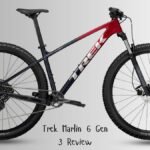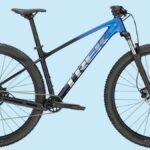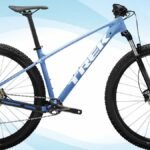
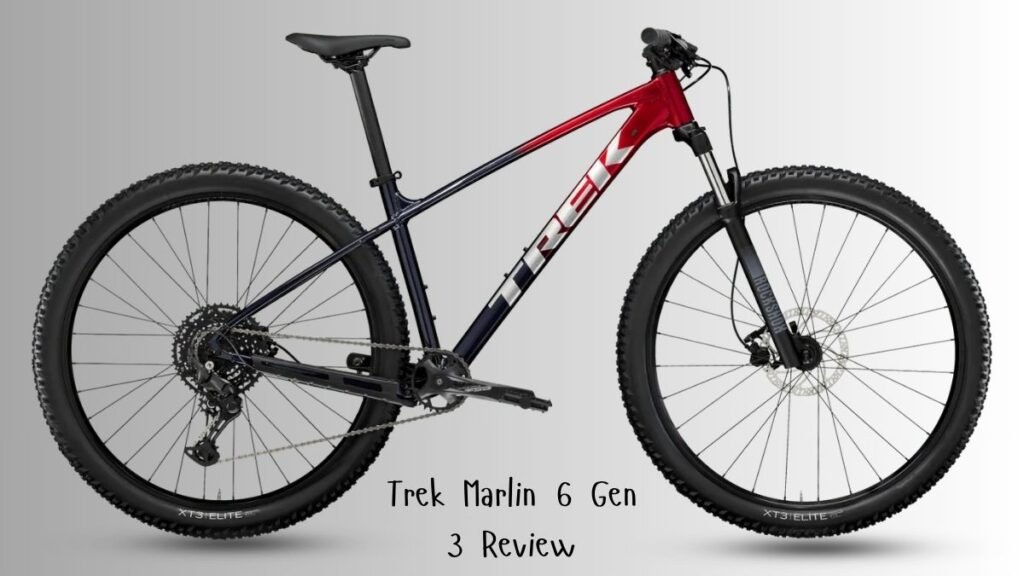
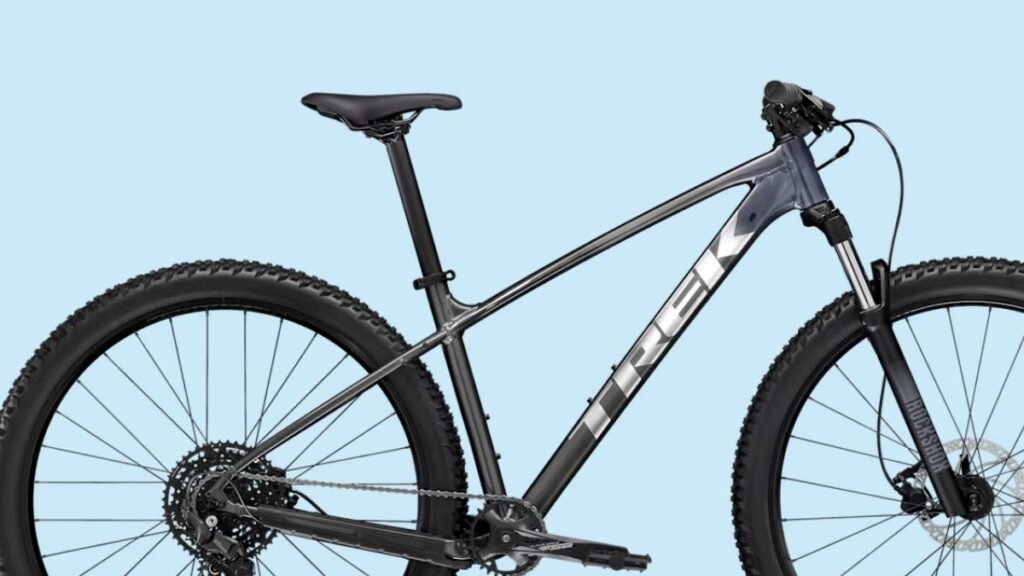
At $999.99, the Trek Marlin 6 Gen 3 is coming with component spec like RockShox Judy Silver fork with 30mm stanchions, maxxis Rekon tires, EXO-cased and tubeless-ready, Bontrager Kovee rims with tubeless strips.
Usually, you won’t find a bike with these component in this price range.
It has a TranzX dropper post, sized the frame installed on every size from XS to XL, so we can say It’s a trail-ready mtb from the factory.
If we talk about drivetrain, so it has 1×10 Shimano CUES U6000 with an 11-48T LINKGLIDE cassette, brakes are Shimano Deore MT200 hydraulic disc with 160mm front rotors on smaller frames and 180mm up front on every size from Medium and above.
Key takeaway:
- Marlin 6 Gen 3 is the first bike in the Marlin lineup where the component spec matches the “trail bike” label.
- The RockShox Judy Silver, Maxxis Rekon tires, stock dropper post, and tubeless-ready Kovee rims make this a capable trail hardtail out of the box rather than one you have to build up to.
- The straight headtube limits future fork upgrade options compared to a tapered setup.
Trek Marlin 6 Gen 3 Specifications
| Component | Spec |
|---|---|
| Frame | Alpha Silver Aluminum, molded chainstay protection, internal routing, rack and kickstand mounts |
| Fork | RockShox Judy Silver, coil spring, preload, TurnKey lockout, 30mm stanchions, 100mm travel |
| Fork offset | 42mm (XS/SM, 27.5″ wheel) / 46mm (MD-XL, 29″ wheel) |
| Headtube | Straight, 1.125″ |
| Drivetrain | Shimano CUES U6000, 1×10 |
| Crankset | Shimano U4000 Alloy, 30T chainring |
| Cassette | Shimano CUES LG300 LINKGLIDE, 10-speed, 11-48T |
| Chain | Shimano LG500, 10-speed |
| Shifter | Shimano CUES U6000, 10-speed |
| Rear derailleur | Shimano CUES U6000, GS cage |
| Brakes | Shimano Deore MT200 hydraulic disc, 2-piston |
| Rotors | 160mm front (XS/SM), 180mm front (MD-XL), 160mm rear (all sizes) |
| Rims | Bontrager Kovee, double-wall alloy, 23mm internal width, tubeless-ready, TLR strips included |
| Tires | Maxxis Rekon, EXO casing, 60 TPI, tubeless-ready, 2.35″ |
| Dropper post | TranzX JD-YSI34, internal routing: 100mm drop (XS/SM), 125mm (MD), 150mm (ML-XL) |
| Saddle | Bontrager Verse Short, stainless rails |
| Pedals | VP-536 nylon platform |
| Sizes | XS (27.5″), S (27.5″), M (29″), ML (29″), L (29″), XL (29″) |
| Weight | 33 lb 1.1 oz (size M) |
| Price | $999.99 MSRP |
The 11-48T cassette with a 30T chainring puts your low gear at 16 gear inches, lower than the Marlin 5’s 11-46T cassette on a 32T ring.
On steep singletrack climbs where you’d normally be dabbing a foot, that extra range keeps you spinning.
The 10-speed spacing across those gears is tighter than the Marlin 5’s 9-speed setup, which translates to smaller jumps and a smoother cadence on variable terrain.
What Makes the Marlin 6 Gen 3 Build Unusual at this Price
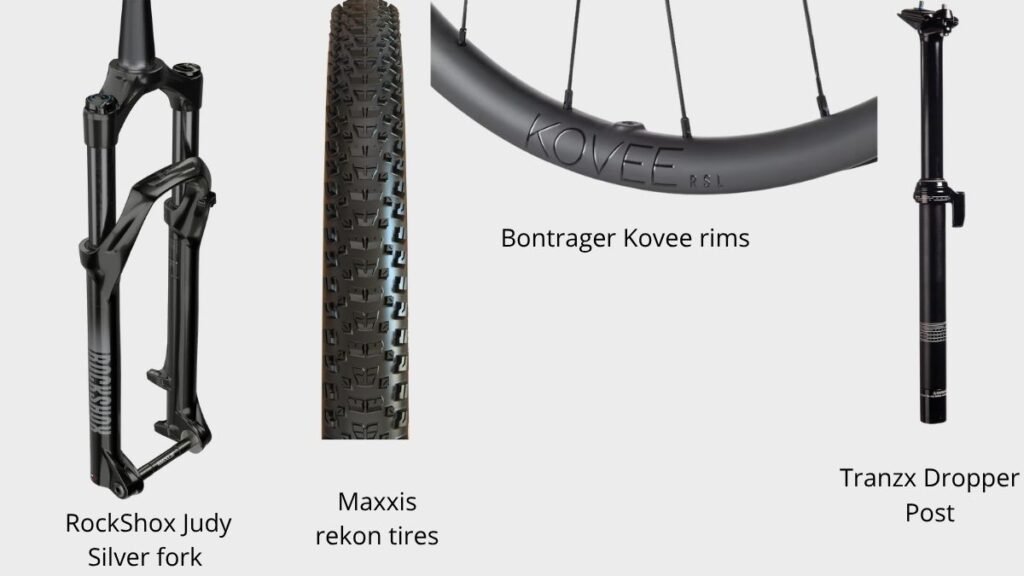
Before getting into trail performance, let’s know what ships in the box, because this is where the Marlin 6 Gen 3 earns or loses its $999 price tag.
Four components on this bike typically cost extra or come in lesser form on competitors at this price:
- RockShox Judy Silver fork with 30mm stanchions and TurnKey lockout
- Maxxis Rekon tires (EXO casing, 60 TPI, tubeless-ready) on both wheels
- Bontrager Kovee rims with 23mm internal width and tubeless strips included
- TranzX dropper post, internally routed, sized to the frame
Four components on this bike cost extra or come in lesser form on competitors at this price, and they’re all stock on the 2026 Marlin 6 Gen 3.
RockShox Judy Silver and what 30mm stanchions mean on trail
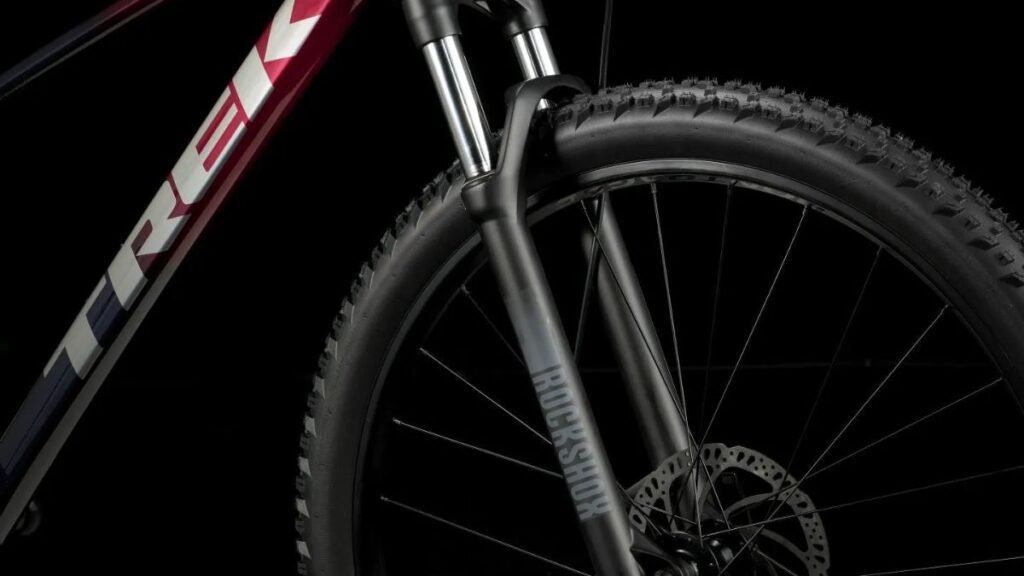
The Judy Silver is a proper suspension fork from a suspension brand, not an SR Suntour unit with a recognizable name stamped on it.
Judy’s 30mm stanchion diameter is stiffer under braking loads and lateral forces than the smaller-diameter stanchions on entry-level forks.
When you brake hard into a rough corner, the fork flexes less, and the front wheel tracks better through the chatter. On smooth XC terrain that’s imperceptible.
On anything technical, it’s the difference between a fork that tracks and one that wanders.
The TurnKey lockout on the Judy is a simple on/off lever at the top of the right leg.
Functionally, it does the same thing as a hydraulic lockout: it firms up the fork for climbs and flat sections, and you open it for trail descents.
It’s not as refined as a remote lockout on a higher-end fork, but it works well for the terrain this bike is designed for.
Maxxis Rekon tires and how they change what you can ride from day one
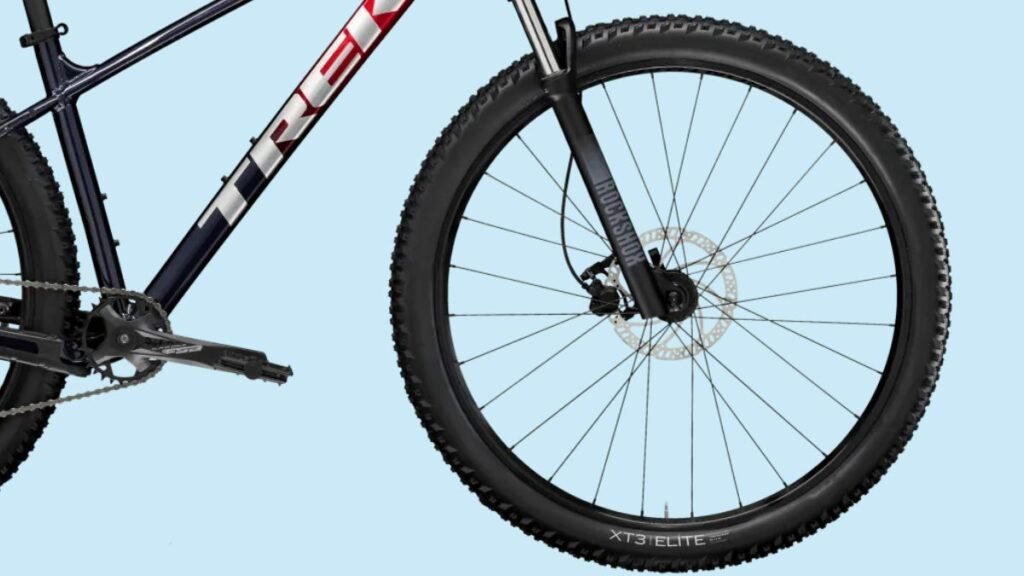
Maxxis Rekon is a trail tire, not an entry-level XC-pattern option that came along because the budget ran out.
The EXO sidewall casing adds cut and puncture protection without the weight penalty of a heavy-duty casing, and the 2.35″ width is wide enough to run at lower pressures for better traction in corners.
At 60 TPI, the casing is supple enough to deform over small obstacles instead of bouncing off them.
On loose-over-hard terrain, the Rekon hooks up well in corners and brakes predictably in a straight line.
This is the tire you’d choose if you were building a trail bike yourself at this budget, getting it stock means you’re not compromising on traction from your first ride.
Bontrager Kovee rims with 23mm internal width and tubeless strips in the box
The Kovee rims have 23mm internal width, which is a 3mm improvement over the 20mm rims on the Marlin 5 and better matched to a 2.35″ tire.
Wider internal rim width supports the tire sidewall better, which means your bike’s tire will behave more predictably under hard cornering loads and holds its shape better at lower pressures.
The tubeless strips are included in the box, ready to use, but isn’t just “tubeless-ready” in name only: you add sealant and compatible valves and the setup is done.
Lower pressure, better traction, fewer pinch flats, and no tube to carry on trail if you’re going full tubeless.
Running the Rekon tires tubeless on these rims at 20 to 24 PSI front and 22 to 26 PSI rear is a practical setup from day one.
TranzX dropper post, sized to the frame
Every size of the Marlin 6 Gen 3 ships with a TranzX internally-routed dropper post.
Smaller frames (XS and SM) get 100mm of drop, Medium gets 125mm, and everything from ML upward gets 150mm.
The sizing is proportional to frame size, which is the right approach.
A dropper post changes the riding experience more than any other single component on a trail hardtail.
When the descent starts, you drop the saddle, your hips can move freely behind the bike, and your weight sits lower and further back, and climbs feel the same as always.
But the confidence going downhill, especially on anything with rocks or roots, increases substantially.
Retrofitting a dropper post on a bike that doesn’t have one adds $150 to $300 in parts and labor.
Shimano CUES U6000 Drivetrain on Singletrack
What changes between U4000 and U6000
The Marlin 5 Gen 3 runs Shimano CUES U4000, while Marlin 6 steps up to U6000 on both the shifter and rear derailleur.
U6000 is Shimano’s higher-tier CUES groupset, with better shift accuracy, tighter tolerance under load, and a GS-cage rear derailleur designed for the wider 11-48T cassette range.
On a sustained technical climb where you’re pushing hard and shifting every few seconds, the U6000 handles that more better than U4000 does.
Both use LINKGLIDE cassette technology, so the durability benefits carry over.
The chain and cassette wear slowly under load, the system doesn’t punish aggressive shifting habits, and when maintenance time comes, too can replace the chain with a LINKGLIDE-compatible chain (Shimano LG500) to preserve cassette life.
10-speed spacing and the 11-48T cassette range
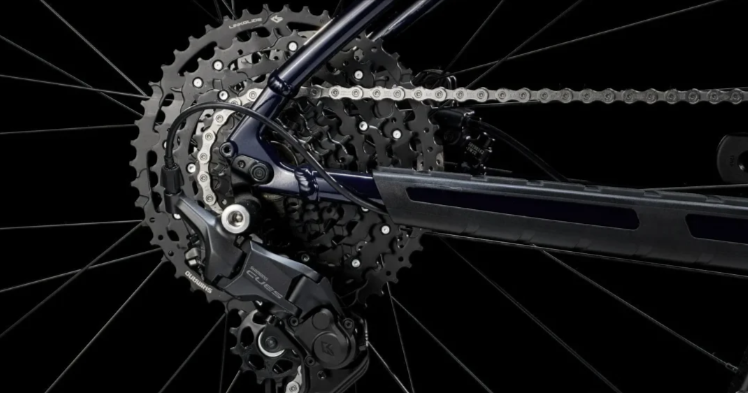
Ten gears across 11-48T gives you smaller jumps between cogs than the Marlin 5’s 9-speed 11-46T setup.
On variable terrain where the gradient changes every few seconds, you can hold a steadier cadence without surging or spinning out between shifts.
With a 30T chainring, the low gear is lower than the Marlin 5’s 32T/11-46T setup, which makes steep technical singletrack climbing more manageable at lower speeds.
But the LG500 chain replacement requirement applies here as well, Standard 10-speed chains are not interchangeable with LINKGLIDE-specific chains.
Keep an LG500 or compatible chain on hand for maintenance rather than swapping in whatever chain is convenient.
RockShox Judy Silver fork and the straight headtube
The Judy Silver handles a wider range of terrain than the SR Suntour forks on bikes below it in the Marlin lineup.
On rock gardens, sustained rooty trail, and chunky descents at moderate speed, the 30mm stanchions track better and the fork recovers faster between consecutive hits.
There’s no rebound adjustment on the Judy Silver, which is the version limitation to understand: the spring rate is fixed, and while preload adjustment lets you set sag, you can’t tune how fast the fork recovers.
On very rough high-speed terrain, an adjustable-rebound fork handles better, for the terrain this bike is designed for, the Judy Silver is a good thing to have.
The straight 1.125″ headtube and what it means for future upgrades
The Marlin 6 Gen 3 has a straight 1.125″ headtube, the RockShox Judy Silver fits because it has a straight 1.125″ steerer tube.
If you want to upgrade to a better fork (a RockShox Revelation, Pike, or Fox 34), those use tapered (1.125″ to 1.5″) steerers, which require a tapered headtube or a headset reducer.
A headset reducer adaptor works for some fork/headset combinations, but it’s an extra component and an extra compatibility check.
The Marlin 7 uses a tapered headtube, which accepts any tapered or straight steerer fork with the right headset.
If long-term fork upgrade potential matters to you, then you should deside the Marlin 6 vs Marlin 7.
Brakes and What the Rotor Size Difference Does on Trail
Shimano Deore MT200 two-piston hydraulic disc brakes are the same caliper on both sizes of rotor.
Big difference between the 160mm setup on XS and SM frames and the 180mm front rotor on Medium and larger is heat dissipation and initial bite strength.
A larger rotor has more surface area that pull heat away from the pad contact zone on long descents, which means less fade on sustained braking.
It also increases leverage, so lighter lever pressure produces more stopping force.
For riders on Medium and larger frames who will be riding any significant descents, the 180mm front rotor is a good choice to upgrade over what smaller bikes in the Marlin lineup come with.
On smooth trail, you won’t notice the difference, but a long descent with rooted braking zones, you will.
The rear rotor stays at 160mm across all sizes, which is standard and appropriate.
Rear braking contributes less total stopping power than front braking on descents, and a larger rear rotor rarely improves real-world performance enough to justify the weight.
Marlin 6 Gen 3 Strengths, Limitations, and Who it Fits Best
Strengths:
- RockShox Judy Silver with 30mm stanchions tracks technical terrain better than SR Suntour units at this price, with improvement in torsional rigidity under braking loads
- Maxxis Rekon tires are a legitimate trail tire with EXO sidewall protection, and the tubeless-ready setup with Kovee rims. Plus, included strips lets you run them tubeless from day one
- TranzX dropper post on every size, with travel matched to frame size, changes the descending experience in ways no other single component at this price range does
- Shimano CUES U6000 with LINKGLIDE provides 10-speed range and long-term drivetrain durability under real-world maintenance habits
- 180mm front rotor on Medium and larger frames provides better sustained braking performance on longer descents
- 23mm internal rim width supports the 2.35″ Rekon tires correctly and allows tubeless to work as intended at appropriate pressures
Limitations:
- Straight 1.125″ headtube limits fork upgrade options to straight-steerer forks
- RockShox Judy Silver has no rebound adjustment, which limits its performance on high-speed, very rough terrain compared to adjustable-rebound forks
- TranzX dropper post is a budget unit; the remote lever and cable actuation are functional but feel less refined than Rockshox Reverb or OneUp units in the $200 to $350 range
- VP-536 nylon pedals ship stock and should be replaced before trail riding; metal pins and a larger platform make a difference in grip and confidence
- Weight at 33 lb 1.1 oz (size M) is on the heavier side for trail use, though this is typical for aluminum hardtails at this price
Who this bike is built for:

The Marlin 6 Gen 3 is for a rider who wants to start on real trail terrain, not work up to it.
If your plan is to ride green to blue-rated singletrack, work on skills, and not spend the first season adding components before the bike matches the terrain, this build makes sense at $999.
The dropper post and Rekon tires are the two components that deliver the most immediate trail-riding confidence, and both ship standard on every size.
For someone whose trail riding has been casual so far and who wants to push into more technical terrain without a major gear investment, the Marlin 6 Gen 3 is a reasonable single purchase.
And if you’re someone who already rides a few times a week and knows you will be pushing into sustained blue or black terrain within a season, the straight headtube is a limitation.
FAQs About the Trek Marlin 6 Gen 3
Every size of the 2026 Marlin 6 Gen 3 ships with a TranzX JD-YSI34 internally-routed dropper post installed from the factory.
Drop travel varies by frame size: 100mm for XS and SM, 125mm for Medium, and 150mm for ML through XL.
The frame has internal dropper routing pre-installed, and the post is already in place when the bike arrives.
Does the 2026 Trek Marlin 6 Gen 3 come with a dropper post?
Can you upgrade the fork on the Marlin 6 Gen 3?
Yes, but the straight 1.125″ headtube limits your options, the RockShox Judy Silver that ships on the bike fits because it uses a straight steerer tube.
Other straight-steerer options include the Manitou Markhor and X-Fusion Sweep, both available in 100mm to 120mm travel in the $200 to $350 range.
Tapered-steerer forks (RockShox Pike, Fox 34, and most higher-end options) require a headset reducer to fit the straight headtube.
It works but adds a compatibility step and another component to manage.
How does the 2026 Marlin 6 Gen 3 compare to the Marlin 5 Gen 3?
The jump from $849 (Marlin 5) to $999 (Marlin 6) is larger in component terms than the $150 price difference implies.
The Marlin 6 gets a RockShox Judy Silver fork instead of SR Suntour XCT 30, Maxxis Rekon tires instead of Bontrager Montrose Comp, tubeless-ready rims instead of non-tubeless. A stock dropper post, 10-speed U6000 CUES instead of 9-speed U4000, and a wider 11-48T cassette instead of 11-46T.
If you know you’ll be doing any real trail riding, the Marlin 6 is a better starting point than the Marlin 5 with planned upgrades.
Is the Maxxis Rekon a good tire for trail riding?
The Rekon is a well-regarded trail tire that balances rolling efficiency with cornering grip.
The EXO casing provides sidewall protection against cuts and abrasion without the weight of a heavier-duty Double Down casing.
At 2.35″ wide on the Kovee rims, it runs well in the 20 to 28 PSI range depending on terrain and rider weight.
For XC loops and blue-rated singletrack, the Rekon is a capable all-around choice and a much better spec than the wire-bead XC tires that come on the Marlin 5 and most competing bikes under $1,000.
What size Trek Marlin 6 Gen 3 should you buy?
Trek’s chart puts Medium at around 5’5″ to 5’9″ and Large at 5’9″ to 6’1″. XS and SM frames use 27.5″ wheels; everything from Medium up runs 29″.
The geometry data shows a 69.5-degree head angle for Medium through XL, which is appropriate for XC and moderate trail riding.
If you’re on the border between Small and Medium, the Medium’s 29″ wheels roll over obstacles more efficiently and are faster on XC terrain.
Choose Small if standover clearance is a constraint, not just because it feels like a smaller bike.
What should you upgrade first on the Marlin 6 Gen 3?
You can replace dropper post cable remote within your first few rides if the stock lever feel bothers you, though many riders use it as-is for a long time.
The pedals are the immediate swap: VP-536 nylon platforms have poor wet-weather grip and should be replaced with metal-pin flat pedals from OneUp, Deity, or Crankbrothers Stamp before any technical trail riding.
Budget $30 to $50, after that, the Rekon tires are already good: run them tubeless with appropriate sealant and valves (around $30 to $40 extra) and you’ve maximized what the stock build delivers.

Muhammad Abraham is the founder of Mountain Bike Insider and has been riding mountain bikes for over 15 years. He started writing professionally in 2017 and launched this site in 2024 to share practical MTB gear reviews, bike comparisons, trail guides, and riding advice based on real-world experience. When he has not used a product directly, he clearly says so and supplements his research with input from other riders and the mountain biking community.