Disclosure: This post may contain affiliate links. As an Amazon Associate I earn from qualifying purchases.
Specialized is one of the most recognized mountain bike brands in the world, not just in the United States. So, if you are planning to buy the best Specialized mountain bike for beginners under $1,000, I will help you with that.
I have chosen 3 mountain bikes from Specialized that are under $1,000, based on certain criteria and a bar, which we will talk about later.
Besides that, I have also chosen some other bikes that are giving competition to Specialized mountain bikes, and they are still in budget.
I will also discuss whether it would be a good option to buy a second-hand bike for $1,000 with more features and specifications.
In the end, you will have all your doubts cleared, and you will know which bike you are going to buy next.
How I Selected and Rated These Bikes
I have chosen 8 criteria to compare these Specialized mountain bikes for beginners, and I have given more weight to the things that a beginner should care about in their bike.
| Criteria | Weight |
|---|---|
| Can it handle normal beginner mistakes and suitable off-road use? | 20% |
| Are the components worth the asking price? | 15% |
| Is the bike manageable while you’re learning? | 15% |
| Are the brakes and suspension suitable? | 15% |
| Can it handle different beginner-friendly trails? | 10% |
| Will it remain useful as your skills improve? | 10% |
| Are maintenance and repairs practical? | 10% |
| Does it offer good value compared with competitors? | 5% |
I used these criteria because when you are learning off-road biking, you will make too many mistakes.
For example, you might choose the wrong trail or line, and your bike will fall. You will hit a lot of rocks and other obstacles.
That is why I focused on the frame, tires, drivetrain components, etc., that are suitable for off-roading and beginners and, more importantly, are within a budget.
Best Specialized Mountain Bikes Under $1000 at a Glance
| Mountain bike | Price | Best for | My rating |
|---|---|---|---|
| Specialized Rockhopper Comp | $999.99 | Regular trail riding and progressing skills | 8.3/10 |
| Specialized Rockhopper Sport | $849.99 | Most beginners who want a balanced setup | 7.9/10 |
| Specialized Rockhopper | $749.99 | Beginners who want to spend less | 7.4/10 |
So my first choice is the Rockhopper Comp, and that is because I really like its configuration. It comes with a RockShox Judy Solo Air fork.
However, if you are trying biking for the first time, you can also try the Rockhopper Sport.
1. Specialized Rockhopper Comp: Best Overall Under $1000
Price: $999.99 | My rating: 8.3/10
If you want to ride on regular mountain biking trails, the Rockhopper Comp by Specialized is a good choice for beginners under a thousand dollars.
And I’m not saying this because it is the most expensive Rockhopper on the list. I’m saying it because I really like its configuration, which includes:
- Shimano Deore
- A RockShox Judy Solo Air fork
- A Shimano Deore 1×12 drivetrain
- Hydraulic disc brakes
- Tubeless-ready rims.
You can upgrade your mountain bike’s tires in the future and go tubeless. That way, you won’t have to worry much about punctures or flat tires. So it makes it a good choice.
The suspension is one of its biggest advantages
I am paying more attention to the suspension because in most entry-level, you will get a coil-sprung suspension fork.
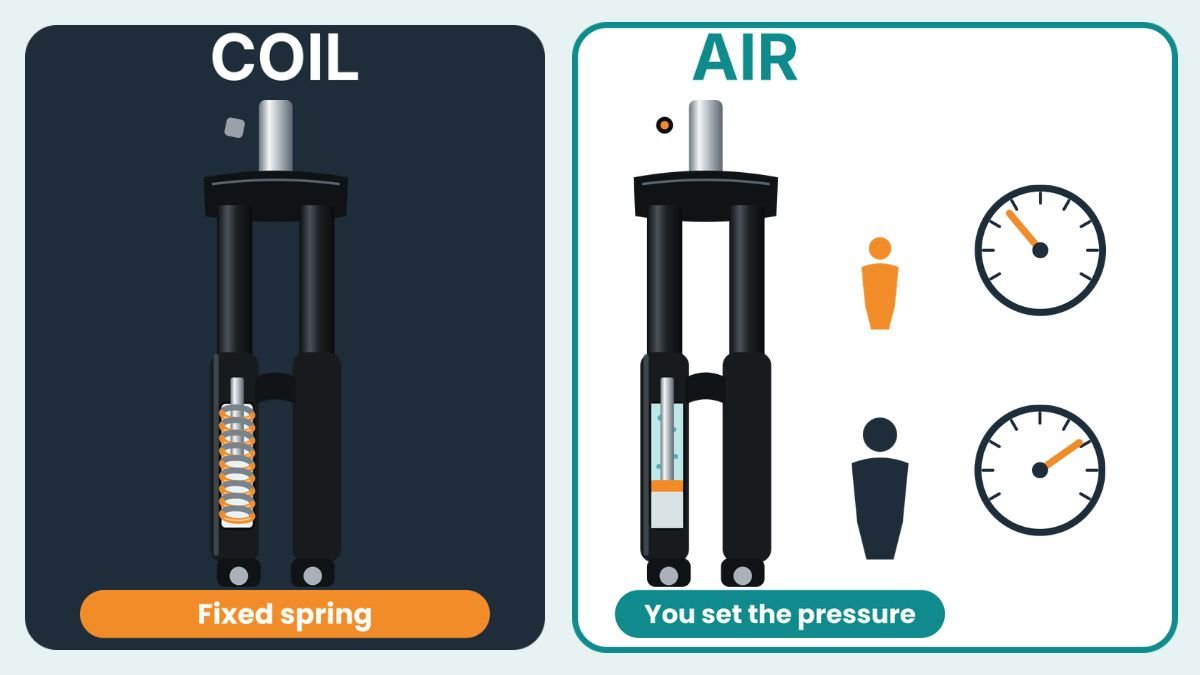
I mean, there is nothing wrong with them, but they offer limited adjustment, which we often need based on our weight.
Specialized Rockhopper Comp has a RockShox Judy Solo Air, which gives you more control over the suspension setup.
So depending on your weight, let’s say you are 120 pounds, and somebody else in your family is 200 pounds, you both can use the same bike and just adjust the suspension. Because of that, you get more control, comfort, and confidence.
Besides this, you also get a TurnKey damper. I know it is not an expensive performance suspension fork, but still, it is really very good compared to the basic suspension you will find on cheaper mountain bikes.
Also, remember that suspension travel is size-specific, ranging from 80 to 100 mm. So the exact amount will depend on your MTB size.
What about the drivetrain?
It has a 12-speed Deore drivetrain with an 11-51-tooth cassette. It gives you a wide spread of gears, including a large range of sprockets for climbing, which is good when you want to ride uphill.
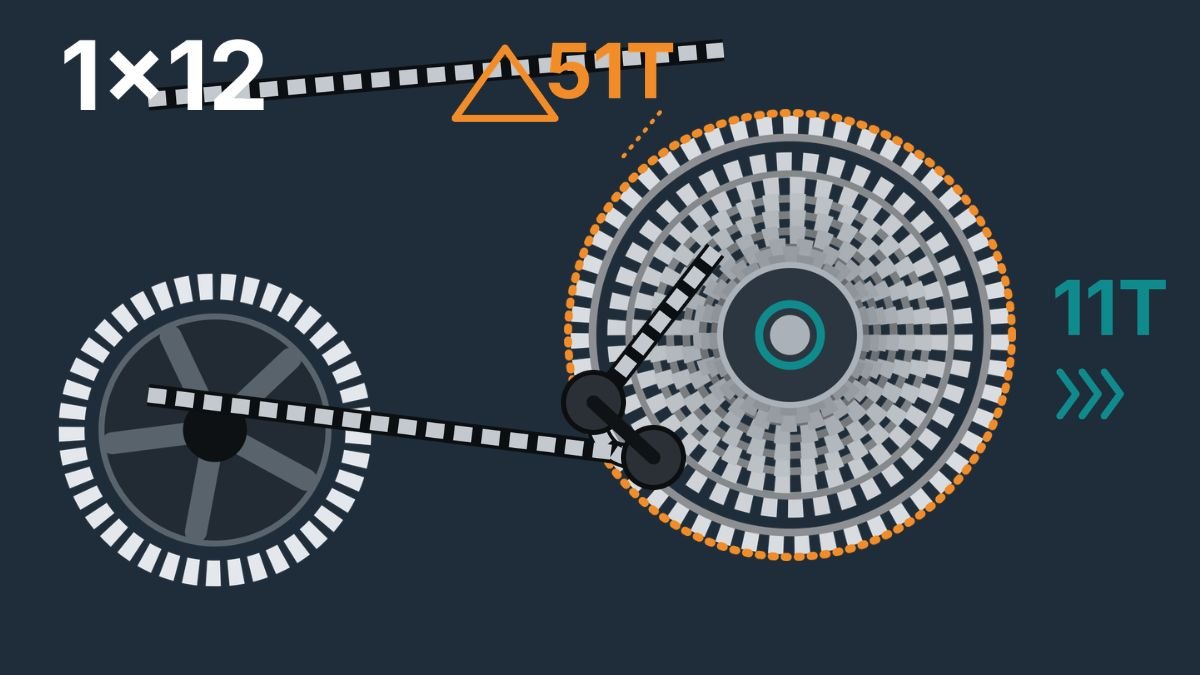
That lower gear can help you maintain a manageable pedaling effort. Of course, it won’t make steep climbs easy, but you will still need fitness, traction, and bike-handling techniques.
And I also like that it is a 1x drivetrain, meaning there is only one chainring at the front. So you won’t have to manage a front derailleur. You can just shift through the rear gears. So it is very simple.
Something important about the different Comp versions
Btw, Specialized also has another Rockhopper Comp at $999.99 with a SRAM S100 12-speed drivetrain, an 11–50t cassette, and Tektro hydraulic brakes.
Both versions include the RockShox Judy Solo Air fork, but they have different drivetrain and brake specifications.
Is the Comp suitable for beginners?
Yes, it is good. If you want to ride regularly, you can ride this bike on forest paths, dirt trails, easy singletrack, and some suitable rocky sections.
Then, as you become more confident with braking, cornering, choosing lines, and develop more skills, you can take on more challenging trails.
It gives you enough capability for cross-country-oriented rides because it has a premium A1 aluminum frame with internal cable routing, a replaceable derailleur hanger, dropper post compatibility, etc.
What would stop me from giving it a higher rating?
Things that I’m not liking about this bike are that it has a quick-release rear axle instead of a through-axle that you get on some other bikes.
Secondly, it has relatively short travel and is a cross-country-oriented hardtail.
So it’s not a bike designed for aggressive downhill riding or large jumps, but under a thousand dollars, it is a good Specialized bike for beginners.
My recommendation: The Rockhopper Comp is the strongest overall Specialized choice.
2. Specialized Rockhopper Sport: Best Balance for Most Beginners
Price: $849.99 | My rating: 7.9/10
Rockhopper Sport is interesting because it sits between the Rockhopper and the Comp, which we have already discussed. It is $150 cheaper than the Specialized Rockhopper Comp.
In terms of configuration, you get an SR Suntour XCM coil spring fork, Shimano MT200 hydraulic brakes, a Microshift Advent 1×9 drivetrain, and Specialized Ground Control 2.5-inch tires.
Besides this, you also get Q’s 1×9 shifting. However, the exact drivetrain depends on which version you are buying.
How about Brakes and Drivetrain
In this Rockhopper Sport, you get either a 2×9 or 1×9 drivetrain, depending on the model year.
It is good for beginners because shifting is very easy, especially when you are climbing a trail or approaching a new rocky section.
The Microshift Advent version uses an 11-46T cassette and a clutch-equipped rear derailleur, which helps reduce unwanted chain movement, something we want when riding over bumps and roots.
You get Shimano M200 or Tektro M275 brakes depending on the setup. They give you useful control and consistent lever operation.
And the Sport’s configuration includes a 180 mm rotor at the front and a 160 mm or 180 mm rotor at the rear, which is a good setup for the type of riding this bike is intended to handle.
Where the Sport starts to feel like a budget bike
Like in the Specialized Rockhopper Comp, you are getting better suspension, but it is not the same with the Rockhopper Sport because it has an SR Suntour XCM suspension fork, which is very basic and uses a coil spring design.
It will absorb some bumps and provide some comfort, but still, I don’t really like this one because it is not as adjustable as the Judy Solo Air on the Comp, which we discussed in the first bike.
It is especially okay for smooth dirt trails with occasional roots and small rocks. But I do not like it for intense riding when you want to ride on tough trails.
So, if I have to buy one, I will not buy it. Instead, I will add $150 more and go with the first bike.
Who would I choose it for?
I will recommend you buy it if your budget is $1,000, you want a Specialized bike, you don’t want to ride on intense trails, like steep or descent trails, and you don’t care much about comfort.
You want to save $150, and you want to ride frequently. You are just looking to ride a few times a month, then you can buy it.
3. Specialized Rockhopper — Best for Beginners on a Tighter Budget
Price: $749.99 | My rating: 7.4/10
Specialized’s Rockhopper is the cheapest mountain bike that you can get under a thousand dollars. It costs around $750. So you will save around $100 compared to the Sport and around $250 compared to the Comp.
You should buy this bike if you are not really sure where you are going to ride. You are not too serious, you will just ride a few times a month, and your budget is extremely tight.
You may not even have mountain biking gear.
So you can spend the rest of the money on gear instead of spending it all on the bike. That way, under a thousand dollars, you will have your MTB and its gear.
What you’re getting for $750
- Specialized Premium A1 aluminum frame
- SR Suntour XCE coil-sprung suspension fork
- Shimano Altus 2×9 drivetrain
- Hydraulic disc brakes
- Specialized Ground Control 2.35-inch tires
- Size-specific wheel and suspension options
- Approximately 14.1kg claimed weight in medium
One thing I like about this bike is that Specialized offers hydraulic brakes on such a cheap bike.
Plus, the frame has a replaceable derailleur hanger, so if it gets damaged, you can replace it.
The two biggest compromises
There are two things that I’m not really liking, and you will have to compromise on them. The first is the suspension fork, and the other one is the drivetrain.
You get an SR Suntour XCE fork, which is an entry-level coil fork with 28 mm stanchions and size-specific travel.
It will provide bump absorption, so it can absorb bumps on suitable trails, but you won’t get the same level of control and adjustment as with the Judy Comp fork, which you are getting in the Specialized Rockhopper Sport.
Besides this, it has a 2×9 drivetrain. So having two chainrings will provide you with a useful spread of gear combinations, but you will also have to manage an additional derailleur and shifter.
As a complete beginner, you will need to learn how to use them. However, if you could get a 1x drivetrain, it would be very simple.
Would I actually buy the base Rockhopper?
If I have a thousand dollars and have to buy a bike, I would only buy this bike if I wanted to explore forest roads, gravel paths, beginner-friendly trails, and learn more skills.
More importantly, if I do not even have other accessories like bike shoes, a helmet, gloves, etc., I could spend up to $700 on this bike and the rest of the money on other things.
But if I can manage to buy the other accessories, I would add $250 and buy the Specialized Rockhopper Comp because I like some of its extra features.
Rockhopper vs Sport vs Comp: What Does the Extra Money Buy?
After looking at all three, let’s compare them side by side.
| Feature | Rockhopper | Sport | Comp (Deore version) |
|---|---|---|---|
| Price | $749.99 | $849.99 | $999.99 |
| Fork | Suntour XCE coil | Suntour XCM coil | RockShox Judy Solo Air |
| Drivetrain | Shimano Altus 2×9 | microSHIFT Advent 1×9 | Shimano Deore 1×12 |
| Brakes | Hydraulic disc | Shimano MT200 hydraulic | Shimano MT200 hydraulic |
| Cassette | 11–36t | 11–46t | 11–51t |
| Frame | Premium A1 aluminum | Premium A1 aluminum | Premium A1 aluminum |
| My rating | 7.4/10 | 7.9/10 | 8.3/10 |
Where These Rockhopper Bikes Fall Short
All three mountain bikes that we have discussed are relatively short-travel hardtails, so they aren’t made to replace an aggressive full-suspension trail bike.
Second, the Rockhopper range has quick-release axles in the configurations, which are common on entry-level bikes, but they will limit compatibility with certain higher-end components.
The base and Sport models also have basic coil forks, so the suspension performance will be more limited than what you’d find on a better-equipped mountain bike.
And while the Comp offers some useful upgrades, it’s still built around an affordable hardtail platform.
3 Mountain Bikes That Could Give Specialized Tough Competition (Under $1,000)
I know that we are mainly focusing on Specialized bikes, but there are a few other bikes too that are giving tough competition.
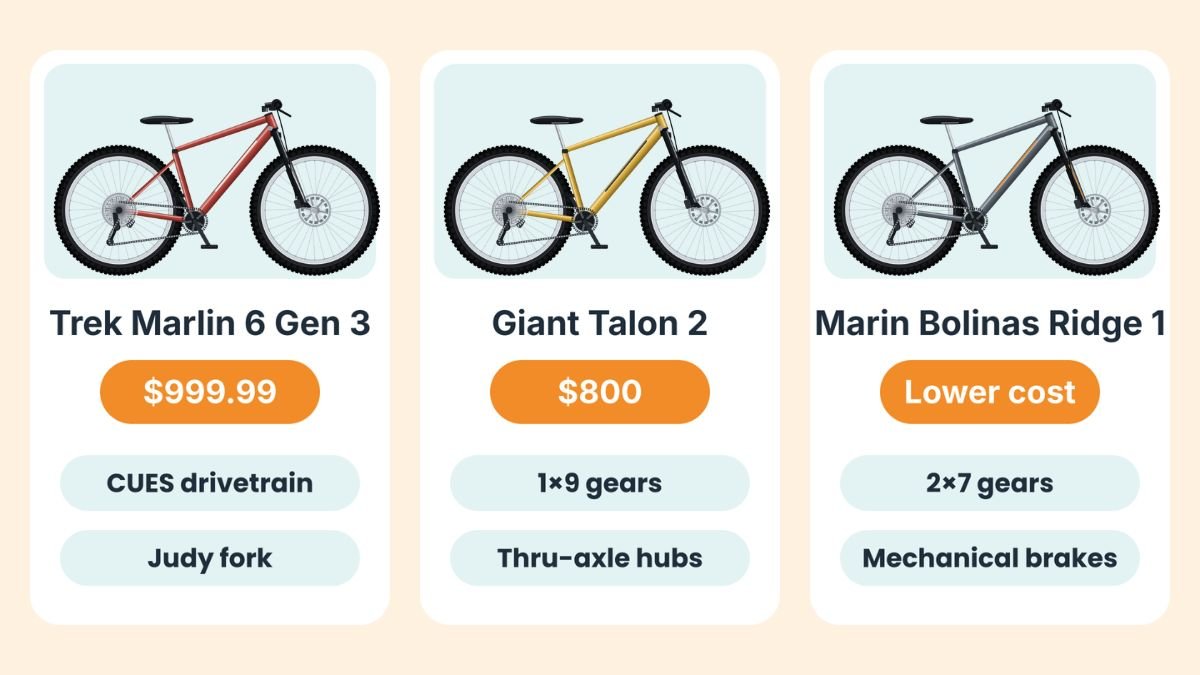
So, as a beginner, you can also look at them because they are under $1000 too.
Trek Marlin 6 Gen 3: A Serious Competitor at $999.99
Trek Marlin 6 Generation 3 is the best competitor to the Specialized Rockhopper Comp because it has:
- A RockShox Judy suspension fork
- Shimano CUES 10-speed drivetrain
- Shimano MT200 hydraulic brakes
- Tubeless-ready Bontrager wheels
These are good features for someone who has a thousand dollars to spend.
Besides this, the Marlin’s geometry will provide you with more confidence, along with rack and kickstand mounting options. So, if you want a mountain bike for weekend trails but also want to use it for everyday riding, you will like this bike.
One more thing: Trek has listed the Judy as coil-sprung. On the other hand, the Rockhopper Comp configuration we have discussed has a Judy Solo Air.
So they have different spring systems. If you want adjustable air pressure, you can go with Specialized.
Another good thing about Trek is that it has a Shimano CUES drivetrain, rack mounting options, and frame fit features. So these are attractive too.
Giant Talon 2: Worth Considering at $800
The Giant Talon 2 costs around $800, and for that amount, you get a 1×9 MicroSHIFT Advent drivetrain, hydraulic Tektro brakes, a coil spring suspension fork, and Maxxis tires.
So, one thing I like about it is that it has thru-axle hubs, which you won’t get on the Rockhopper bike models that we have discussed.
A thru-axle will provide a more consistent wheel attachment system and offer better compatibility, but only when you upgrade the wheel in the future along with the axle standard.
And the Talon 2’s geometry is designed for cross-country and trail-oriented riding. At this price range, it is a good competitor to the Rockhopper Sport.
Marin Bolinas Ridge 1: A Cheaper Way to Get Started
So we discussed a total of five bikes before: 3 from Specialized, 1 from Giant, and another one from Trek. However, this sixth bike is a Marin Bolinas under $1,000 for beginners. It costs around $649 for the 2025 model. It’s the cheapest option in this lineup.
You will get an aluminum frame, an SR Suntour XCE suspension fork, a 2×7 Shimano drivetrain, mechanical disc brakes and off-road tires.
Now, I cannot say that it is a direct competitor to the Rockhopper because it has a basic drivetrain and brakes.
But if you don’t have other accessories, or even if your budget is too tight and you are just somehow trying to stay under $1,000, then you are probably not really serious about mountain biking on a regular basis. So, around $650 is a good price for an MTB.
However, if you want to ride regular singletrack trails, my strongest picks will be either Specialized or Comp.
Schwinn Bonafide 29″ Hardtail Mountain Bike
Similar budget hardtail sold on Amazon; check frame size
Mongoose Switchback Comp Hardtail Mountain Bike
Similar budget hardtail sold on Amazon; check frame size
Which competing bike would I consider?
| Bike | Main reason to consider it | Important compromise |
|---|---|---|
| Trek Marlin 6 Gen 3 | CUES drivetrain, Judy fork, versatile frame | Listed Judy fork is coil-sprung |
| Giant Talon 2 | $800 price, 1×9 drivetrain, thru-axle hubs | Basic coil fork |
| Marin Bolinas Ridge 1 | Lower purchase cost | Mechanical brakes and basic 2×7 gearing |
Note: I won’t buy any of these bikes just because they have better specifications. Instead, I will compare the complete bike, its overall support, and then the final price.
Should You Buy a Used Specialized Mountain Bike Under $1000 with More Features?
It is a good choice too if your budget is $1,000. Within $1,000, you may also get a Rockhopper Expert, a higher-end Rockhopper Comp, Specialized Chisel, Stumpjumper, etc.
However, buying a used bike is only a good option if you can inspect it. Otherwise, you may end up paying more money.
For example, if you find a Specialized full-suspension mountain bike for $800 or $850, which is expensive in the market.
But if its suspension is not working well, its bearings are worn, the chain and cassette need replacing, or maybe the tires are damaged, things like that will cost you money too.
So, if you can inspect all these things, or you already have experience, or someone with better mountain biking knowledge can help you, you can buy a used MTB under $1,000 as a beginner. Or you can also check my guides on buying a used MTB: Tips for buying used Mountain Bikes.
Where I’d look for a used Specialized
A few places you can check for bikes are:
- Pinkbike BuySell: Useful for finding mountain bikes listed by cycling enthusiasts.
- Facebook Marketplace: Good for checking local listings and arranging an in-person inspection.
- Local mountain biking groups: Members sometimes sell bikes when upgrading.
- Used-bike shops: Good if you want professional inspection or service support.
If you are a beginner, I’d prefer buying locally when possible so you can inspect the bike before paying.
What should you inspect?
If I were buying a used Specialized, these would be my main checks.
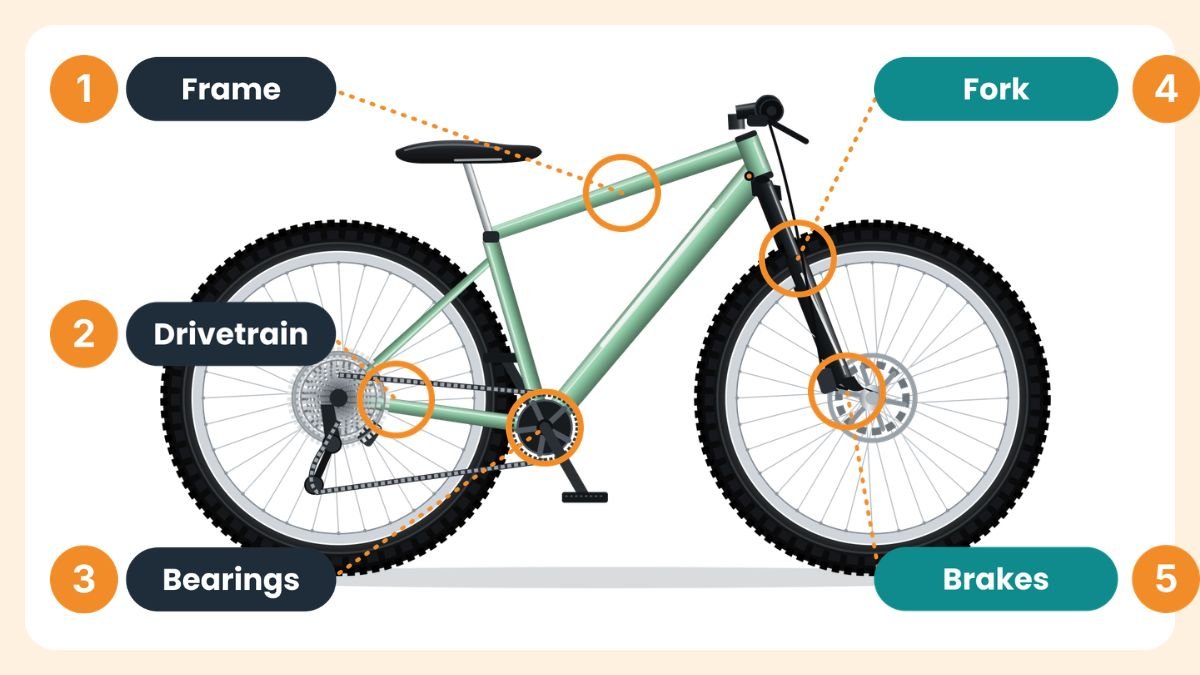
- Frame condition: Look for cracks, dents, unusual marks, and signs of previous repairs. Pay particular attention to the head tube, bottom bracket, and frame joints.
- Suspension: Check the fork stanchions for scratches or damage.
- Drivetrain: Check the chain for wear, examine the cassette and chainrings, and see whether the bike shifts properly through its gears.
- Brakes: Make sure the levers feel consistent and the brakes work properly. Also, check the pads, rotors, and hydraulic lines.
- Wheels and tires: Spin the wheels to check for significant wobbling.
- Bearings and headset: Check for unwanted movement, grinding, or unusual noises.
- Ownership: Ask for the serial number and any available proof of purchase.
- Fit: Make sure the bike is actually the right size.
If you are not familiar with mountain bikes or mountain bike mechanics, you can pay a qualified bike shop to inspect the bike. They will save you from an expensive mistake.
So, new or used?
If you are completely new and it is your first time, I would say just go for a new bike. Then you won’t have to worry about anything. You can get a new Rockhopper Sport or Comp. With a new bike, you get a manufacturer’s warranty. You won’t have to rush for maintenance or servicing.
But if you have a knowledgeable friend or a mechanic who can inspect the bike, you can pay the mechanic some money to help you find a second-hand bike with better features.
Also, remember one thing: buying a used higher-end bike is only a bargain if its condition and ownership costs make sense.
What Should You Buy Along With Your First Mountain Bike?
Even if you are restricted to a budget of $1,000, I still won’t recommend spending every penny on the bike because you also need other equipment that will enhance your mountain biking experience.
Here are a few things worth budgeting for:
| Item | Reason to buy |
|---|---|
| Proper mountain biking helmet | Essential head protection |
| Eye protection | Helps protect against dust, insects, and debris |
| Multitool | Useful for basic adjustments |
| Spare tube and tire levers | For dealing with flats |
| Portable pump | To restore tire pressure |
| Suitable flat pedals and shoes | For secure foot placement |
| Chain lubricant and cleaning supplies | For routine maintenance |
Smith Engage MIPS Mountain Bike Helmet
MTB helmet with MIPS and Koroyd; choose your size
Topeak Mini 20 Pro Multitool
20 functions for basic trailside adjustments
Lezyne Pocket Drive HV Hand Pump
High-volume mini pump for mountain bike tires
OneUp Composite Flat Pedals (Black)
Large 115 × 105 mm platform with replaceable pins
Finish Line Dry Chain Lube, 8 oz
Dry-film lube that resists dust and dirt
Also, you don’t have to buy everything at once. You can buy accessories based on your priorities.
For example, safety is number one, so get those things first instead of cosmetic upgrades.
Also, do not upgrade the suspension fork immediately on a brand-new entry-level mountain bike.
Final Verdict: Which Specialized Mountain Bike Would I Choose?
If I have $1,000, I’m buying the Specialized Rockhopper Comp because of its configuration with the RockShox Judy Solo Air fork and Shimano Deore 12-speed drivetrain.
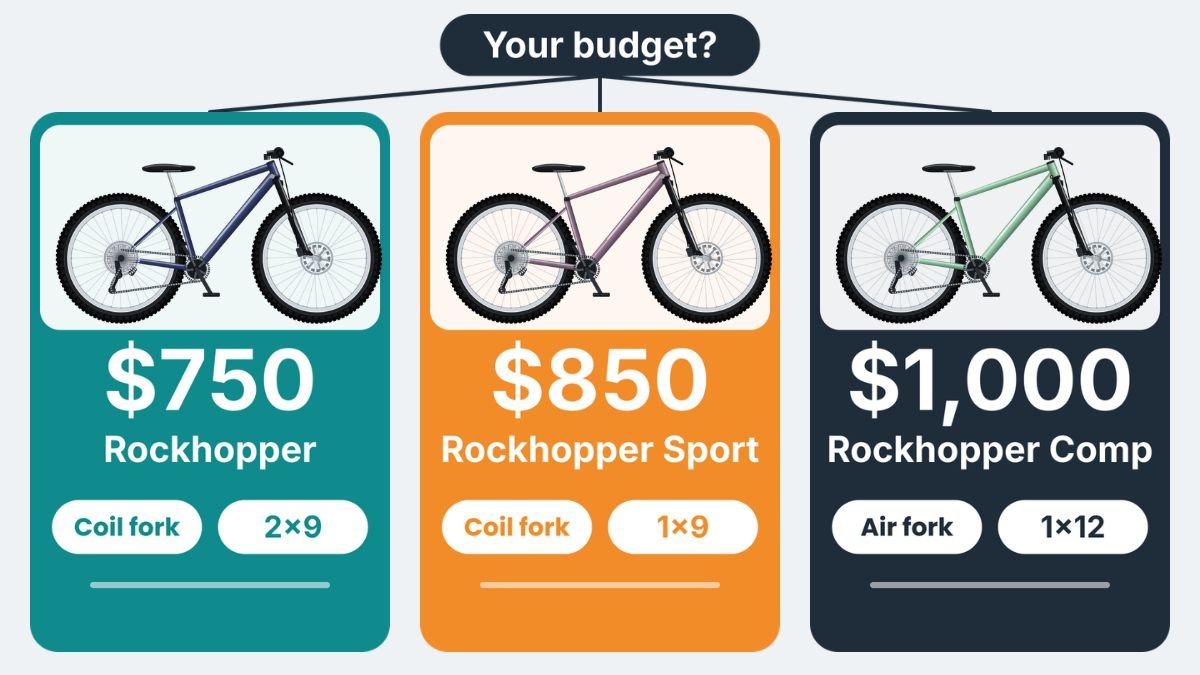
And if my total budget is $1,000 and I need other things as well, and I need a Specialized bike, then I will buy the Rockhopper Sport and spend the rest of the money on other things.
Frequently Asked Questions
What is the best Specialized mountain bike for beginners getting into off-road biking?
For beginners with a budget under $1,000, I’d recommend comparing the Rockhopper Sport and Rockhopper Comp first.
The Sport is a good middle-ground option if you want a simple bike for beginner trails. And the Comp is good if you want to ride regularly and want a more adjustable suspension fork and wider-range drivetrain.
Is the Specialized Rockhopper good for rocky trails?
Yes, but mainly for suitable rocky sections on beginner-friendly trails.
Also look at the difficulty of the terrain. Small rocks and moderate obstacles on a cross-country trail are very different from steep, technical downhill terrain with large drops.
I’d keep the Rockhopper within its intended riding category and avoid treating it like an aggressive downhill bike.
Is the Rockhopper Comp worth the extra money?
Yes, it is worth it if you want to ride regularly because it has a RockShox air fork and a wider-range 12-speed drivetrain.
But if you just want to ride on smooth paths or easy trails, you don’t really have to spend a lot on the Rockhopper Comp.
However, you can spend more if you are going to ride on different trails because you may plan to ride on more challenging trails in the future and then regret not spending a little extra money.
You might think, if I had spent a little more, I could have ridden more comfortably.
So, it’s better to spend that money in advance. You won’t have to worry about whether the trail is smooth or advanced. You can go anywhere you want.
Should a beginner buy a hardtail or full-suspension mountain bike?
If your budget is under $1,000, I would consider a fairly cheap hardtail because it has fewer suspension components to maintain, and you can get a better drivetrain, brakes and fork at the same price.
Though a full-suspension bike will give you an advantage on rough terrain, buying the cheapest full-suspension bike just because it has a rear shock is not a good choice in my opinion.
Can I upgrade a Specialized Rockhopper later?
Yes, you can upgrade your Specialized Rockhopper depending on its model and compatibility. For example, you can upgrade the tires, pedals, grips, dropper post, etc.
Is a used Specialized mountain bike worth buying?
Yes, of course, you can get a used Specialized mountain bike, but you just need to know how to inspect it, especially for suspension problems, a worn drivetrain, a damaged frame, neglected servicing, etc.
If you have a friend who’s a mechanic, that’s good. Otherwise, you have to learn how to inspect it yourself.
Do beginners really need a dropper seatpost?
A dropper post is a useful feature because you can lower yourself while riding and have more room to move your body on descents.
But it is not necessary if you can get a bike that fits your body properly.
I just recommend that you don’t spend extra money just because of this one feature. You can also upgrade it in the future if you really need that.