If you rent your place and have kids’ toys slowly eating your garage floor, you can use freestanding shelves, over-door organizers, tension rods, stackable crates, and bungee cord bins.
All of these are renter-safe, cheap, and available at any dollar store or Target.
You are looking at $20 to $60 total, depending on how much stuff you have, and none of it requires a single hole in the wall.
My aunt has a garage with two cars, kids, and, for a couple of years, a rotating pile of toys that her youngest kids used to leave everywhere.
She figured out a system that actually held up, so a lot of what I am sharing here comes from watching what worked in her space and what did not.
Why Most Garage Storage Advice Does Not Work for Renters
Almost every guide you find about garage toy storage assumes you own the place.
They tell you to mount slatwall panels, install ceiling racks, or drill bike hooks into studs.
That is fine if you own the garage. If you rent, drilling into walls means losing your deposit or having a landlord conversation you do not want.
The other problem is cost. A lot of these guides casually suggest spending $150 on a wire shelving unit or $80 on a bike pulley system.
For a family that is already stretched, that is not a small ask.
So this guide is specifically for people who cannot drill, cannot spend a lot, and still need the garage to work.
Everything here is freestanding or tension-based, and most of it can be picked up at a dollar store, Walmart, or Amazon for under $15 per solution.
The No-Drill Setup That Actually Holds Up
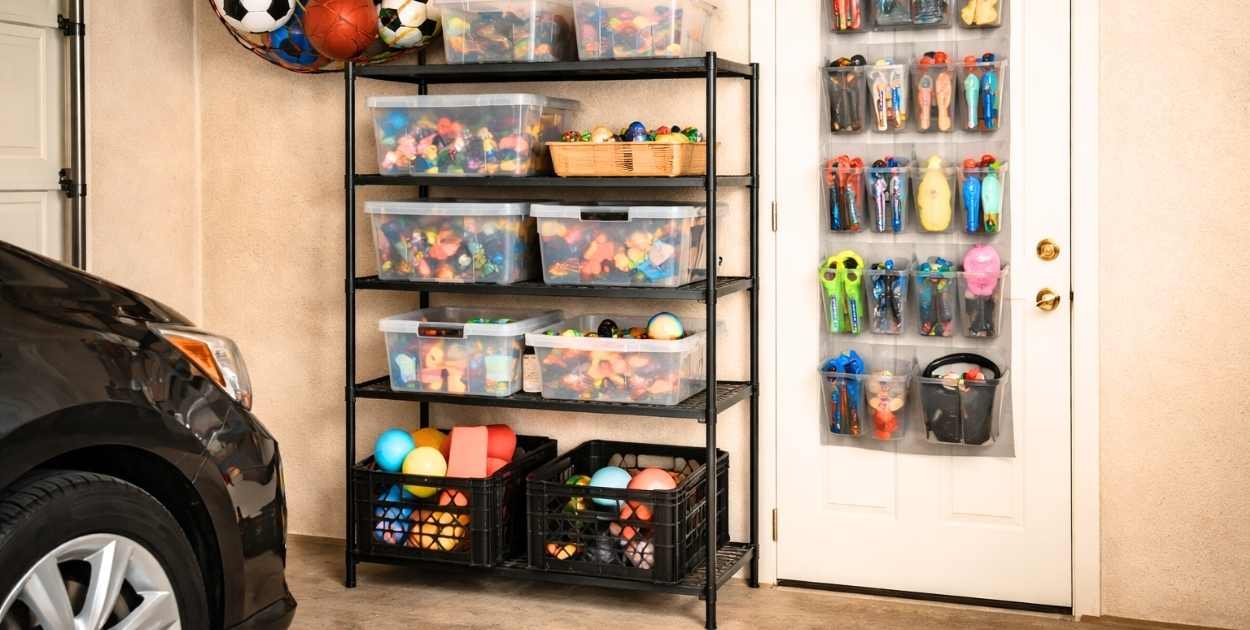
Here is the basic structure that works even in a cramped garage:
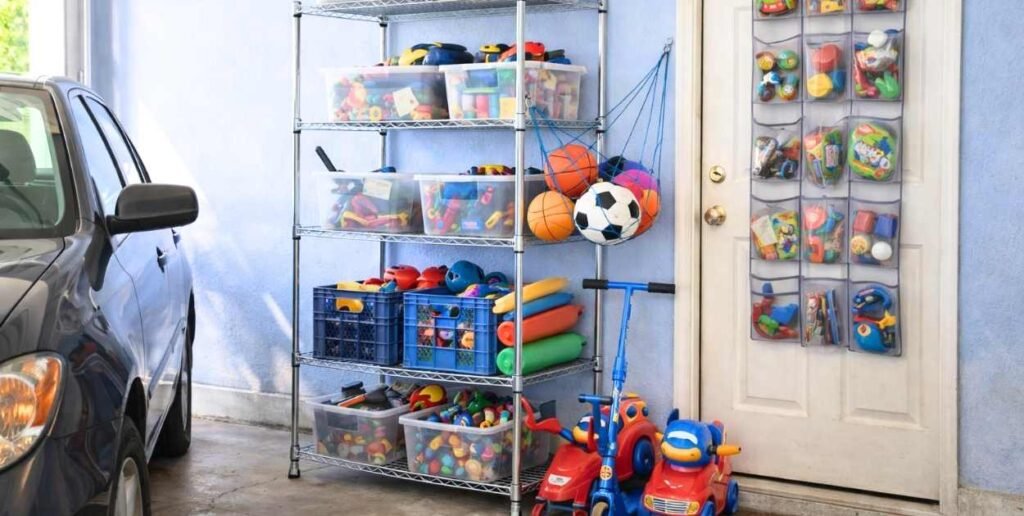
- A freestanding metal shelf unit (3 to 5 tiers): This is your main storage backbone. The wire ones from Walmart or Costco run $25 to $45 and hold a serious amount of weight. My aunt had one of these pushed against the back wall of her garage, and it was basically the entire system. Clear plastic bins on the shelves make it easy to see what is inside without labeling everything.
- Stackable milk crates or open bins: These are good for bulkier stuff like balls, foam noodles, and ride-on toy accessories. You can get them for $3 to $6 each at dollar stores. Stack them two high, and they take up almost no floor space compared to what they hold.
- A bungee cord hammock in a corner: This is the one thing I would say is close to a must-have for ball storage. You run bungee cords between two freestanding objects (or tape hooks rated for 10+ lbs, which are renter-safe) and create a net that holds soccer balls, basketballs, and similar items up off the floor. Costs may be $5 to $8 total.
- Over-door shoe organizers: These hang over the top of a garage door frame or a utility door without any screws. They are perfect for small toys, chalk, jump ropes, small water guns, or any of the random bits that always end up on the floor. A 24-pocket organizer costs around $8 to $12.
- Tension rod dividers inside shelf bins: If you have a wide shelf and want to keep categories separated, tension rods that fit across the shelf interior can keep bins from sliding around or mixing together. These cost $2 to $5 each.
How to Think About the Space Before You Buy Anything
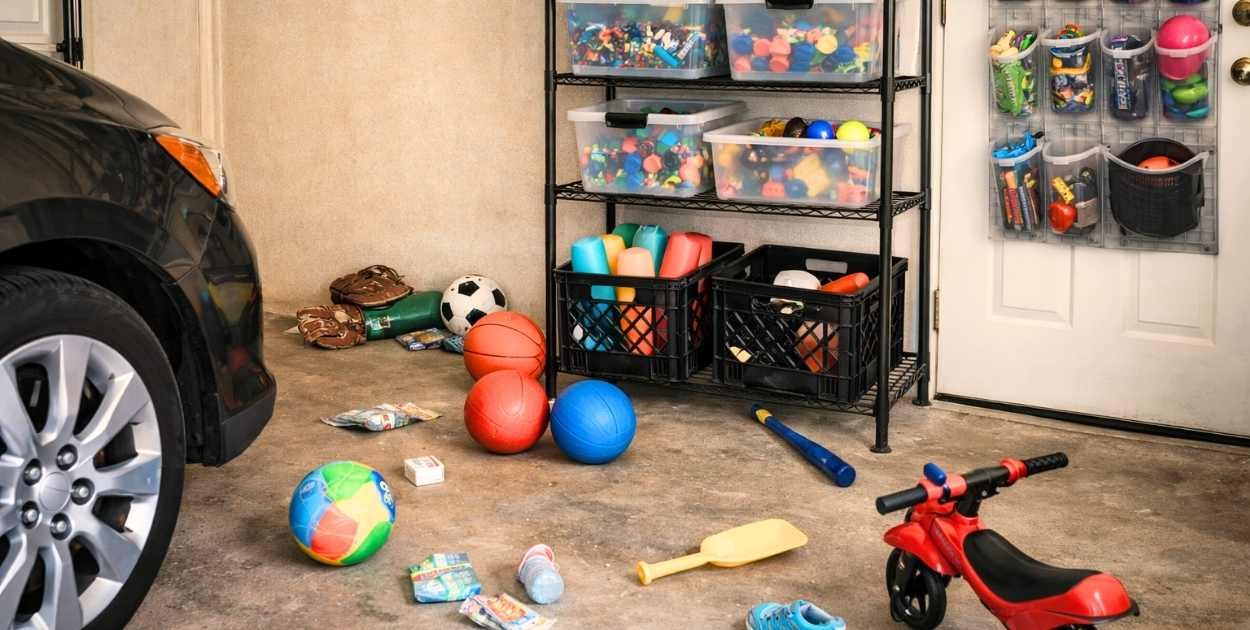
Before you spend even $10, spend 10 minutes in the garage just looking. Not cleaning, just looking.
Where does stuff actually end up? That is your natural storage zone. If balls always roll to one corner, that corner is your ball zone.
If bikes always lean near the door, that is your bike area.
The mistake most people make is organizing based on categories that make sense in their head, but not based on how the space actually gets used.
My aunt tried a “sports” zone and a “ride-on” zone at first, but her kids just put everything in the closest available spot.
So she reorganized it by location habits instead of toy type, and that stuck.
Also measure the height of your garage walls.
A lot of renters do not realize they have 8 to 10 feet of vertical space they are not using.
Even without drilling, a tall freestanding shelf gets you halfway up the wall with zero damage.
Storing Bikes and Scooters Without Drilling
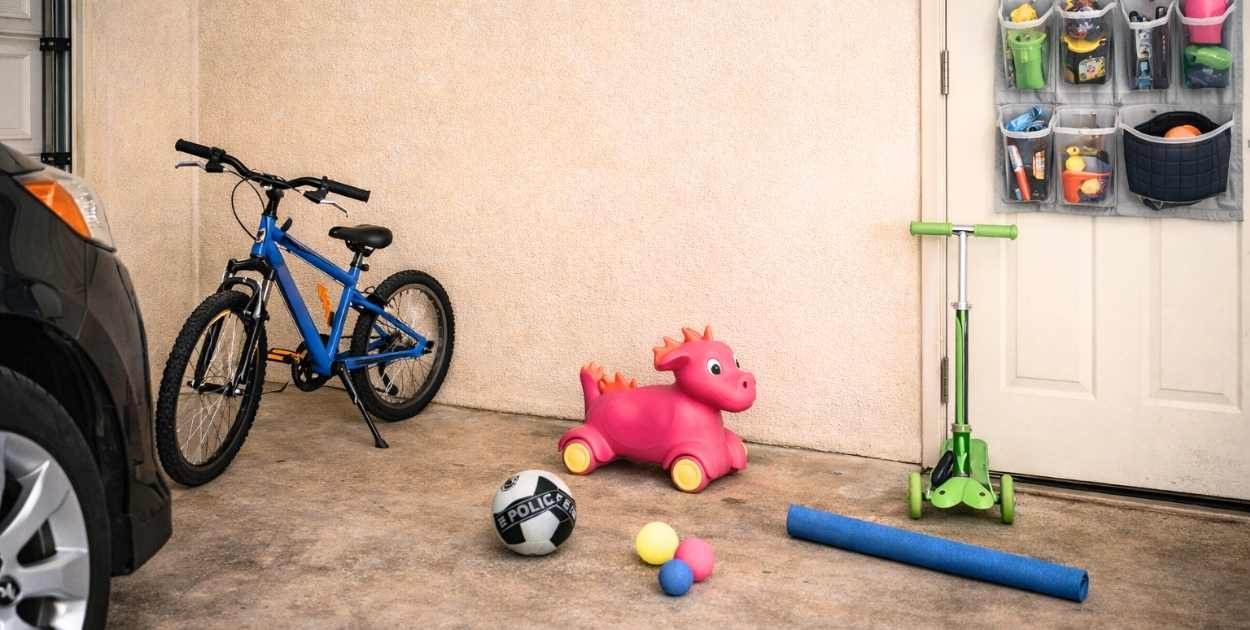
This is where most budget guides fall apart; they either say “drill a hook into a stud” or they just do not address it.
But bikes and scooters toppling over is genuinely one of the most frustrating garage problems.
Here are three options that work without any drilling:
- Freestanding bike rack: These are $20 to $35 on Amazon and hold 2 to 6 bikes upright without touching the wall. They are metal, stable, and movable. This is the cleanest solution.
- Kickstand plus wall-lean strategy: If the bikes have kickstands, line them along the wall in a row with a small rubber mat underneath to stop sliding. Not elegant, but it works and costs nothing.
- PVC pipe stand: Cut PVC pipe into short sections and glue them onto a plywood base so the front wheel slots in. Total cost is under $15. You can find the exact build on YouTube in about 3 minutes. The base sits on the floor, and nothing touches the wall.
Getting Kids to Actually Put Toys Away
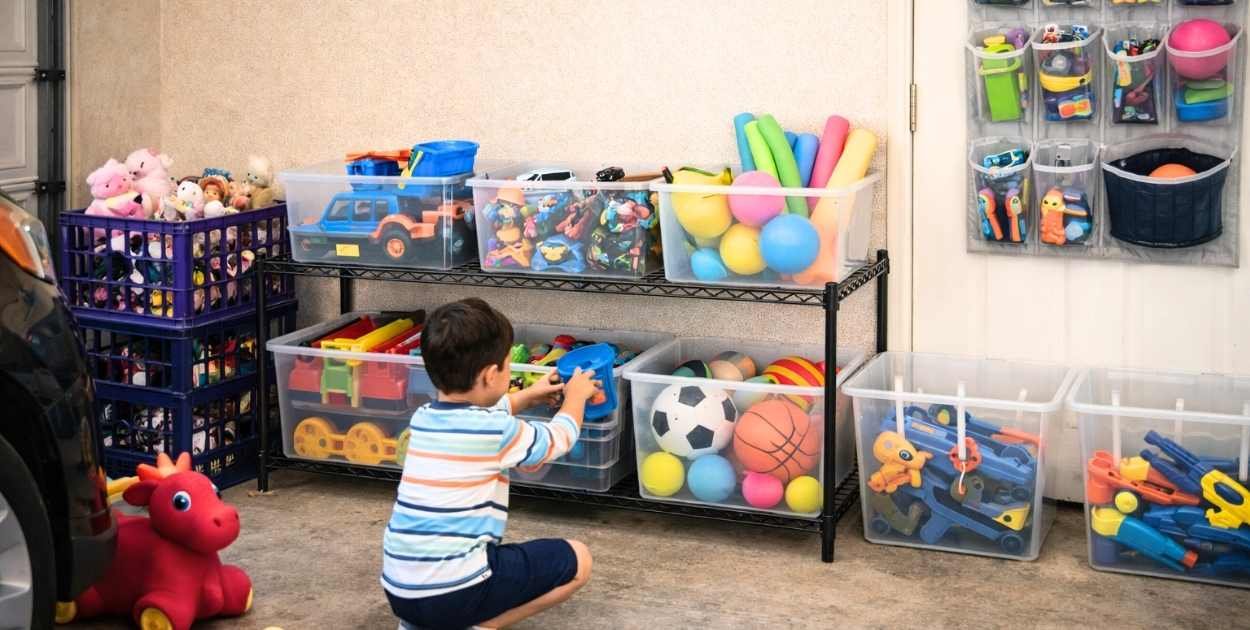
I myself say “use labels” and move on, but labels help if the kids are old enough to read them.
For younger ones, picture labels or color coding work better.
The more honest thing to say is: the simpler the system, the more likely kids are to follow it.
If putting a toy away requires three steps (open lid, sort by type, close lid), it is not going to happen consistently. If it means tossing a ball into an open crate, it will.
My aunt used to have a rule that toys with lids just became open-top bins. She cut the lids off a couple of containers entirely, so there was no barrier.
Her daughter stopped leaving things on the floor within a week. That is it.
Also, a kid’s height matters more than you think. If the bin is too high for them to see into, they will not use it.
Keep the active toy zone between knee and shoulder height for your youngest kid who uses the garage.
What to Toss Before You Organize
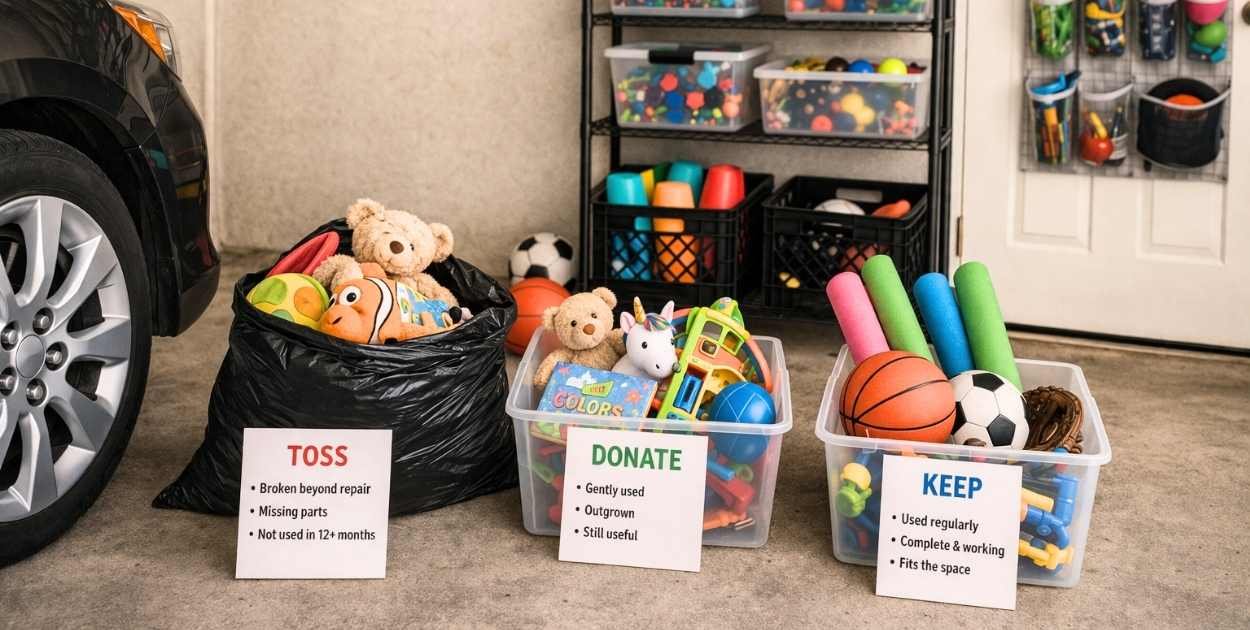
Before you set anything up, do a quick pass with three piles: keep, donate, toss. You do not need to be ruthless. Just be honest about what is actually being used.
For kids’ toys specifically, look for:
- Toys that fit a younger age, and no one is using anymore
- Broken or missing-pieces items that have just been sitting there
- Seasonal stuff (pool floats, snow sleds) that can move to a high shelf or a bag in the corner instead of floor space
- Duplicates of the same type of toy when you have way more than gets used
My aunt went through this once with her kids’ toys and got rid of two big garbage bags’ worth of stuff.
The remaining toys actually fit easily after that, which made the whole setup much less stressful to maintain.
Quick Budget Breakdown
Here is a rough cost picture for a basic no-drill garage toy storage setup:
- Freestanding wire shelf (4 tier): $25 to $45
- Clear plastic stackable bins (4 to 6): $10 to $20
- Over-door organizer: $8 to $12
- Bungee cord ball hammock setup: $5 to $8
- Milk crates x2: $6 to $10
- Total rough range: $54 to $95
If you already have some bins or a shelf at home, you can get this done for well under $40.
And if you need to keep it under $20, start with just the over-door organizer and the bungee hammock; those two things alone clear a surprising amount of floor space.
Wrapping It Up
Garage storage ideas for kids’ toys on a budget need a freestanding shelf, a few open bins, an over-door organizer, and a bungee hammock for balls to handle most of what a family realistically has in the garage.
Start with the biggest problem first, whether that is floor clutter, bikes falling over, or small toys everywhere, and solve that one thing before buying more stuff.
The system my aunt ended up with was nothing fancy, just a shelf, some crates, and the rule that if it hits the floor, it goes on the shelf.
A Few Questions People Actually Ask
Can you really do this without any holes in the wall?
Yes, freestanding shelves, floor-based crates, over-door organizers, and tension rods cover probably 90% of what a family needs for toy storage.
The only place you might feel limited is bike storage, and even there, the freestanding rack option solves it without touching a wall.
What if the garage is really small and we actually park a car in it?
Stick to the walls and corners. A narrow freestanding shelf along one wall takes up maybe 12 to 18 inches of depth and holds a ton.
Vertical is your friend here because floor space is the premium.
Also, think about stuff that can hang over the car door (over-door organizer on the utility door) or stack high in the corner where the car never reaches.
My toddler just dumps everything out and makes it worse. What actually works?
With very young kids, the storage system does not matter as much as where things are.
Keep toddler-accessible stuff limited to one low open bin.
Everything else goes higher than they can reach.
Is it worth buying an expensive garage storage system?
If you own the home and plan to stay, maybe. If you rent or are not sure how long you will be there, it is not worth it.
A $30 wire shelf does the same structural job as a $200 garage system for storing kids’ toys.
The expensive ones look nicer and last longer, but they do not actually organize better.

Abraham is the creator of Mountain Bike Insider. He is a writer and researcher who enjoys mountain biking, working on DIY projects, organizing spaces, and testing ideas in real life. He focuses on clear and honest explanations based on experience and research, without pretending to be a professional expert.