Disclosure: This post may contain affiliate links. As an Amazon Associate I earn from qualifying purchases.
In design, the DMR V11 is like the expensive DMR V8 pedals, while the Deity Deftrap took its design from Deity’s premium TMAC pedals. So they both have composite bodies, which keeps their prices down.
The V11 has a square platform with a pronounced convex shape, and it has adjustable steel pins. On the other hand, the Deftrap is a little longer and has a symmetrical platform with a combination of steel pins and molded nylon grip points.
But one thing that interests me more is how those different platform shapes and pin arrangements affect the way your shoe sits on the pedal.
Deity Deftrap vs DMR V11: Key Differences at a Glance
Before discussing their designs in more detail, let’s compare what each pedal offers.
| Feature | Deity Deftrap | DMR V11 |
|---|---|---|
| Design inspiration | Deity TMAC | DMR Vault |
| Body material | Nylon-glass fiber composite | Glass-reinforced nylon |
| Platform size | 113 × 103 mm | 105 × 105 mm |
| Platform shape | Symmetrical, non-offset | Vault-inspired concave |
| Concavity | 1.5 mm per side | Pronounced concave profile |
| Pins per side | 8 steel + 2 molded nylon | 11 replaceable steel |
| Pin height adjustment | No dedicated tuning system | Adjustable |
| Claimed weight (pair) | 391 g | 450 g |
| Rebuildable internals | Yes | Yes |
So the he Deftrap has a longer platform, lower claimed weight, whereas the V11 offers more flexibility with its pins and different footbed shape.
How Much of the Original Vault Is in the V11?
The DMR Vault is famous for its broad platform, concave shape, aggressive pins, etc.
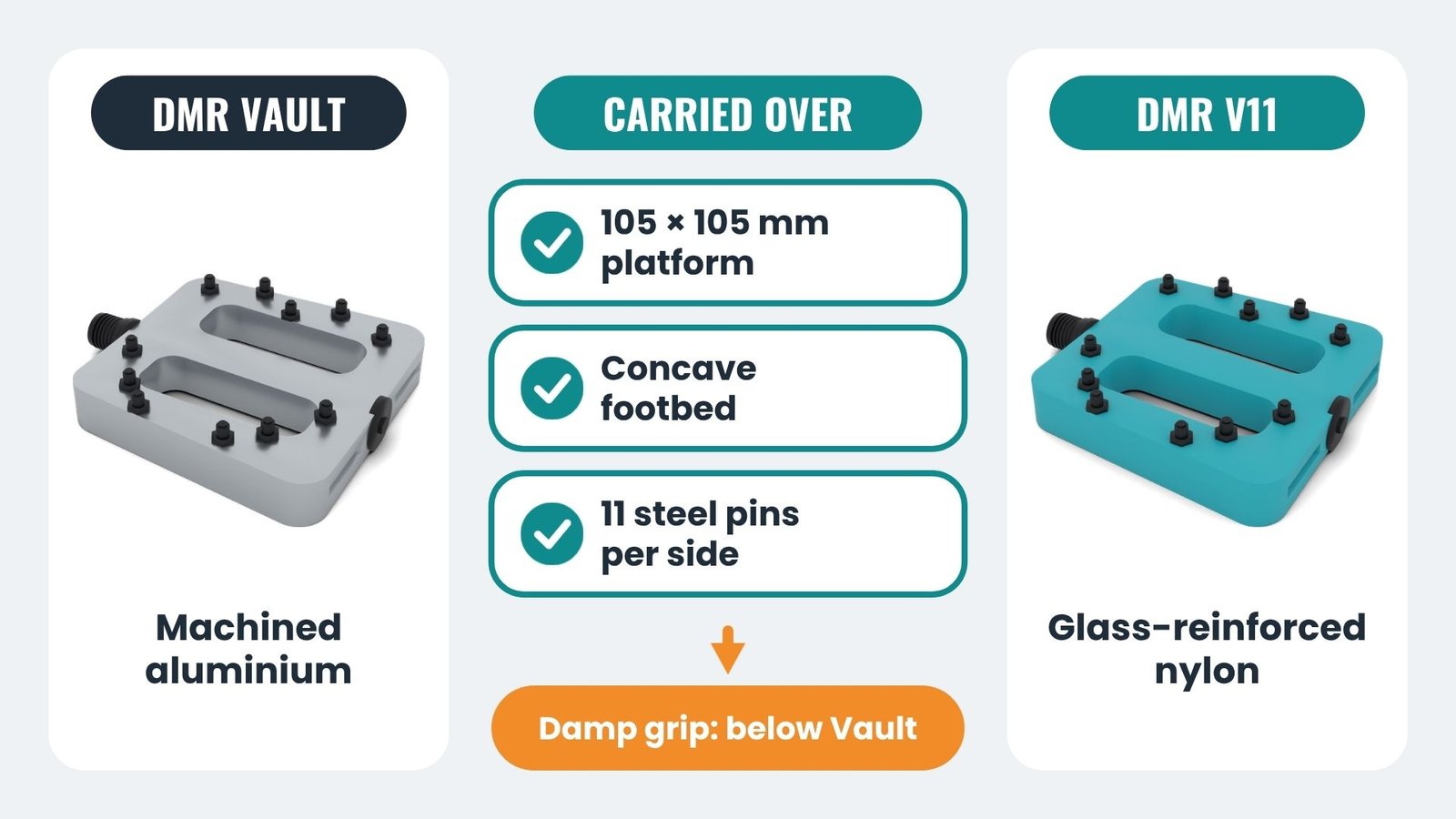
And it has an aluminum pedal design that provides you with a stable connection between your shoes and the bike, which you will appreciate on technical trails.
On the other hand, the V11 has a similar platform design to the DMR Vault. It uses glass-reinforced nylon instead of machined aluminum.
It carries over several important features:
- 105 × 105 mm platform: A broad, nearly square surface that gives your shoe plenty of room.
- Concave footbed: A recessed center designed to help your shoe settle into the platform.
- Eleven steel pins per side: Including DMR’s aggressive Moto pins around the outer edges.
They are designed to help your shoe settle into the center of the pedal, and the surrounding pins provide traction. However, using a similar shape doesn’t mean the V11 performs similarly to the Vault.
Even though the design is the same, I personally appreciate the V11’s grip and stability, but it does not match the aluminum Vault’s traction, especially in damp conditions.
So what I can say is that the V11 has important design features from the Vault, but you should not expect a similar experience.
How the Deftrap Supports Your Foot
The Deity Deftrap is designed using Deity’s own TMAC pedals as inspiration. But it doesn’t have the TMAC features carried over to the Deftrap.
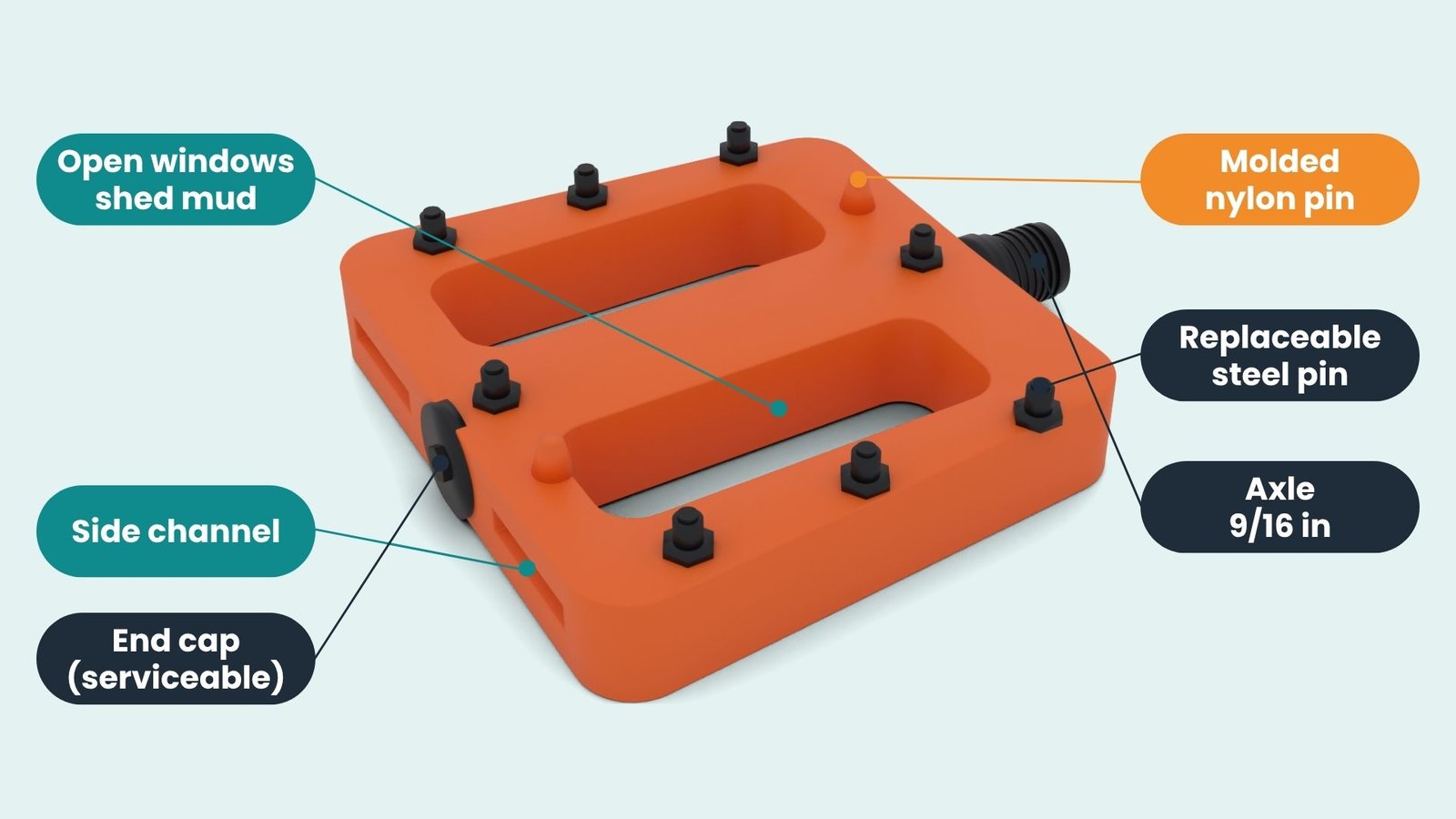
They have used a 113 × 103 mm platform, which makes it 8 mm longer than the V11 but 2 mm narrower.
Deity Deftrap Pedals
Longer 113 mm composite platform, simple grip setup
Plus, it also has Deity’s non-offset symmetrical design, where the platform is arranged evenly around the axle. So it’s not biased toward one side.
This is intended to provide you with a consistent area for your shoe to rest on, regardless of how you position your feet.
It has a 1.5 mm concavity, which is relatively modest, especially if we compare that with the Vault, which has a more pronounced recessed footbed.
This time, they have used replaceable pins and two molded nylon grip points on each side, which provide most of the aggressive traction, while the molded features are part of the composite body itself.
One thing that I like about the Deftrap design is that it does not rely on having an unusually deep platform to keep your foot secure. Instead, they have combined a large standing surface with strategically positioned pins.
A Longer Platform or a Deeper Footbed: Which Actually Helps?
The Deftrap measures 113 × 105 mm, and the DMR V11 measures 105 × 105 mm. So now you might think that the Deftrap provides more support because it’s longer. Well, there is a difference, but both pedals have relatively large footprints, so neither should feel particularly cramped with ordinary mountain bike shoes.
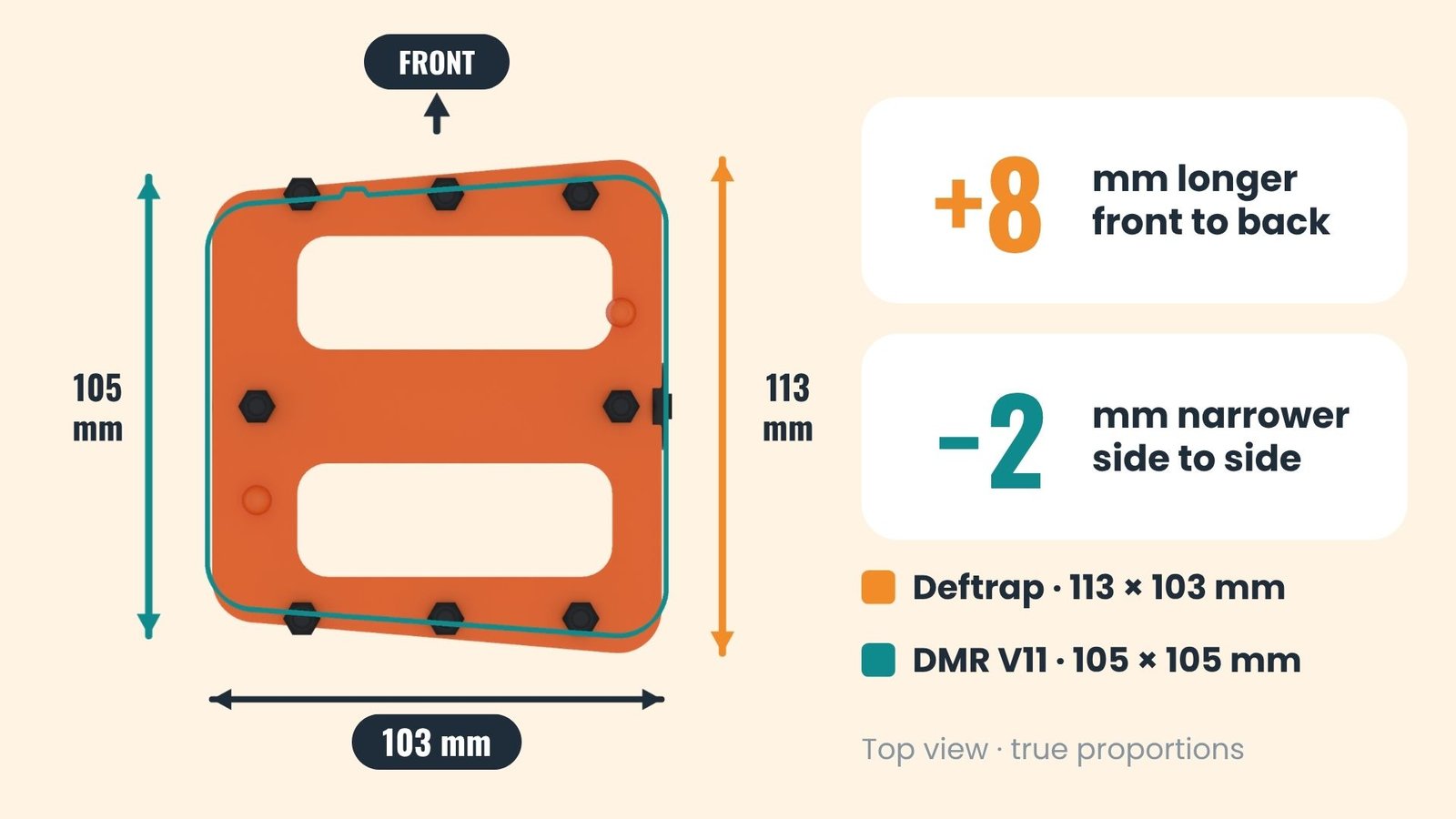
The longer Deftrap will provide you with more room in the front-to-back direction, which is useful depending on your shoe size and where you prefer to place your feet.
Meanwhile, the V11 has a more square footprint and a pronounced concave shape, which is designed to help you settle your shoe into the platform.
So these different shapes affect how the pedals feel, but we can’t say that one will definitely be more comfortable for you personally. So here are a few things that will help you understand the differences you will notice between them:
- Shoe stiffness: Stiffer soles may make the pin positions more noticeable, while flexible soles will conform differently to the platform.
- Foot position: Where you place your foot relative to the axle changes which parts of the platform support your shoe.
- Shoe size: Both offer generous platforms, but their different dimensions may suit particular shoe shapes and sizes.
- Sole rubber: A sticky outsole can provide strong traction on either pedal, regardless of their different shapes.
So, your shoe design matters. Some riders place their feet a little closer to the ball of their foot, while some position their feet further forward.
But none of these preferences fall exactly into the same position for everyone. The way a pedal supports your shoe can change depending on where you place your feet.
The V11’s deeper concave shape is good for riders who feel their shoes are seated within the pedal rather than resting on top.
However, that secure feeling can also have some disadvantages because when your shoes are engaged with the pedal, changing your foot position may require lifting them off the pedal instead of sliding them across the surface.
And the Deftrap can also hold your shoe securely, but repositioning may become difficult, especially with sticky rubber soles.
So I won’t treat the DMR V11’s concave shape as automatically the better one. It has a different approach to support and grip.
But if your priority is a relatively flatter platform with a simple design, you can go with the Deftrap, and for a more pronounced concave footbed, you can choose the DMR V11.
The V11’s Adjustable Pins Are Its Most Practical Difference
One thing that I like about the DMR V11, and generally a strong point of the V11, is that it gives you 11 replaceable steel pins, including its aggressive outer pins around the platform. So you can adjust them.
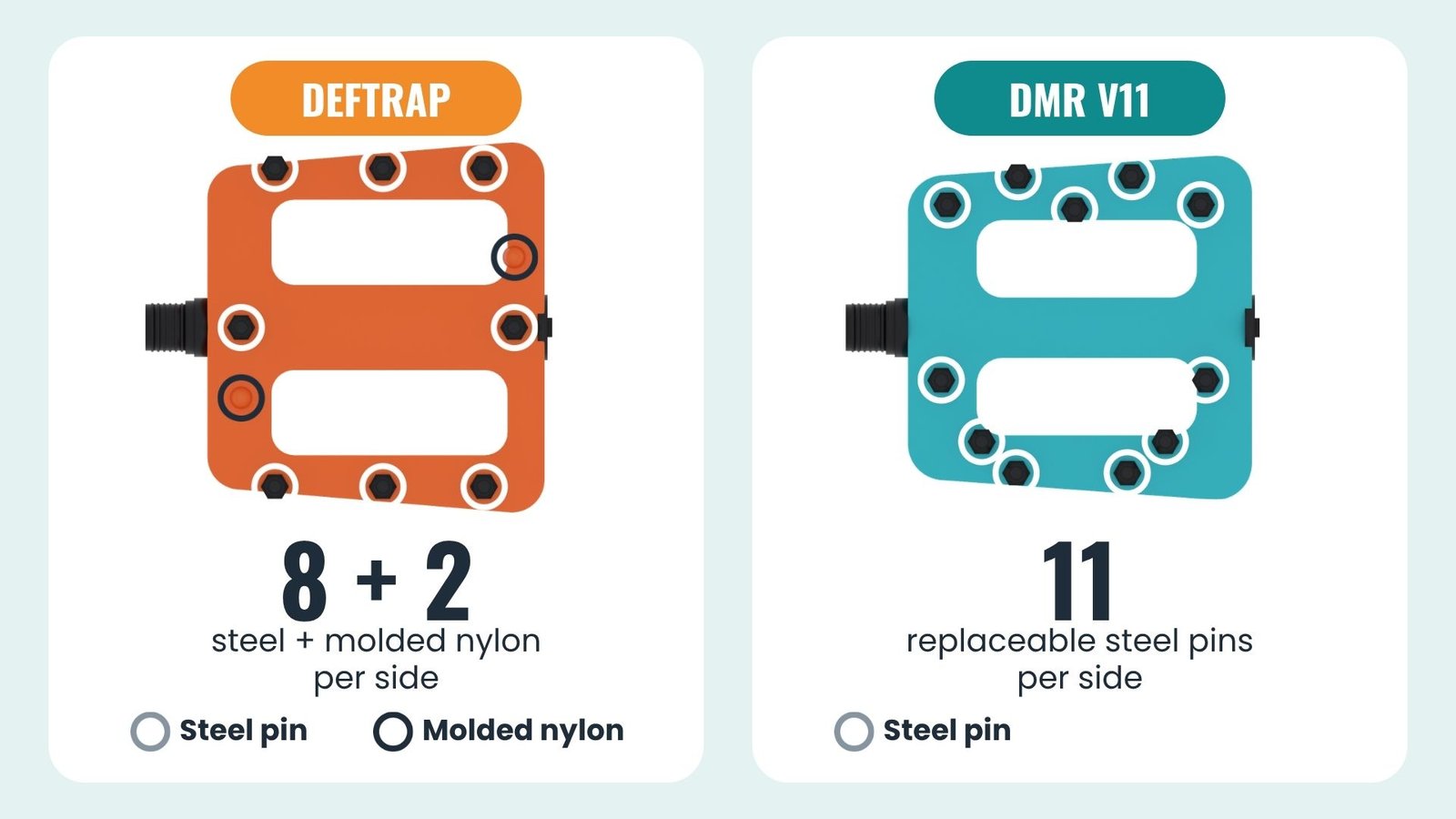
These pins are secured using captive nuts and allow you to adjust the exposed height, meaning if you want more exposed pin height when riding rough trails to keep your feet in place, or you want to frequently adjust your shoes because you prefer a less aggressive arrangement, in both cases, it is good.
DMR V11 Pedals (Black)
Composite platform with 11 adjustable steel pins
On the other hand, the Deftrap has 8 replaceable steel pins and two molded nylon grip points per side. So you can’t adjust or replace them individually because they are part of the pedal body. You can replace the damaged steel pins, but you can’t have the same level of control over the entire grip arrangement.
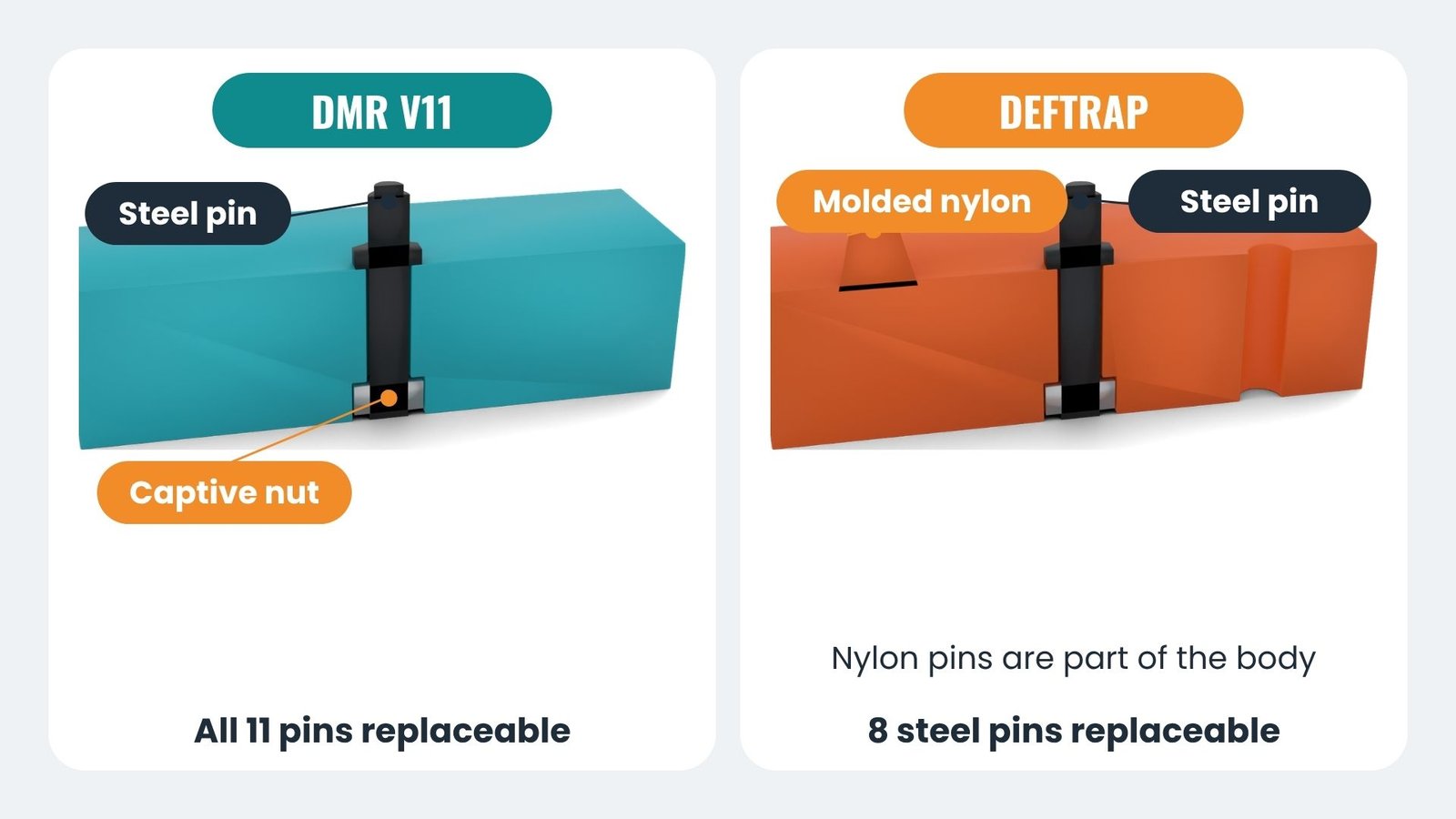
So this is what it means in practice:
| Your priority | More suitable option |
|---|---|
| Adjusting pin height to experiment with grip | DMR V11 |
| Having all metal pins individually replaceable | DMR V11 |
| A simple grip setup without much adjustment | Deity Deftrap |
| Strong traction without relying on maximum pin count | Either pedal |
Pedal pins are exposed to rocks, roots, and many other obstacles. Over time, they may bend, wear down, or become damaged. So you will have to replace all 11 pins on the V11.
This makes the V11 a good choice for riders who want to experiment with their grip setup.
However, do not think that all 11 pins will provide you with more traction than the Deftrap’s steel pins and two molded features. You should remember that each pin engages with the shoe. How you distribute pressure, how the rubber compound behaves, etc., all matter as well.
If you are the kind of rider who installs pedals and rarely adjusts anything afterward, the DMR V11’s extra customization might not make much difference to you.
I see it as a genuine advantage for riders who want that control rather than something everyone necessarily needs.
What Independent Testing Tells Us About Their Grip
I did some discussion and research to find out what people who have been using these pedals for a long time feel about them.
Even though I bought both of these pairs for testing, I could only give a quick review, but I wanted to provide a long-term review.
So I used my favorite communities, groups, Reddit, etc. And here is a quick summary of my observations:
| Pedal / Review | Main finding |
|---|---|
| Deftrap | Impressive grip and stable support on rough terrain |
| V11 | Strong traction and a supportive platform |
| V11 | Good overall performance, but not quite the original Vault’s grip in damp conditions |
Which One Would I Actually Choose?
Number one, I would make a decision based on what I want from the pair of pedals rather than trying to identify one model that wins in every category.
For example, if I want a large platform, strong and reliable grip, and minimal slippage, I will go with the Deftrap. It is very easy to pedal, and I also like its symmetrical body, which provides good support.
And I would choose the V11, which is inspired by the Vault, because of its pins and adjustability. I can also adjust my shoes a lot on different trails and in different riding conditions, depending on how I want to ride.
So I will leave that decision up to you. I am personally okay with both, but my first choice would be less adjustability with better grip. It is just my opinion.
However, both these pedals have serviceable internals, which is good at this price point. So you won’t have to replace the entire pedal if a bearing or bushing wears out.
My Quick Buying Recommendation
Choose the Deity Deftrap if:
- You want a longer, good-sized platform.
- You prefer strong grip without spending time adjusting pins.
- You want the lighter option based on manufacturer weights.
- You value a simple, capable composite pedal for regular trail riding.
Deity Deftrap Pedals
Longer 113 mm composite platform, simple grip setup
Choose the DMR V11 if:
- You like the shape and design philosophy of the original DMR Vault.
- You want to adjust pin height to suit your shoes and riding preferences.
- You prefer having all eleven steel pins individually replaceable.
- You’re interested in a more pronounced concave footbed.
DMR V11 Pedals (Black)
Composite platform with 11 adjustable steel pins
Final Verdict
The DMR V11 is a convincing composite pedal because it shares important design characteristics with DMR’s premium pedal, including a concave platform and an aggressive pin arrangement.
The Deftrap has its own premium design features, such as a slightly longer platform, a lower weight, and a wide platform, along with a strong reputation for grip. And it doesn’t need the V11’s adjustable pin system to perform well on rough trails.
I’d choose the DMR V11 if I wanted more control over pin height and preferred a pronounced, Vault-inspired footbed.
I’d choose the Deity Deftrap if I wanted a bigger-sized platform with reliable grip and a simpler setup.