Disclosure: This post may contain affiliate links. As an Amazon Associate I earn from qualifying purchases.
The Deity Deftrap and OneUp Composite pedals have large composite platforms, metal pins, and serviceable internal hubs.
So you don’t have to spend over a hundred dollars on an aluminum pedal just to get something suitable for your riding.
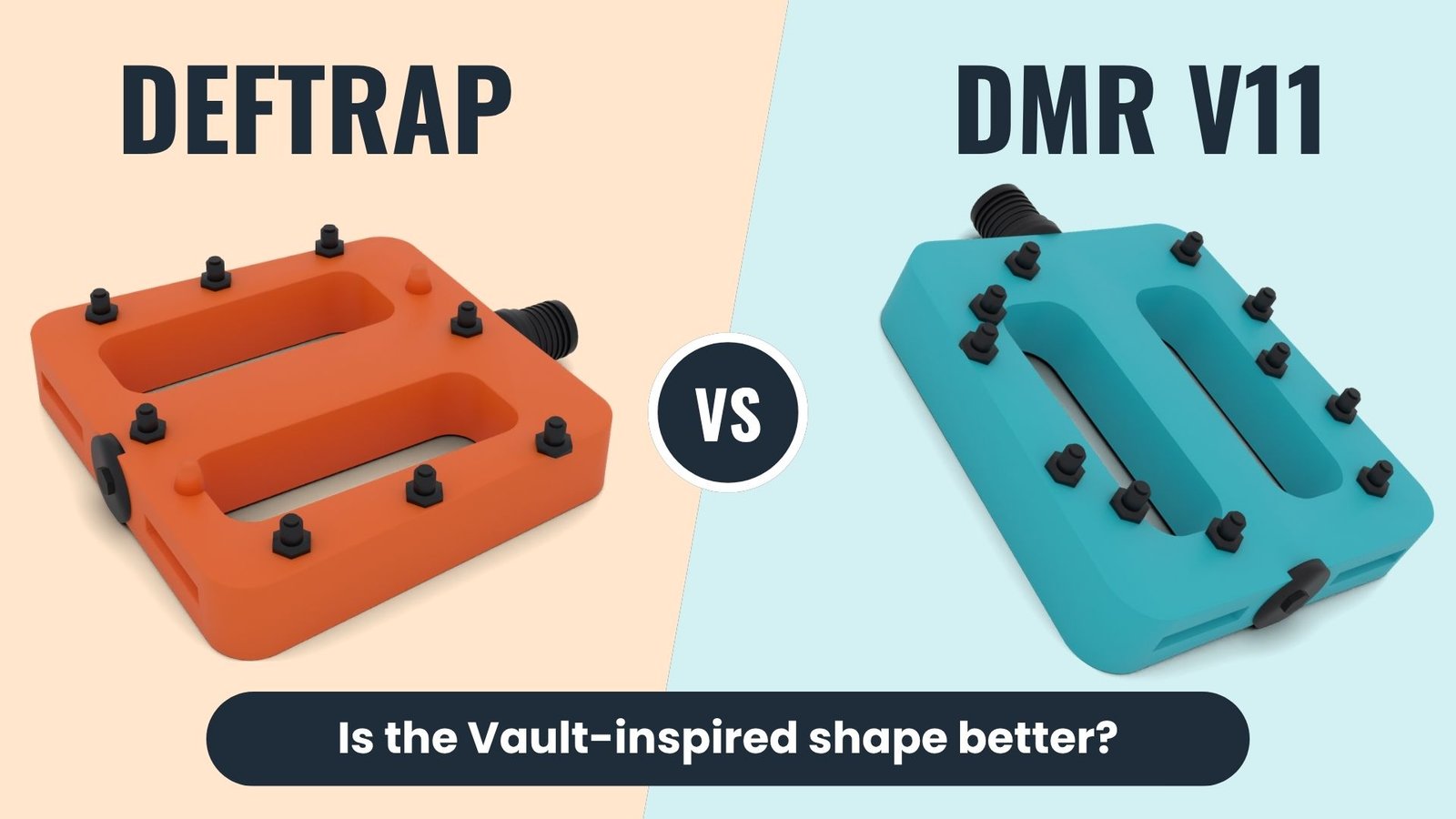
Though they look similar, they are different. The Deity Deftrap has a concave platform, which helps keep your feet planted, while the OneUp Composite has a slightly convex shape with thin, tapered edges.
Depending on where you want to ride and how often you adjust your feet, you can choose the pedals that suit you. After reading this post, you’ll know about both pedals and their features, helping you decide which one you should buy.
Deity Deftrap vs OneUp Composite: Specifications Compared
| Feature | Deity Deftrap | OneUp Composite |
|---|---|---|
| US listed price | $54.99 | $49.99 |
| Platform size | 113 × 103 mm | 115 × 105 mm |
| Weight per pair | 391 g | 355 g |
| Body material | Nylon-glass fiber composite | Nylon composite |
| Platform shape | Concave, 1.5 mm | Slightly convex |
| Pins per side | 8 replaceable steel + 2 molded nylon | 10 replaceable steel |
| Axle | Steel | Chromoly steel |
| Bearings | 2 sealed bearings + DU bushing | Serviceable bearing/bushing system |
| Rebuildable | Yes | Yes |
The OneUp Composite is slightly larger and weighs 36 grams less per pair. But I wouldn’t give too much importance to these differences. Apart from that, the size difference is only 2 mm.
A larger platform isn’t necessarily going to provide better support, and saving 36 grams across two pedals might not make much difference for most trail riders.
So one thing you need to keep in mind when choosing pedals is how each platform supports your shoes, how securely the pins hold your feet, and whether the design helps you avoid pedal strikes.
Platform Shape and Foot Support
This is the biggest difference between the Deity Deftrap and OneUp Composite pedals.
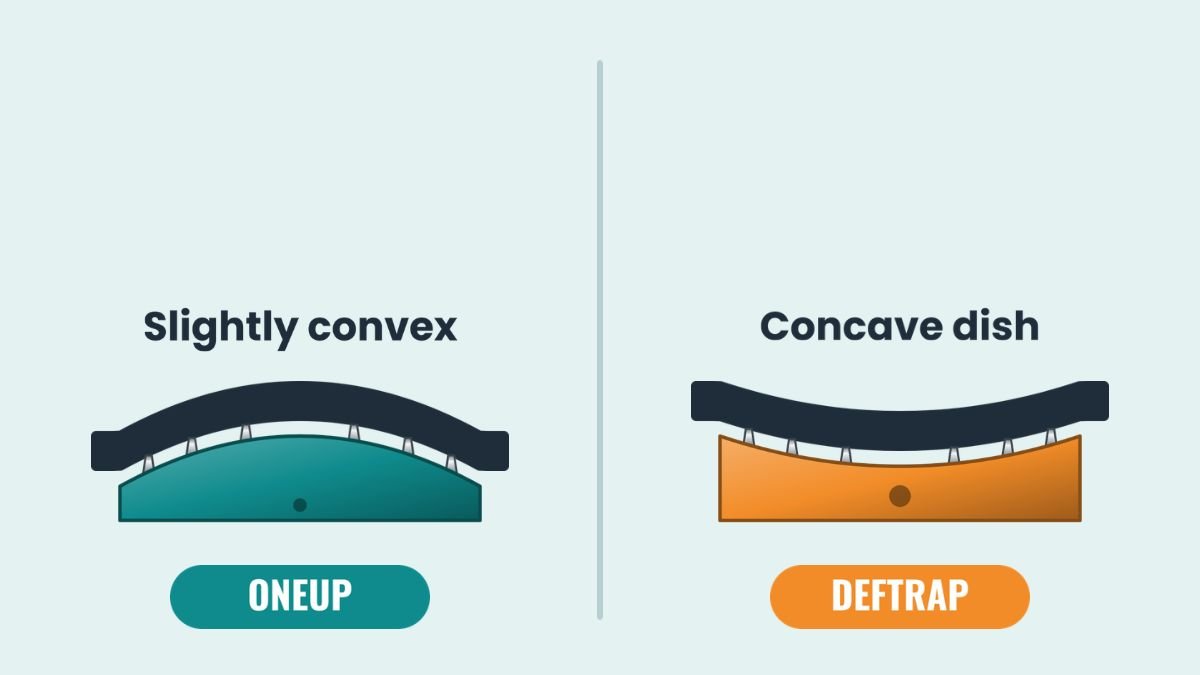
The Deity Deftrap has a concave platform, which means the middle sits a little lower than the outer area.
Deity gives you around 1.5 mm of concavity, which works together with the pins to help keep your shoe in position.
And this is very useful when you’re riding on rough trails because your bike is constantly moving. At that time, you need a pedal that provides a more planted connection.
On the other hand, the OneUp Composite has a convex profile, so the middle is raised rather than lowered. OneUp has designed this shape to fit the natural arch of our feet.
However, the metal pins can still provide traction, and the shape can make small foot adjustments easier.
For example, suppose your foot lands slightly too far forward after taking your foot off the pedal.
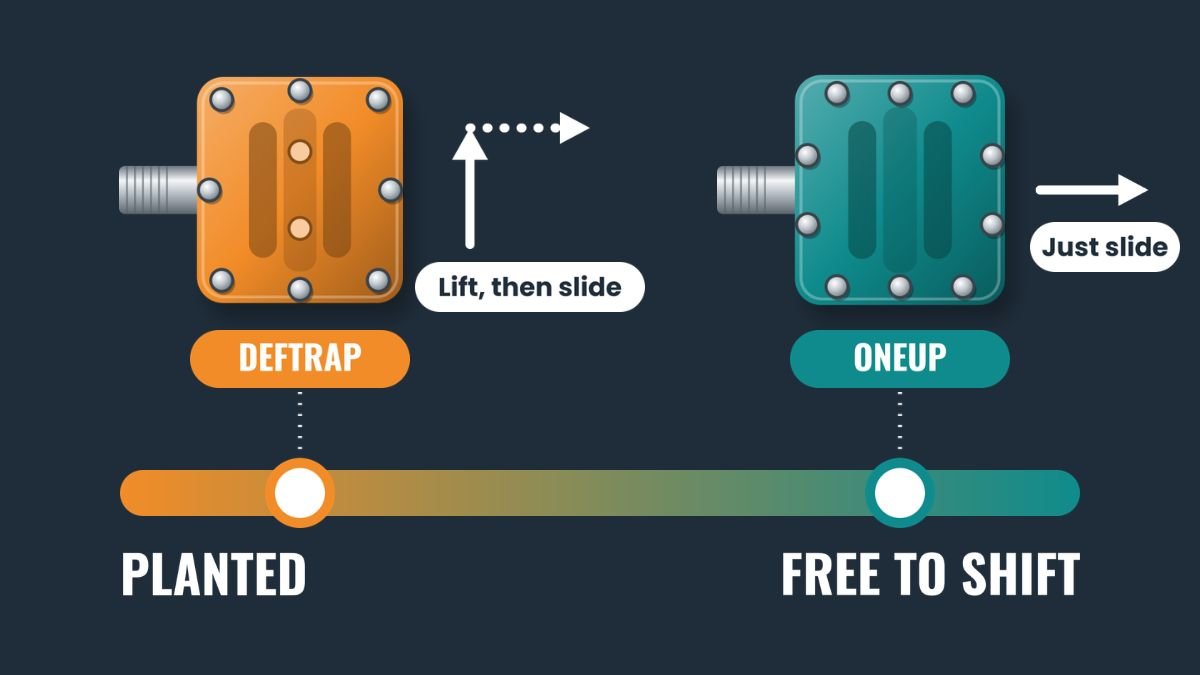
If you have a securely planted fit on the Deftrap, you may need to lift your shoe a little before moving it back into position. On the other hand, with the OneUp, it’s easier to make that adjustment.
But yes, the stiffness and rubber compound of your shoes will also affect how either platform feels.
So, in simple words, if you want a pedal that helps keep your feet planted, you should buy the Deftrap. And if you want more freedom to adjust your feet, you can go with the OneUp.
Deity Deftrap Pedals
Concave composite platform, 113 × 103 mm
Grip, Pin Design, and Foot Repositioning
The Deity Deftrap and OneUp Composite both have 10 pins per side, but the pin arrangement is different. The Deftrap has 8 replaceable steel pins and 2 molded nylon pins on each side.
On the other hand, the OneUp Composite has 10 replaceable steel pins, meaning all of its pins can be replaced if they get damaged.
OneUp Composite Pedals (Black)
Thin, convex 115 × 105 mm platform, 355 g
However, I cannot say that having the same number of pins will provide the same grip because it depends on the placement and height of the pins, platform shape, rubber on your shoes, and how you position your feet.
According to riders who have tested them, the Deftrap has an advantage when it comes to that locked-in feeling, which makes it good for rough descents where you want your feet to remain in position even when the trail gets rough.
But the downside here is that repositioning your feet will require more movement.
If we talk about the OneUp, it still provides strong grip, but its platform makes it somewhat easier to move your feet around.
This is crucial if you frequently change your foot position, especially when you need to adjust it while cornering, jumping, or riding through technical sections.
So, depending on your preference, you can choose between them.
Pedal Thickness and Rock Clearance
The OneUp Composite has an upper hand here, especially when you’re riding rocky trails or trying to avoid obstacles.
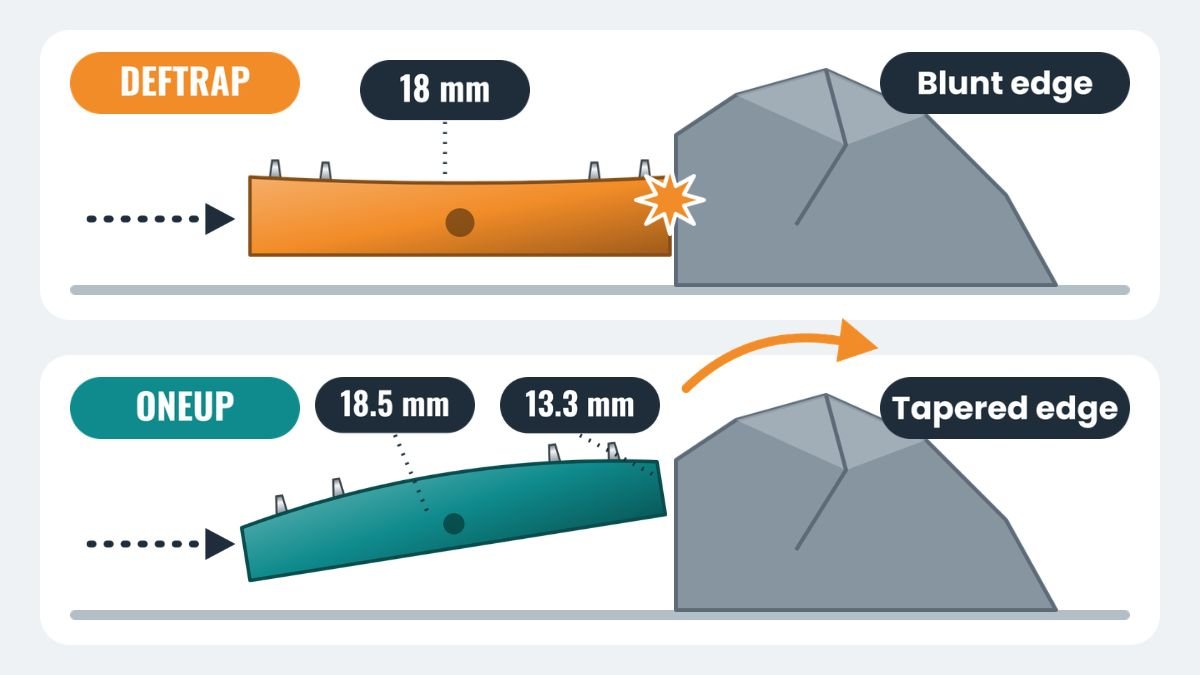
This is because the OneUp has a tapered design around its leading and trailing edges, measuring around 13.3 mm at those edges, while its center is thicker. This chamfered shape helps the pedal clear some obstacles.
If we talk about the Deity Deftrap, its center is around 18 mm thick, and its outer edges are thicker and more squared off. So, the platform shape contributes to its supportive feel, but it can also make the pedal more likely to catch on rocks if you time your pedal stroke poorly. That’s where I feel it has a disadvantage.
So, according to my analysis, along with independent reviews, the Deftrap offers stronger grip, but it is more prone to catching on obstacles than the OneUp.
One more important thing: your bike’s bottom bracket height, crank length, suspension sag, and the way you pedal also matter when you’re pedaling through rocky sections. And considering your riding position, you can still strike rocks with either pedal if your technique is already poor.
However, if I have to compare the OneUp Composite and the Deity Deftrap, I would go with the OneUp because it has an advantage here.
Sizing and Shoe Compatibility
Both pedals provide enough room to support your feet, so it’s not really going to be a downside.
The Deity Deftrap measures 113 x 103 mm, while the OneUp Composite measures 115 x 105 mm. So, they have just a 2 mm difference in each dimension, which is not too much.
What I would consider is your shoe size, sole width, and whether the platform supports your feet properly.
If you have wider shoes, the Deftrap’s square shape is a good option.
However, the OneUp is also large enough to work well with many bigger mountain bike shoes.
Besides this, OneUp also offers a smaller composite pedal with a 97.5 x 92 mm platform and seven pins per side. It is specially designed for riders with smaller shoes, approximately US men’s size 6.5, US women’s size 8, or EU size 38.
OneUp Small Composite Pedals (Black)
For smaller feet, 7 pins per side
So, if your feet are small, you may not even need a pedal that extends far beyond your shoes.
However, keep in mind that the Small Composite is a separate model, so its dimensions should not be confused with those of the full-size pedals we are comparing here.
Also, two shoes with the same labeled size can have different sole widths and pedal contact patterns. So, if you’re not sure, I would recommend comparing your actual shoe dimensions with the pedal platform instead of choosing based on your shoe size alone.
Durability, Bearings, and Maintenance
Neither of them is just cheap plastic. Both have nylon-based composite bodies, metal axles, and serviceable internal components.
Composite pedals are less expensive than aluminum ones, but that doesn’t mean they are not good.
These are well-designed composite pedals, so they can handle regular trail use. Their bodies may slide when you strike certain rocks, but they won’t develop the dents you might see on aluminum pedals.
The Deity Deftrap has two sealed bearings and an oversized DU bushing. Deity also includes an open channel in the platform to help clear mud and snow.
The OneUp Composite has a serviceable bearing and bushing arrangement, with replacement parts available to maintain the pedal.
So, the main difference I can point out here is the pin placement. On the Deftrap, eight steel pins per side are replaceable, while two are molded into the body. On the OneUp, all 10 steel pins per side can be replaced. So, if your pins are frequently damaged, the OneUp is a good choice for you.
However, here are a few things I would recommend doing to keep your pedals in good condition:
- Check the pins occasionally, especially after rocky rides, to make sure none are loose or damaged.
- Clean dirt and mud around the axle seals, particularly after riding in wet conditions.
- Pay attention to rough rotation, sideways play, or unusual noises, as these may indicate that the bearings need attention.
- Check replacement-part availability before buying, so you know whether pins and service kits are available where you live.
Price and Overall Value
Prices may go up and down, but as of today, the day I’m publishing this, the OneUp Composite costs around $49.99, and the Deity Deftrap costs $54.99. So, they have just a $5 difference, which is not very significant.
The number one thing is that you must maintain your pedals, no matter which one you choose.
However, if you want the Deity Deftrap’s concave platform and secure grip, you can spend an extra $5 here.
If you like the OneUp’s tapered edges and easier foot repositioning, it may fit your riding style better, so you can choose the OneUp.
There is also a weight difference of around 36 grams, but personally, I don’t think it’s going to make much difference.
OneUp claims a weight of 355 grams per pair, compared with 391 grams for the Deftrap. But you should consider the weight difference if you want to keep your bike light.
Personally, I would give more importance to grip, foot support, pedal clearance, and other factors rather than weight.
Both offer good value because you get a large composite platform, metal pins, and serviceable internals without paying the premium price you would have to pay for a pair of premium aluminum pedals.
Which Would I Recommend for Your Riding?
After comparing the Deity Deftrap and OneUp Composite, I cannot choose one for everyone. As you can see, at different points, each pedal offers its own advantages.
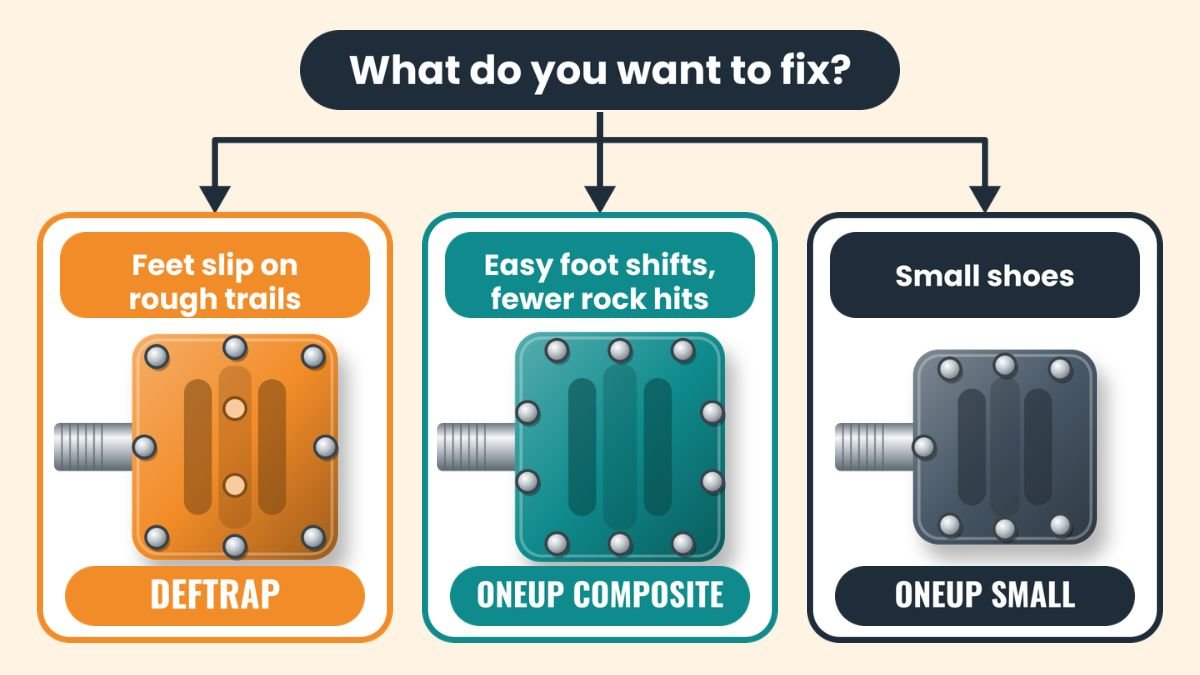
For example, if you want to ride rough descents and enjoy aggressive trail riding, the Deity Deftrap is a good choice because its concave platform and strong grip make it suitable for that kind of riding.
But for general riding, rocky climbs, and technical trails, the OneUp Composite is better because it provides strong grip, and on top of that, it has tapered edges, which are useful when riding around rocks.
And if you are a beginner, I think the OneUp would be a sensible choice because you will be riding on mixed trails, including smooth and rocky sections. And if you have smaller feet, you can still go with the OneUp Small Composite.
However, here is how I would narrow down the decision:
- Choose Deity Deftrap if you want strong grip, a planted feeling, and secure foot support on rough descents.
- Choose OneUp Composite if you frequently ride rocky trails, adjust your foot position, or prefer a lighter pedal.
- Consider OneUp Small Composite if you have smaller feet and find regular platforms unnecessarily large.
Deity Deftrap Pedals
Concave composite platform, 113 × 103 mm
OneUp Composite Pedals (Black)
Thin, convex 115 × 105 mm platform, 355 g
If you ask me which one I would recommend, I would say you should look at what you are trying to improve with your current pedals.
For example, if your feet move around too much when the trails get rough, you should choose the Deftrap.
But if you are already happy with the grip and want something that makes it easier to reposition your feet and is less likely to catch on rocks, then the OneUp would be a more sensible choice.
Frequently Asked Questions
Are Deity Deftrap and OneUp Composite pedals the same size?
No, although they’re close but not the same, the Deftrap is around 113 × 103 mm, while the full-size OneUp Composite is 115 × 105 mm.
Which pedal has better grip, Deity Deftrap or OneUp Composite?
Based on their design and feedback from riders who have tested them, the Deftrap provides a more locked-in feeling because of its concave platform and pin arrangement.
The OneUp also provides strong grip, but it can be easier to reposition your feet on.
Can you replace the pins on both pedals?
Yes, of course, you can do that. In the Deftrap, you have eight replaceable steel pins and two molded nylon pins per side.
And in the OneUp Composite, you have 10 replaceable steel pins per side.
Are composite pedals durable enough for aggressive mountain biking?
Yes, quality-wise, composite pedals can handle aggressive trail riding, and both models have metal axles and serviceable internals.
However, neither is immune to damage from hard impacts. So you should check the pedal body, pins, and axles after a significant rock strike.
Which pedal is better if I frequently hit rocks?
I would lean more towards the OneUp because of its tapered edges, as they help it glance off some obstacles instead of catching on them.
But crank length, bottom bracket height, suspension sag, and pedaling technique also matter.