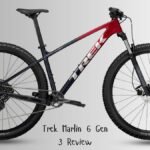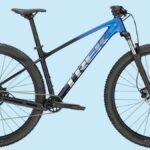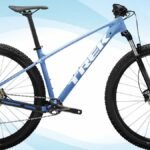
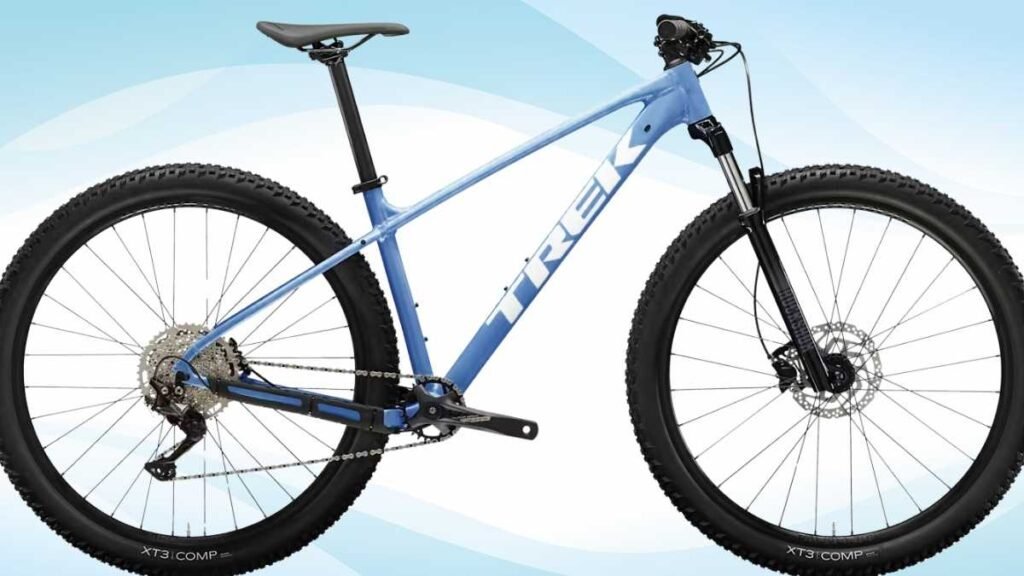
If you can spend $400 more than the Marlin 6, you will get Marlin 7 Gen 3, with RockShox Judy Silver Solo Air fork, a 12-speed SRAM Eagle drivetrain, and it only weighs 1.85 lbs less.
Its air forks are lighter than coil forks, and the Solo Air unit on the Marlin 7 drops enough mass that the complete bike comes in under 31.5 lbs at size MD, compared to the Marlin 6’s 33 lbs.
Key takeaway:
- Marlin 7 Gen 3 is good for you, if you wants trail performance from an aluminum hardtail without pushing past $1,400.
- SRAM Eagle’s 12-speed range and the tunable air fork make a difference over the Marlin 6’s coil setup, and the bike is lighter to boot.
- However, both the Marlin 6 and Marlin 7 share the same straight 1.125″ headtube, so future fork upgrade options have similar constraints.
Trek Marlin 7 Gen 3 Specifications
| Component | Spec |
|---|---|
| Frame | Alpha Silver Aluminum, molded chainstay protection, internal routing, rack and kickstand mounts |
| Fork | RockShox Judy Silver Solo Air, rebound adjust, TurnKey hydraulic lockout, 30mm stanchions, 100mm travel |
| Fork offset | 42mm (XS/SM, 27.5″) / 46mm (MD-XXL, 29″) |
| Headtube | Straight, 1.125″ |
| Drivetrain | SRAM SX Eagle (shifter, crank, cassette) + SRAM NX Eagle (rear derailleur), 1×12 |
| Crankset | SRAM SX Eagle Alloy, 30T chainring |
| Cassette | SRAM SX Eagle PG-1210, 12-speed, 11-50T |
| Chain | SRAM SX Eagle, 12-speed |
| Shifter | SRAM SX Eagle, 12-speed |
| Rear derailleur | SRAM NX Eagle, 12-speed |
| Brakes | Shimano Deore MT200 hydraulic disc, 2-piston |
| Rotors | 160mm front (XS/SM), 180mm front (MD-XXL), 160mm rear (all sizes) |
| Rims | Bontrager Kovee, double-wall alloy, 23mm internal width, tubeless-ready, TLR strips included |
| Tires | Maxxis Rekon, EXO casing, 60 TPI, tubeless-ready, 2.4″ |
| Dropper post | TranzX JD-YSI34: 100mm (XS/SM), 125mm (MD), 150mm (ML/LG), 170mm (XL/XXL) |
| Saddle | Bontrager Verse Short, stainless rails |
| Pedals | VP-536 nylon platform |
| Sizes | XS (27.5″), S (27.5″), M (29″), ML (29″), L (29″), XL (29″), XXL (29″) |
| Weight | 31 lb 3.1 oz / 14,150g (size MD) |
| Price | $1,399.99 MSRP |
30T chainring paired with an 11-50T cassette puts low gear at 15 gear inches, enough to climb steep technical singletrack without stalling.
At the top end, it’s around 82 gear inches, which covers flat trail and fireroad without spinning out.
Across 12 cogs, those gears arrive in smaller steps than the 10-speed setup on the Marlin 6, which smooths out cadence management on terrain where the gradient keeps shifting.
RockShox Judy Silver Solo Air
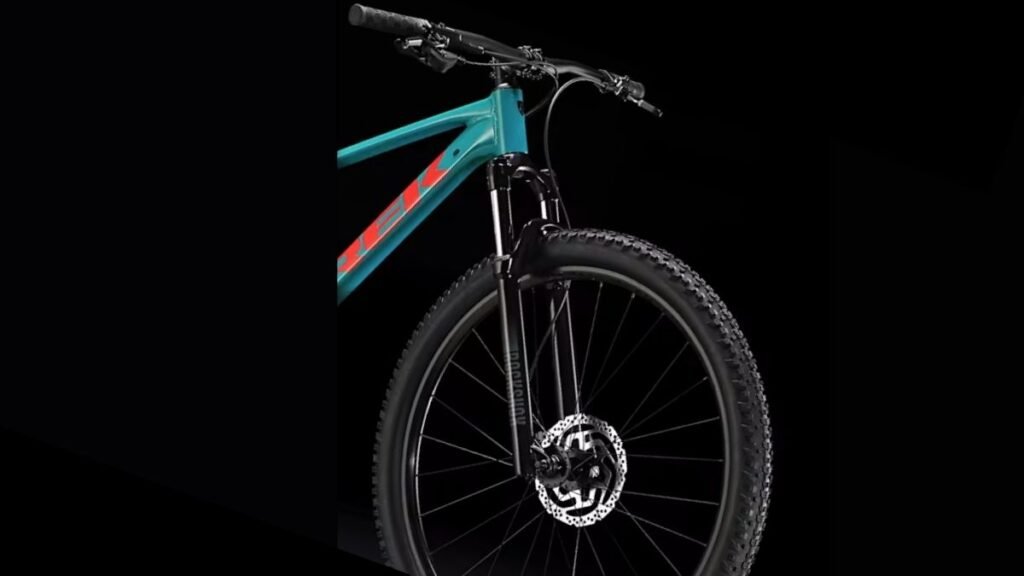
Air forks and coil forks both use the same basic principle: compress to absorb a hit, extend to return to riding position. But one thing that make difference is how the spring behaves across its full range of travel.
A coil spring on the Marlin 6’s Judy is linear: it pushes back with the same rate throughout the compression stroke.
That’s consistent and predictable, but it means you can’t tune it to your weight without swapping springs.
An air spring gets progressively stiffer as you push deeper into the travel.
At the initial part of the stroke, it’s supple and responsive to small bumps.
Deep in the travel, air pressure builds and resists bottom-outs.
You tune both the feel and the resistance by adjusting air pressure to match your weight, and it costs you nothing to change.
Setting pressure correctly makes a difference on trail, run too little air and the fork dives through its travel on bigger hits, losing composure on back-to-back obstacles.
Too much and small trail chatter stops getting absorbed, making the front end feel harsh and nervous.
For a starting point, 1 PSI per lb of body weight (rider weight plus gear) works well as an initial setup: a 160 lb rider would start around 60 to 65 PSI and adjust from there.
Lower it 5 PSI if the fork uses more than 80 percent of its travel on normal trail hits; raise it 5 PSI if you’re barely using 50 percent.
Rebound adjustment and what it controls
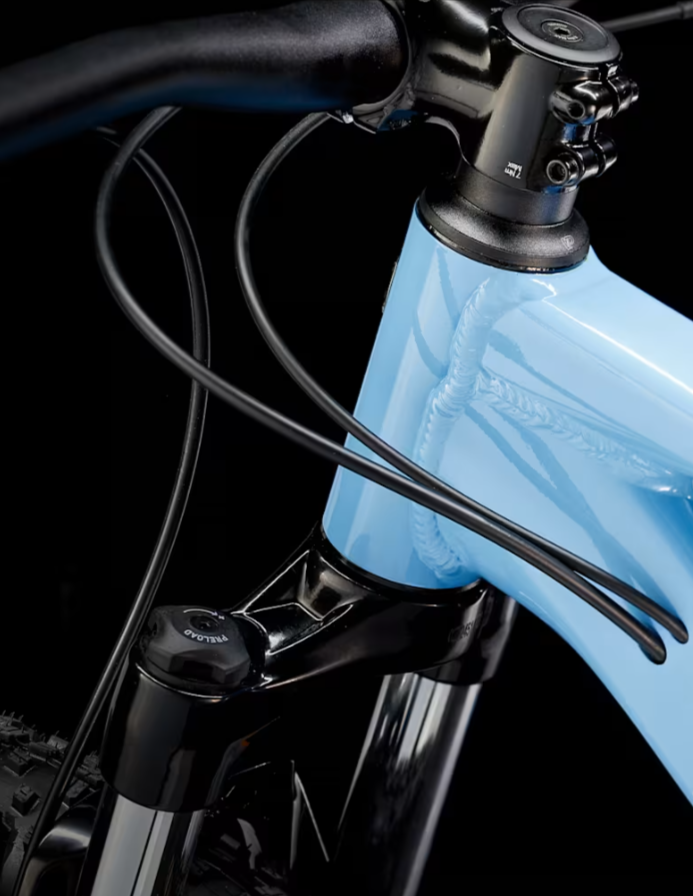
Rebound is the speed at which the fork extends back to its full length after compression.
If it’s too fast, so the fork springs back before your wheel can settle on the next bump, causing a bucking, unpredictable feel. But if it’s too slow and it will stay compressed, losing available travel for the next hit.
Finding the right rebound setting takes one short test run: set it at mid-range, hit a handful of medium-sized roots or rocks.
Then, check whether the front wheel feels planted and controlled between hits.
Slow rebound down if the fork seems to bounce back at you; speed it up if the bike starts riding lower and lower through repeated rough sections.
On the Judy Silver Solo Air, the adjustment knob at the bottom of the left leg handles this.
For XC and blue-rated trail, a setting somewhere between half and three-quarters of the way toward the slow end.
Fork maintenance schedule to know upfront
Air forks need periodic service that coil forks don’t.
Because, dust seals and lower leg oil need attention, around every 50 riding hours or once a year, whichever comes first.
If you skip lower leg service leads to stiction, it will reduced sensitivity, and seal damage.
Full service intervals vary but normally run every 100 to 200 hours, budget $60 to $100 for lower leg service at a shop, or do it yourself if you’re comfortable with forks.
SRAM Eagle Drivetrain
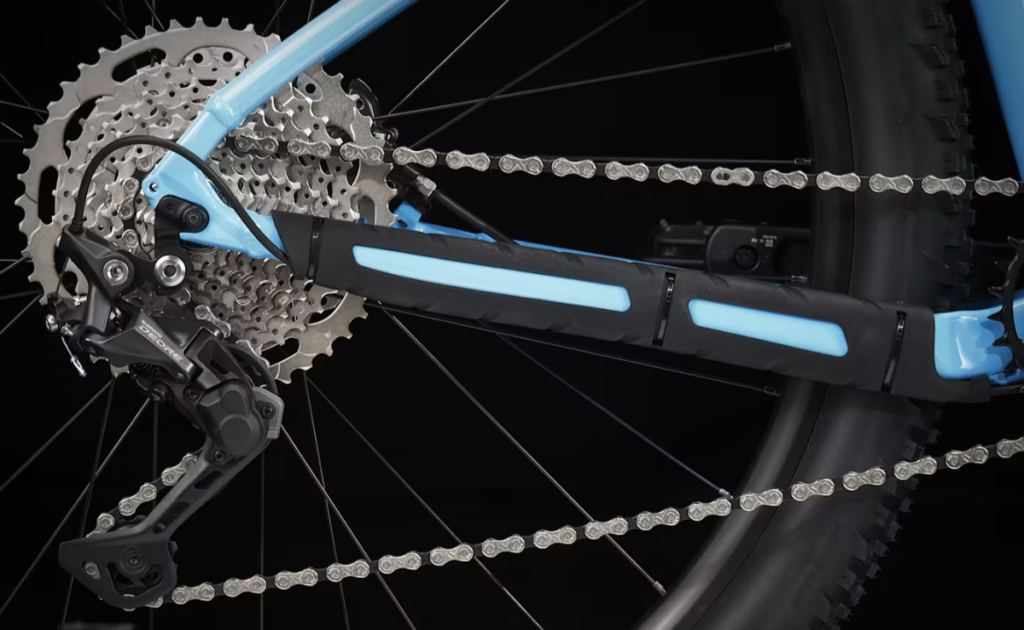
Some of the riders in my Facebook and reddit community describe this drivetrain as “SRAM Eagle” without noting that it’s a combination of two Eagle tiers.
The shifter, crank, cassette, and chain are SRAM SX Eagle, the rear derailleur is SRAM NX Eagle.
Trek mixes them this way intentionally.
Why Trek uses an NX Eagle derailleur with SX Eagle components
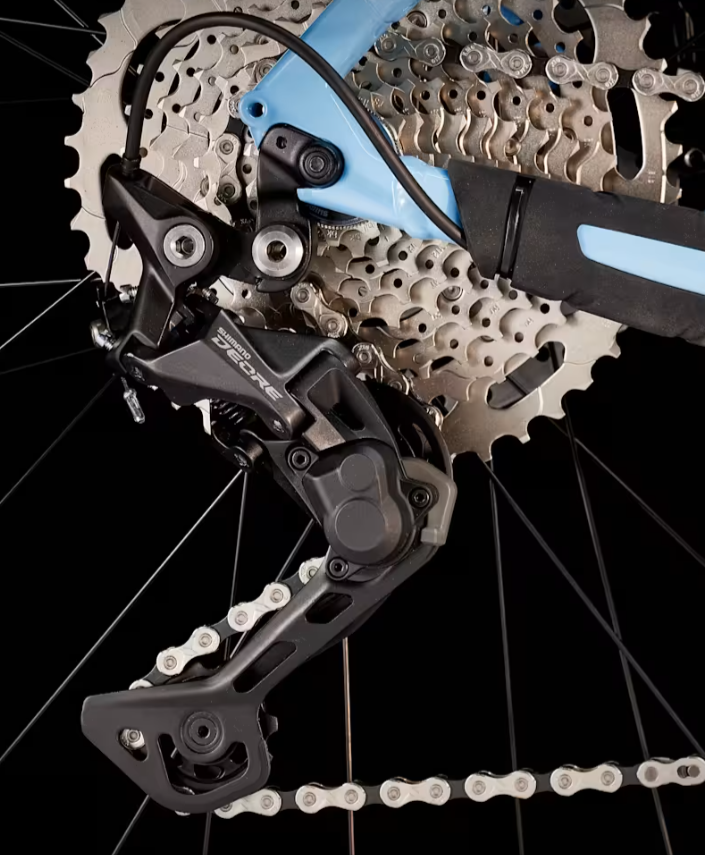
SRAM NX Eagle sits one level above SX Eagle in the Eagle lineup.
Its rear derailleur uses a stronger cage construction and a more robust clutch mechanism than the SX Eagle derailleur.
It makes it better suited to the kinds of rough, variable terrain that aren’t good for mtb components.
By pairing the NX derailleur with SX Eagle’s shifter, crank, and cassette, Trek gets better chain retention and derailleur durability in the component that takes the most trail abuse, while keeping the overall cost manageable.
For maintenance purposes, NX and SX Eagle components are cross-compatible.
SRAM designed Eagle as an ecosystem.
If the shifter or cassette wears out first, replacing with any Eagle-tier component at the same level works fine.
Standard SRAM Eagle chains are not model-specific either; any SRAM 12-speed Eagle chain fits.
What 12-speed SRAM Eagle does on trail
Twelve gears from 11-50T means your gear steps are tight enough to hold a steady cadence on all but the most abrupt gradient changes.
On extended climbs where the pitch shifts from moderate to steep every 30 seconds, you’ll be shifting more often but landing in a usable gear every time.
With a 30T chainring, that 50T big cog puts your low gear at 15 gear inches, which is low enough to spin up grades that would stop other Marlin builds.
SRAM Eagle’s shifting character differs from Shimano CUES, and SRAM shifts with a quick, deliberate click.
Under load, it does fine and you can shift while pedaling hard, but it prefers being at least slightly off the pedals compared to Shimano’s LINKGLIDE system, which was specifically engineered for heavy load shifting.
Neither is wrong, they’re just different, for XC and trail riding with moderate climbing, Eagle handles the job without issues.
What Changes on Trail: Marlin 7 Gen 3 Performance Notes
On smooth and moderate terrain, the Judy Silver Solo Air fork feels more active and responsive than the coil version on the Marlin 6.
Small chatter gets absorbed with less fuss, and the fork tracks through connected root sections more consistently because the progressive air spring is sensitive at the initial stroke in a way coil springs aren’t.
If you have ridden a coil fork at this price and thought “this feels a bit wooden on small stuff,” the air version is good for.
On Rougher, technical terrain, rebound adjustment pays off.
On a sequence of closely spaced rocks or a steep rooted chute, being able to slow the rebound down keeps the fork from kicking back between impacts and lets the wheel stay in contact with the ground.
On the Marlin 6’s coil Judy, there’s no rebound adjustment: it returns at a fixed rate regardless of what you’re riding through.
Climbing efficiency on an air fork, when correctly set up, is also a little better than a coil.
Brakes: same as Marlin 6, including the rotor size split
The Shimano Deore MT200 brakes on the Marlin 7 are similar to those on the Marlin 6. 160mm front rotors on XS and SM frames, 180mm front on MD and larger, 160mm rear on all sizes.
If you’re expecting a brake upgrade between the two bikes, you won’t get there.
Both are capable trail brakes with decent lever feel and consistent modulation, but if you’re coming from a bike with Shimano SLX or XT, you will notice the MT200’s softer bite.
Straight headtube: same limitation as the Marlin 6
Both bikes share a similar straight 1.125″ headtube.
Upgrading the fork beyond the Judy Silver (a RockShox Revelation, a Manitou Mezzer, or a Fox 34) requires either a straight-steerer version of that fork or a headset reducer adaptor.
This doesn’t block fork upgrades, but it narrows the field compared to a tapered headtube.
Trek Marlin 7 Gen 3 Strengths and Limitations
Strengths:
- RockShox Judy Silver Solo Air is tunable to rider weight, lighter than a coil fork, and more sensitive at the top of the travel stroke, which opens up terrain than the Marlin 6’s setup
- SRAM Eagle’s 11-50T 12-speed cassette offers the widest gear range in the Marlin lineup, with tight enough steps to hold steady cadence on variable gradient climbs
- NX Eagle rear derailleur is a step above the SX Eagle unit in durability and clutch strength, which important on rough terrain where chain slap and impact loads stress the derailleur
- Lighter weight than the Marlin 6 at the same size, despite costing $400 more, because the air fork saves more mass than the added SRAM components add
- TranzX dropper post reaches up to 170mm drop on XL and XXL frames, more than any other Marlin model, giving taller riders appropriate travel for descents
- Maxxis Rekon 2.4″ tires (vs 2.35″ on Marlin 6) provide more cornering knob contact on loose terrain and more air volume for lower tubeless pressures
Limitations:
- Straight 1.125″ headtube limits future fork upgrade options to straight-steerer forks, the same constraint as the Marlin 6 that costs $400 less
- Brakes are similar to the Marlin 6, so no upgrade here for the price premium
- TranzX dropper post remote feel is functional but less refined than dedicated aftermarket droppers from RockShox or OneUp
- Air fork requires periodic maintenance (lower leg service every 50 hours, full service every 100 to 200 hours) that a coil fork doesn’t, adding $60 to $100 per service interval in shop cost
- VP-536 nylon pedals ship stock and should be swapped before trail riding, same as every Marlin below it
- Weight, while lighter than the Marlin 6, is still on the heavy side for a hardtail at 31.2 lbs at size MD, which limits how much the bike rewards aggressive efforts on climbs
What type of rider is the Marlin 7 Gen 3 for?

If you want to push into blue and black trail terrain within first season, and want a bike that can handle that without a fork upgrade in year one, can get Marlin 7 Gen 3.
At $999, the Marlin 6 is a better-specified trail hardtail than anything below it in the Marlin lineup.
At $1,399, the Marlin 7 adds an air fork that opens the terrain range and a 12-speed drivetrain that makes sustained technical climbing easier.
Good for XC Loops
If you rides a mix of XC loops and moderate singletrack but don’t want to upgrades, the Marlin 7 is a suitable MTB for you.
At this price, alternatives from Marin, Norco, and Polygon at similar price points compete on trail-geometry and components, so doing a comparison based on specific local terrain is worthwhile before committing.
At some point, spending $1,400 on an aluminum hardtail puts you near the range where full-suspension options appear on the used market.
FAQs About the Trek Marlin 7 Gen 3
Is the Marlin 7 Gen 3 worth the extra cost over the Marlin 6?
For riding on on blue or black-rated terrain, yes, because you get an air fork that you can tune to your weight, 12-speed SRAM Eagle with an 11-50T cassette, plus it’s lite.
And if you mostly ride on XC loops and easy singletrack, the Marlin 6 at $999 is harder to justify spending an extra $400 on.
What air pressure should you run in the RockShox Judy Solo Air?
Start with 1 PSI per 1 lb of total system weight (rider weight plus gear, usually 10 to 15 lbs).
A 160 lb rider fully geared would start around 63 to 68 PSI.
Pump up, then go ride some representative trail sections, check your sag by seeing how far the fork traveled on a normal hit: ideally 15 to 25 percent of the fork’s travel in sag under your weight while seated in riding position.
Adjust 5 PSI at a time until the fork feels active on small bumps without diving too deep on big hits.
Does the Marlin 7 Gen 3 have a tapered headtube?
No, Marlin 7 use a straight 1.125″ headtube, tapered headtubes (1-1/8″ top, 1.5″ bottom) appear on the Procaliber and higher-spec Trek trail bikes.
Fork upgrades on the Marlin 7 are limited to straight-steerer forks or require a headset reducer adaptor to run tapered-steerer options.
What is the SRAM SX Eagle and NX Eagle difference?
SRAM Eagle is a 12-speed drivetrain family with several tiers: SX, NX, GX, X01, and XX1, in ascending order of weight and precision.
Trek pairs an SX Eagle shifter, crank, and cassette with an NX Eagle rear derailleur on the Marlin 7.
NX Eagle’s derailleur is more durable and has a stronger clutch mechanism than the SX version.
What size Trek Marlin 7 Gen 3 should you buy?
Trek’s size guide puts Medium at around 5’5″ to 5’9″, Large at 5’9″ to 6’1″, and XL at 6’1″ to 6’4″. XS and SM frames come with 27.5″ wheels; Medium through XXL roll on 29″. XL and XXL riders specifically benefit from the 170mm dropper on those sizes.
If you’re on the border between Medium and Large, lean Large if your current bike feels short in the reach, or stay Medium if standover height is a concern.
How often does the air fork need service?
Lower leg service on the Judy Silver Solo Air should happen every 50 riding hours or once a year, whichever comes first.
This involves draining and refreshing the lower leg oil that lubricates the internals and keeps seals healthy.
it will cost you $60 to $100 at the shoap.

Muhammad Abraham is the founder of Mountain Bike Insider and has been riding mountain bikes for over 15 years. He started writing professionally in 2017 and launched this site in 2024 to share practical MTB gear reviews, bike comparisons, trail guides, and riding advice based on real-world experience. When he has not used a product directly, he clearly says so and supplements his research with input from other riders and the mountain biking community.