Disclosure: This post may contain affiliate links. As an Amazon Associate I earn from qualifying purchases.
The trade-in value of a mountain bike is always much lower than its private sale value. This is how mountain bike shops operate.
When MTB shops buy a used mountain bike, they do some work on it and then earn a margin by selling it.
So, how much your bike is worth depends on which model it is, every brand has a different reputation, which model you have, how old it is, what condition it’s in, and whether it will prove profitable for the shop, and there are more factors, which I’ll discuss in this post.
Most bikes lose 60%, 70% or 80% of their value, again depending on many factors.
If you want to estimate the value of your mountain bike, you can use the Mountain Bike Value Estimator. It will tell you how much your bike is worth, and after that, you can sell it online, offline, or wherever you want.
Difference between Trade-In and Private Sale
| Trade In | Private Sale |
| In trade in, you will get less money, but you won’t have to put in much effort. | In a private sale, you’ll have to put in more effort, but you’ll get more money. |
| Trade in is better for speed and certainty. | A private sale is better for getting more money. |
| With trade-in value, you’ll only have to negotiate with one shop. | In a private sale, you may have to negotiate with buyers or do more bargaining because you can receive orders from anywhere. |
So, these are a few things I’ve explained to you. Now let’s understand them in detail.
Typical Trade-In Value Range (Without Overpromising)
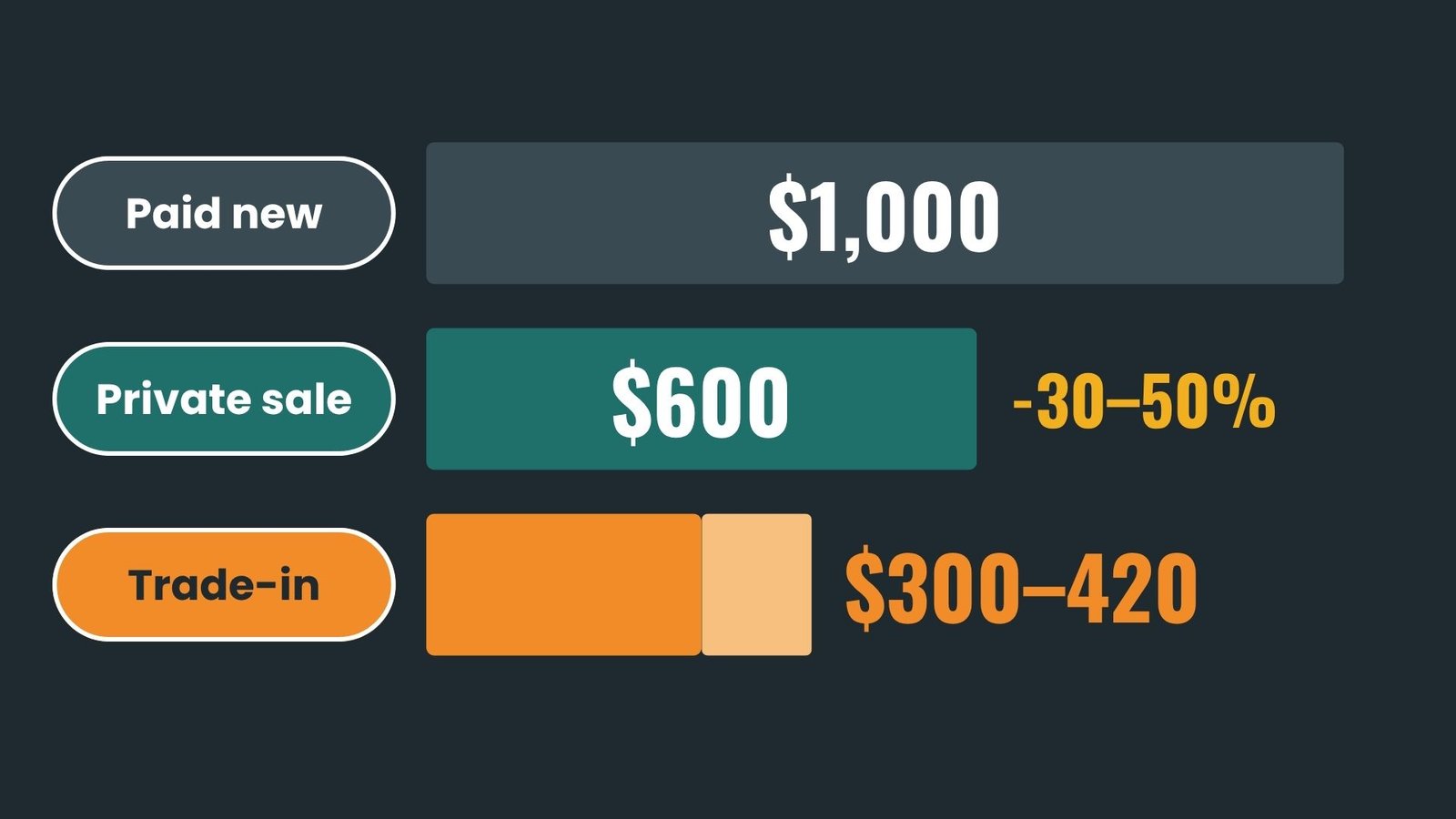
In trade-in value, shops will offer you much less money. For example, you bought a new bike for $1,000, and you checked its estimated value, which is around $600.
So, you can sell it somewhere else for $600, but if you go for a trade-in, a shop will typically offer you $300 to $420 after a 30% to 50% reduction, which is very low.
On top of that, if you have an old entry-level or hard-to-sell mountain bike, the amount will be even lower.
So, if you’re getting $300 in private selling, perhaps the shopkeeper might offer you only $100.
How Shops Calculate Mountain Bike Trade-In Value
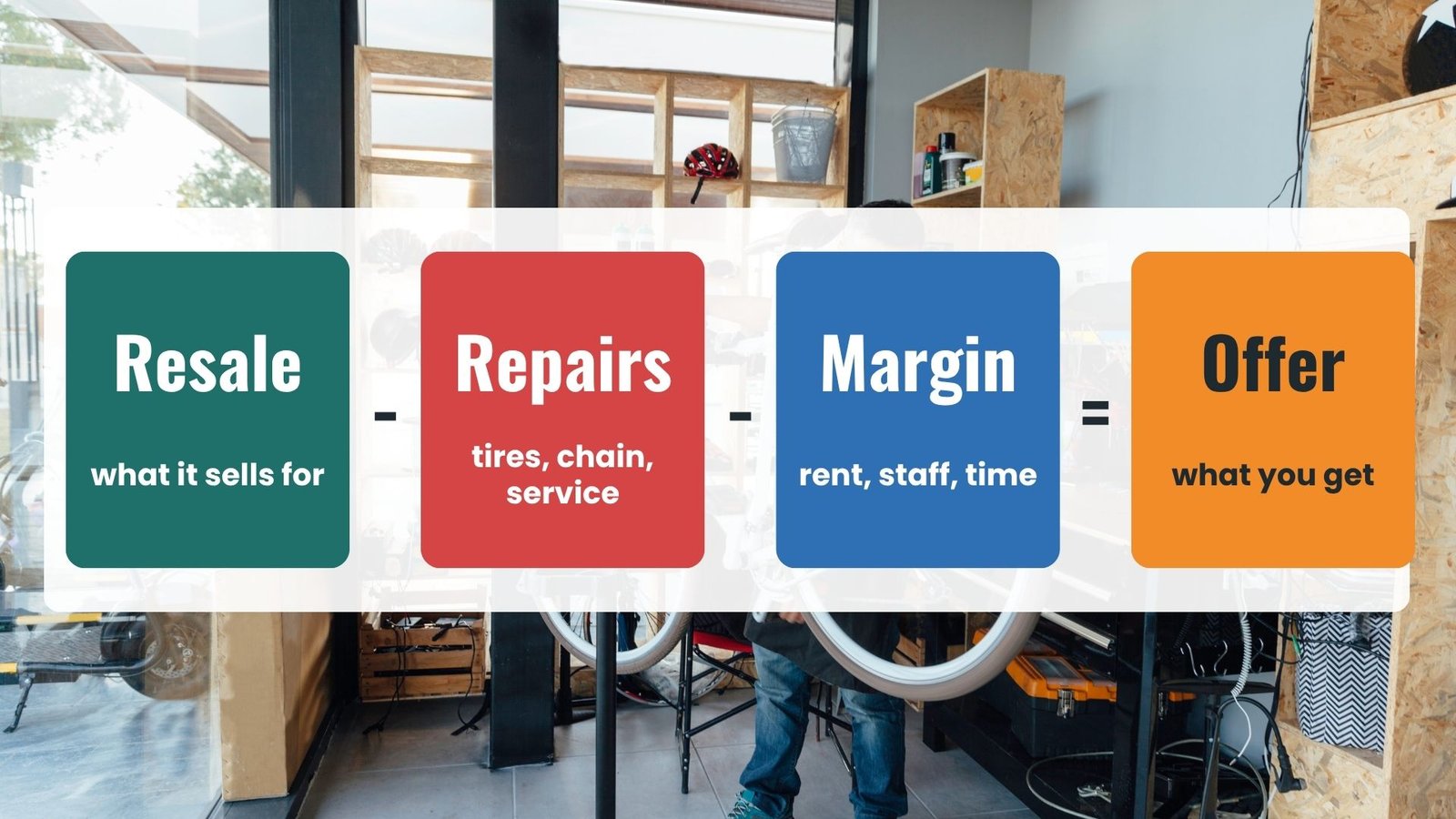
Whenever bike shops buy your bike, they keep in mind how much it’s going to sell for, and the exact price will depend on the demand in your local area, the brand, the model, and so on.
Apart from that, the listings in nearby shops will also affect your bike’s price.
If you have a bike from brands like Trek, Specialized, Giant, etc, almost any shop will easily buy it, but they will buy unpopular brands at a very low price.
Reconditioning Costs:
When you’re selling your bike, the shopkeeper will check everything, such as the tires, drivetrain, etc.
Then, if they think they’ll need to replace something to increase its price, they’ll deduct the cost from the price they were going to offer you.
They’ll even charge for servicing, like fork servicing and tightening the nuts and bolts.
These things help the shopkeeper calculate the cost of your bike.
Margin, Risk, and Time on the Floor
A shop will never offer you the private sale price for your mountain bike, no matter how good it is, because they have to cover their rent, staff, and other expenses.
They also have to sell it to someone else and make money from it. How long the bike will sit in their inventory is another thing.
So, they consider these factors when setting the price, which is a big deal. They want the bike to come in quickly and sell quickly.
Trade-In Value vs Private Sale: What’s the Gap?
If you want to sell your bike privately, you can use Pinkbike’s buy and sell option or your local Facebook Marketplace. Now, let’s compare these two options: trade-in value versus private sale.
Entry Hardtails:
If you have an entry-level hardtail bike, it will be the most difficult to sell in the trade-in category because these bikes have very low value.
It’s not because people aren’t using them, but the thing is, there’s not enough profit margin for the shopkeeper.
So, they’re not very much interested in these bikes either, because many people just buy new ones.
A new hardtail bike costs around $400 to $500, and in a trade-in, you’ll get around $25 to $75, with some variation.
They’ll then resell it for around $150, so there’s very little profit margin.
Plus, many buyers also find these bikes cheap, so they prefer buying a new one.
Mid-Range Trail Bikes:
Middle-range mountain bikes, which cost around $1,200 to $2,500, are relatively easy for shopkeepers to buy because these mid-range bikes often come from good brands that already have a decent reputation in the market.
Shopkeepers also find it easier to predict their resale value.
For these bikes, shopkeepers will offer you around 40% to 55% of the private sale value, unless your bike is in good condition and is no more than two or three years old.
High-End and Older Full-Suspension:
High-end bikes can also be a little difficult to sell. Let’s say your bike cost $5,000.
For that, you might get around $1,500 for it in a trade-in, whereas if you sell it privately, you could sell it for anywhere between $2,500 and $3,500, depending on multiple factors.
What Affects Your Mountain Bike Trade-In Offer?
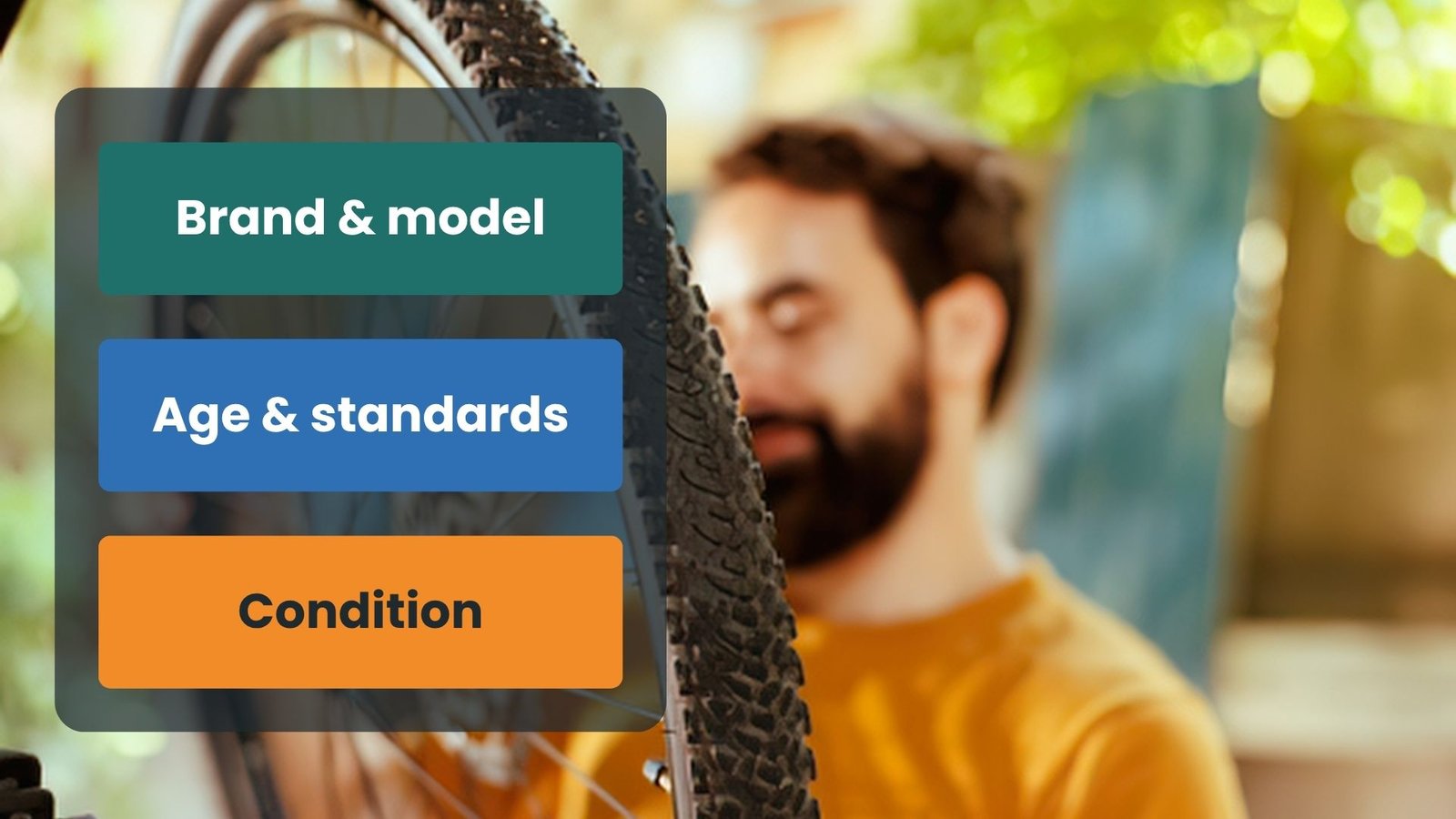
This mainly depends on three categories: your bike’s brand, its condition, and its age.
Brand and Model Demand
If you have a mountain bike from a good brand, like Trek, Specialized, Giant, Cannondale, etc., the shopkeeper will easily buy these bikes and will also give you a good resale value.
Whereas if it’s a generic bike, like a hardtail, they might not buy it, but they’ll easily buy Trek Marlin 5 and Specialized Rockhopper bikes.
There are many brands like Santa Cruz, Yeti, and Pivot, whose bikes sell very easily just because of their names.
Age, Wheel Size, and Standards
For example, if you bought a bike in 2020 with 29-inch tires and a 1x drivetrain, it will sell better than a bike you bought in 2015 with 27.5-inch wheels.
Even though your 2015 bike isn’t that bad, the biggest reason is that many parts for bikes sold in 2015 may no longer be available, and it will be a fairly outdated bike.
When the shopkeeper buys that bike, the buyer also thinks about where the next buyer will find its parts to upgrade it, or will someone buy it?
With a bike from around 2020, even if some parts are slightly damaged, the parts will still be available, so that bike will be easily sold.
Condition: Frame, Drivetrain, Suspension, Tires
Your bike’s frame, suspension, drivetrain, tires, and other components affect its price.
If your bike’s frame is damaged or has cracks, these things will be a liability for the shopkeeper.
So, either the shopkeeper will refuse to buy it, or if the parts can be replaced or fixed, they’ll offer you a much lower price
Then they’ll upgrade the other parts and sell it further.
Suspension is one of the biggest factors too.
Average Mountain Bike Trade-In Value: What to Expect
Entry Hardtails and Budget Bikes
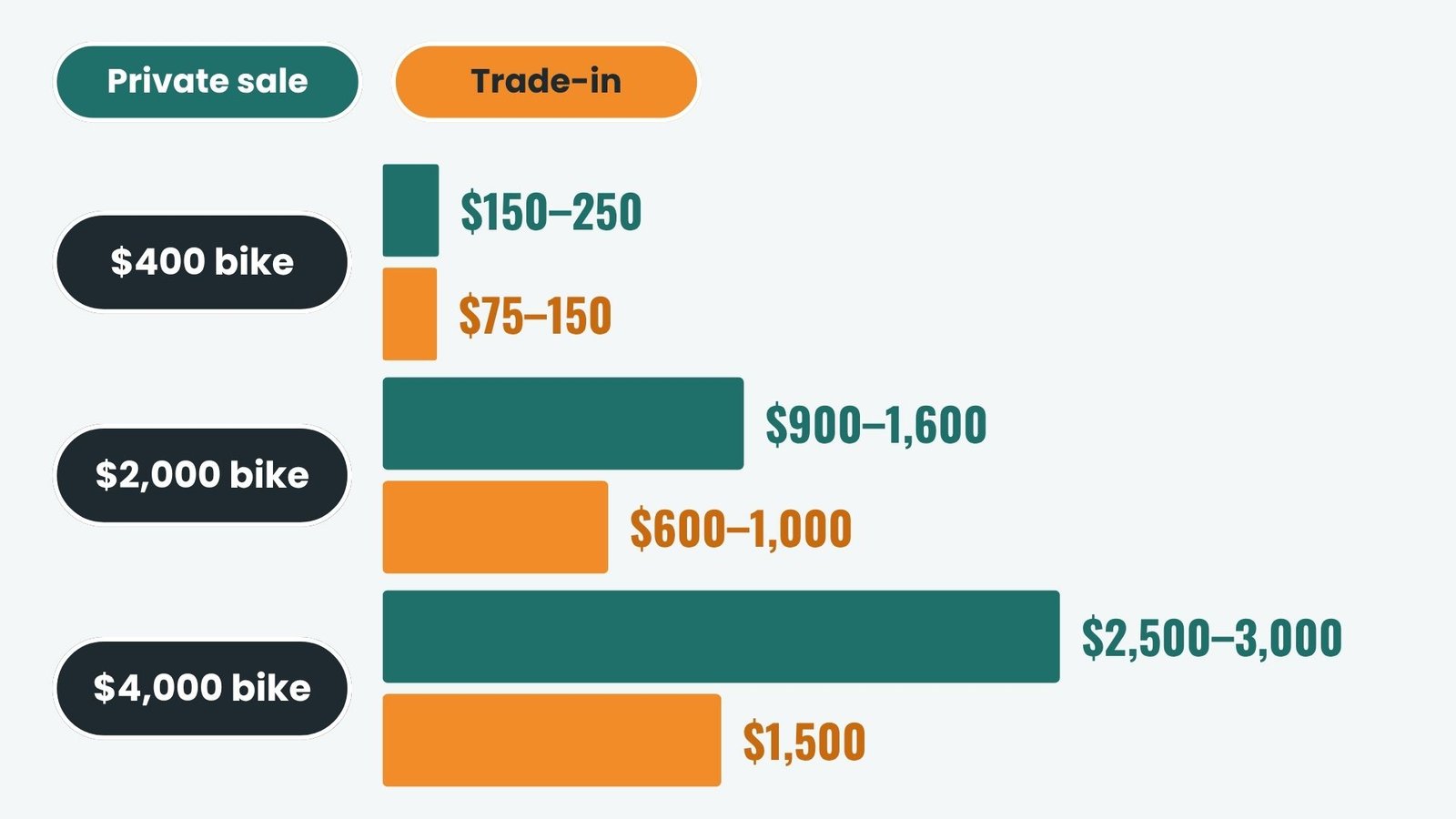
If you have a budget bike that you bought for $400, even if it’s in good condition, a shopkeeper will buy it from you for around $75 to $150 in a trade-in.
This would be the average value for a $400 retail bike.
But if you sell the same bike privately, you’ll get around $150 to $250, even when the bike’s condition is the same.
I’ve seen a lot of research and discussions in Facebook communities and so on, where people say that if they have to sell a bike for so little, they’d rather donate it or use its parts on another bike because the amount they’re getting is so low.
Mid-Range Trail and All-Mountain Bikes
If you have a decent mountain bike that’s used for trail riding, and you bought it for somewhere between $1,800 and $2,200 and it’s around two to three years old, you’ll get around $600 to $1,000 for it, depending on the brand, model, condition, etc.
But if you sell it privately, you’ll get around $900 to $1,600. You just need to list it in the right place.
High-End and E-MTBs
If it was a high-end bike, say a $4,000 full-suspension bike, you’d get around $1,500 for it.
This would be an average price, again depending on multiple factors.
But if you sell it privately, you could easily get $2,500 to $3,000.
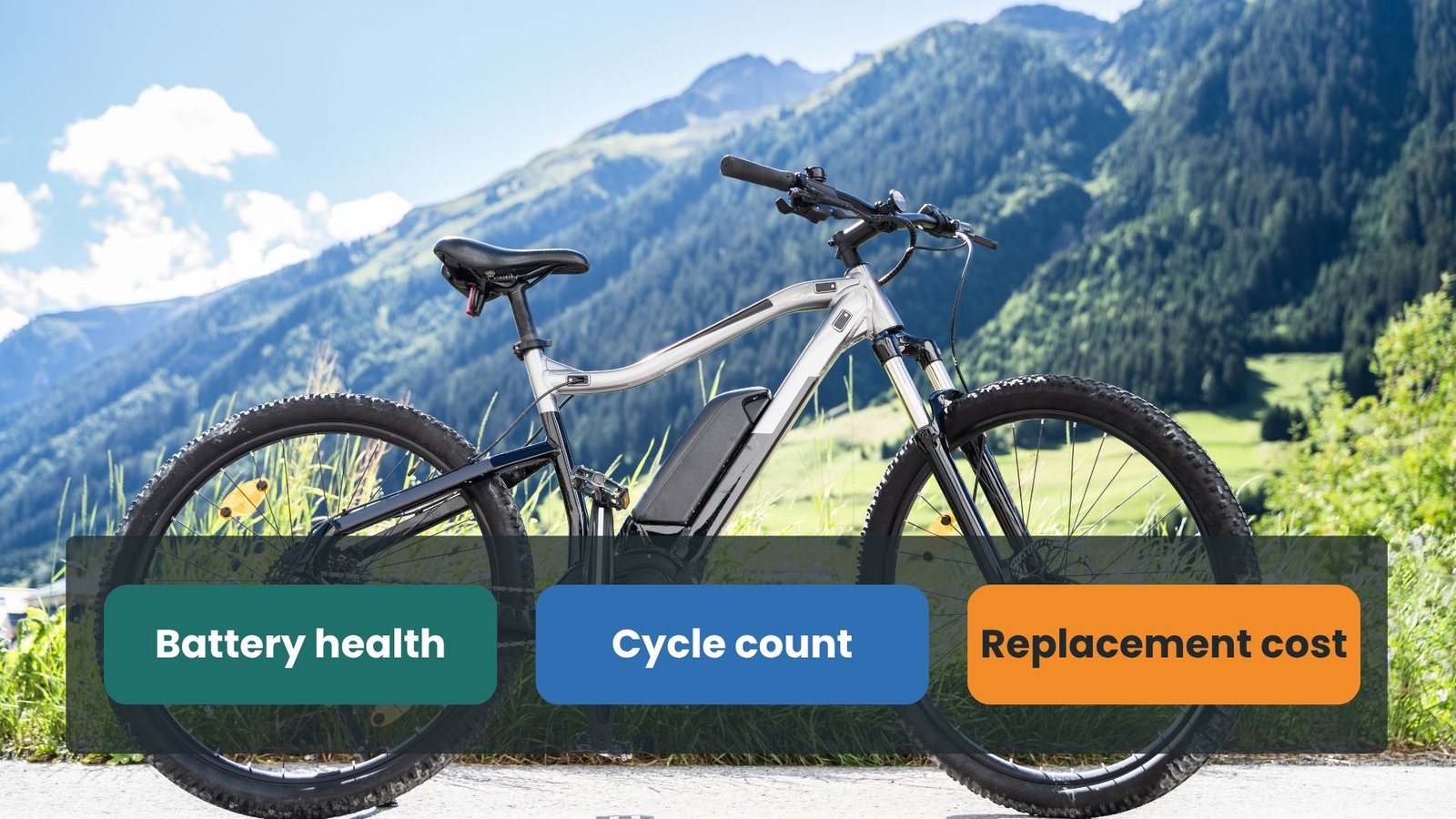
Selling a used E-MTB is more complex because of the battery health, cycle count, degradation, and what a replacement will cost the next buyer within a year.
Therefore, shops are cautious with e-MTBs.
Brand and Model: Trek, Specialized, Giant, and Others
Why Big Brands Get Better Trade-In Offers
The biggest reason why major brands like Trek, Specialized, Giant, and so on sell well is that shopkeepers know these brands have higher demand in the market.
If I buy one at a low price (The bike isn’t in much good condition), I will buy it, do all that servicing work and then sell it with a good profit margin.
Just like that, shops are confident about big brands bikes, that’s the biggest reason.
Model and Tier Matter besides the Brand
The tires and the upgrades you’ve made to the bike also matter a lot. Let’s say you bought a good bike: Santa Cruz.
Now the bike itself is good, but the upgrades you’ve made, like the tires, are from a second-tier brand. This will also reduce your bike’s value, even if it’s in very good condition.
The brand name is good, the logo and everything else are there, but the tires are causing problems.
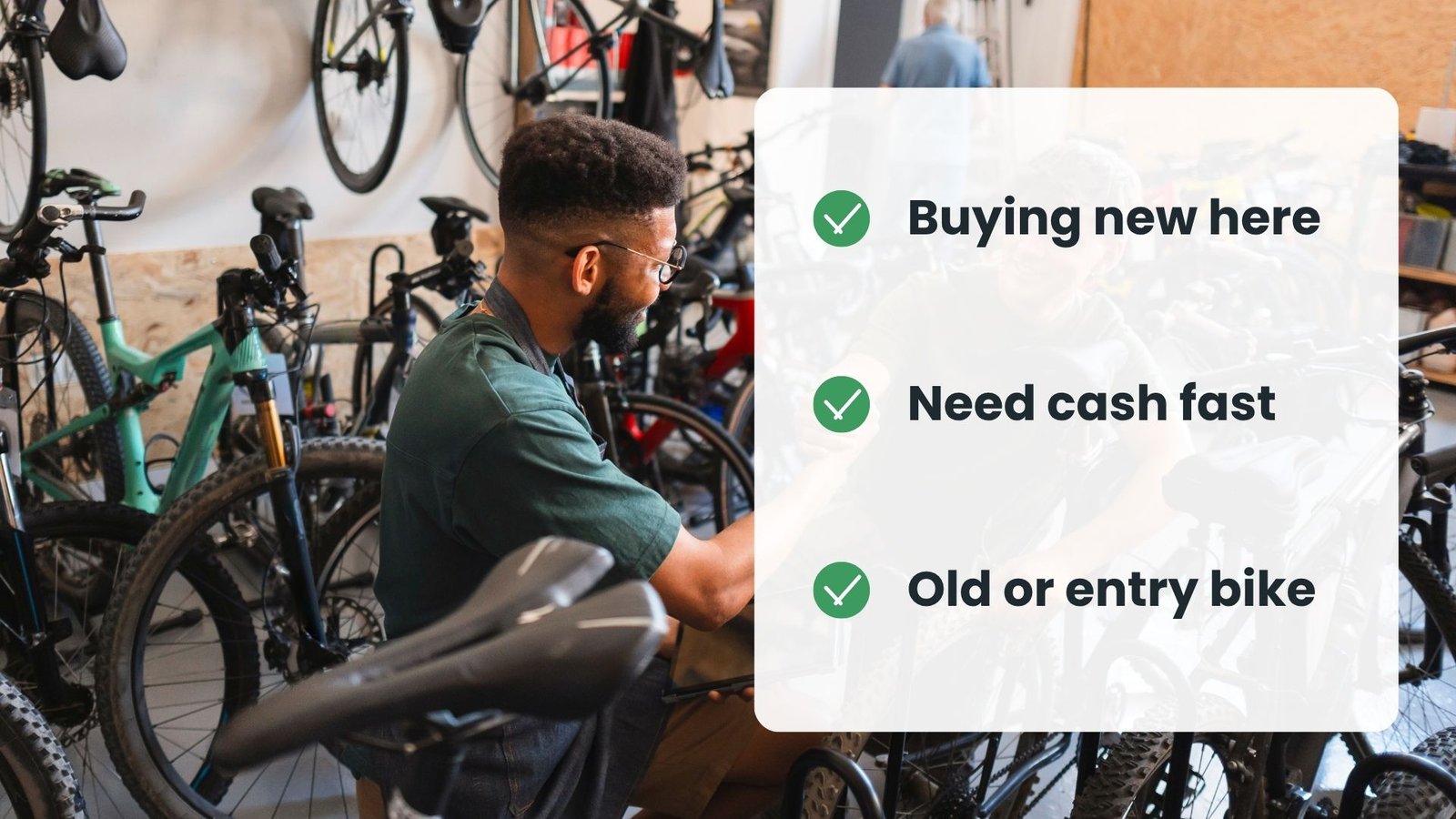
When Trading In Your MTB Makes Sense
You’re Buying a New Bike at the Same Shop
If you’re upgrading your bike, meaning you’re buying another bike from the same shop you want to sell your current bike to, then that’s fine. You can sell it to them.
Because the shop knows it’s making more profit.
First, they’re selling you a new bike, and on top of that, you’re buying it from them, so they’ll earn a margin on that as well.
In this scenario, they might give you a little more money because they’re making a profit from both sides, and they’ll keep that in mind.
From their perspective, if they don’t buy your old bike, you might not buy the new one from them either.
And don’t be surprised if they offer you a price that’s almost equal to what you’d get in a private sale. The chances are low, but it’s possible.
However, you’ll need to negotiate a bit, and you should know how to do that properly.
You Need a Quick, Guaranteed Sale
If you want to sell your bike privately, it will take time. You’ll have to list your bike and then ship it.
Let’s say you live in Texas and an order comes from California, so you’ll have to ship it there.
You’ll also have to handle packaging, choosing the right courier service, and a lot of other tasks.
But you’ll get a slightly better price, and you’ll have to wait until you receive a sale.
If you can’t do all this, you have an emergency, or you don’t really care about making more money, then that’s fine.
Just go to a nearby shopkeeper and sell your bike there.
Your Bike Is Old, Entry-Level, or Hard to Sell Privately
Sometimes, especially with entry-level bikes or other types of very cheap bikes, such as those that are very old or come from a very small brand, these bikes don’t sell online either.
Shopkeepers might not buy them offline either, but sometimes they do buy them, work on them, fix the body damage, make them look good, and then sell them.
So, they’ll give you very little money, but this is one way you can sell your bike. You can try online too.
How to Get the Best Trade-In Deal at a Bike Shop
Know Your Private-Sale Baseline First
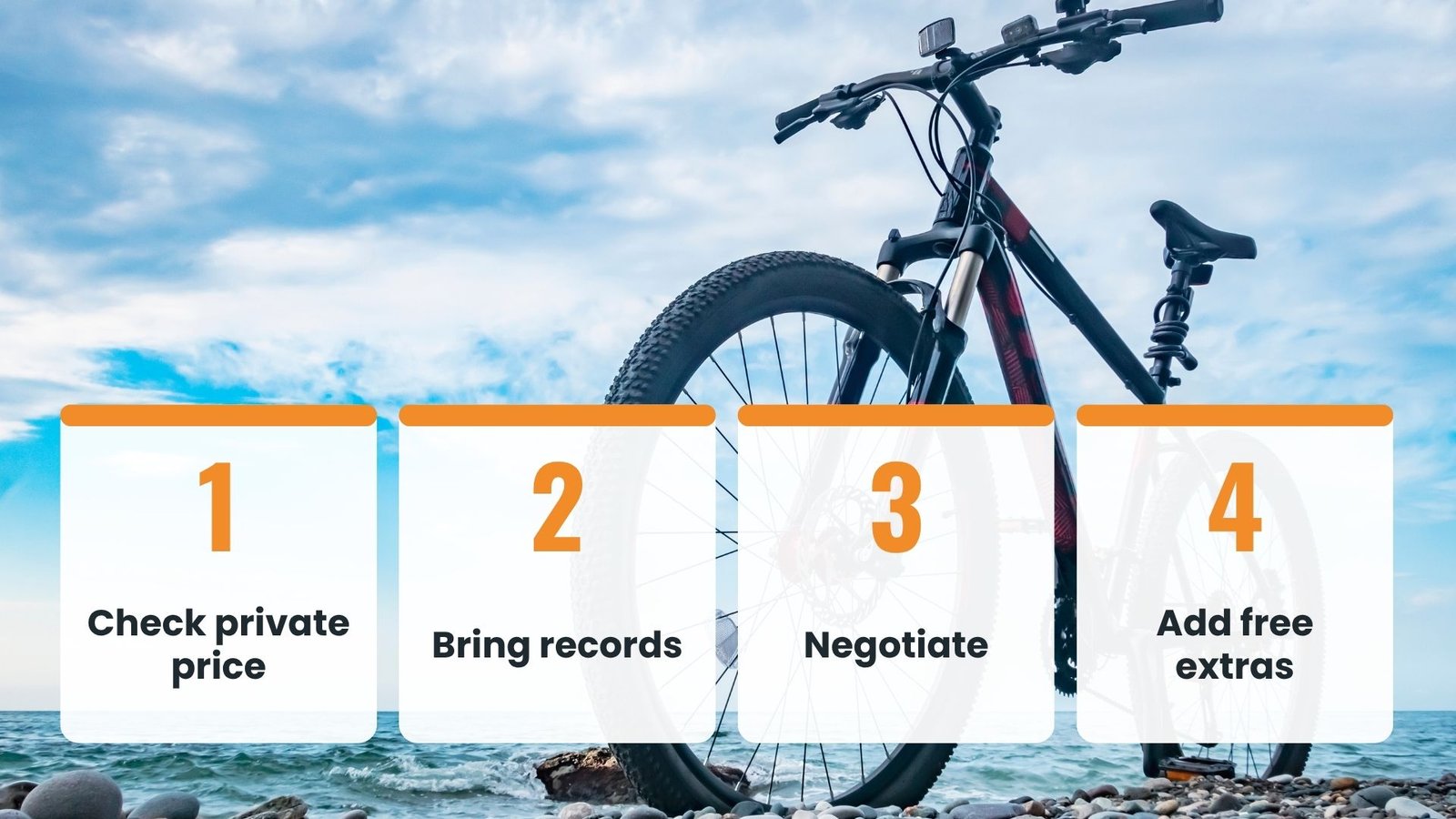
The first thing you should know is the value of your bike. For that, you can go to our Tools section and use the Bike Value Estimator Tool, which will tell you what your bike is currently worth based on the current market.
Once you know the value, you can list your bike on different platforms, like Facebook Marketplace, Pinkbike, etc.
If you use our tool, make sure you provide all the details properly, including your bike’s condition, brand, model, upgrades you’ve made, when you want to sell it, how old the bike is, and all the other things it asks you about.
Bring Records, Receipts, and Upgrade Info
Whether you sell offline or online, if you have the service history, original purchase receipt, and documents related to the upgrades you’ve made, these will increase your bike’s value.
Even if they don’t increase it by much, they’ll make it much easier to sell your bike.
The things I’ve mentioned, like service history, purchase receipts, etc., help build trust.
Negotiate the Deal
When you’re listing your bike, let’s say you’ve used our tool to find out its estimated value.
Then, when you list it and write the description, you can set a higher asking price.
For example, if your bike is worth $1000 and the tool estimates its value at around $600, you can list it for $800 and mention in the description or somewhere else that the price is negotiable.
In such a case, when someone approaches you and negotiates, you can reduce the price from $800 to $750, or even $700.
You already know the estimated value of your bike, if the buyer don’t agree, that’s fine.
You can still sell it for $600.
But if you started at $800 and brought the price down to $750, you would still have made around $150 in extra profit.
Apart from this, you can also offer some additional benefits, like including a helmet with the bike. You can factor its cost into the price, but in the description, you just need to write that it’s free with the bike.
Give Something Free to Attract a Buyer
Let’s say the estimated value of the bike is $600, and the helmet costs $50. You can list the bike for $650 (non-negotiable) and write that the helmet is free with the bike, even though you’ve already added the helmet’s price to the total.
This is a technique many companies use, so you can use it too.
Mountain Bike Trade In Near Me: What to Do and Expect Locally
Call Shops Before You Visit
The easiest way to find a buyer for your mountain bike, particularly a shop, is to go to Google and check which shops near you trade in mountain bikes.
And an even more important thing is that once you find them, call them first and ask whether they buy bikes, whether they’ll give you cash or store credit, and what they can offer you.
You can also find out the estimated value of your bike beforehand.
See what they’re offering, and then think about whether you can negotiate that price.
You can get the rest of the information by visiting the shop.
But I don’t want you to load your bike into your car, drive to the shop, sell it for a very low price, and then come back home.
I want you to find out beforehand, and not just from one shop.
Check with multiple shops and ask each of them the same questions.
Tell them about your bike, ask how much they’ll pay for it, and find out whether they even buy that type of bike.
Then, wherever you feel they’re offering you more money and you can negotiate the price up or down, go there.
Store Credit vs Cash:
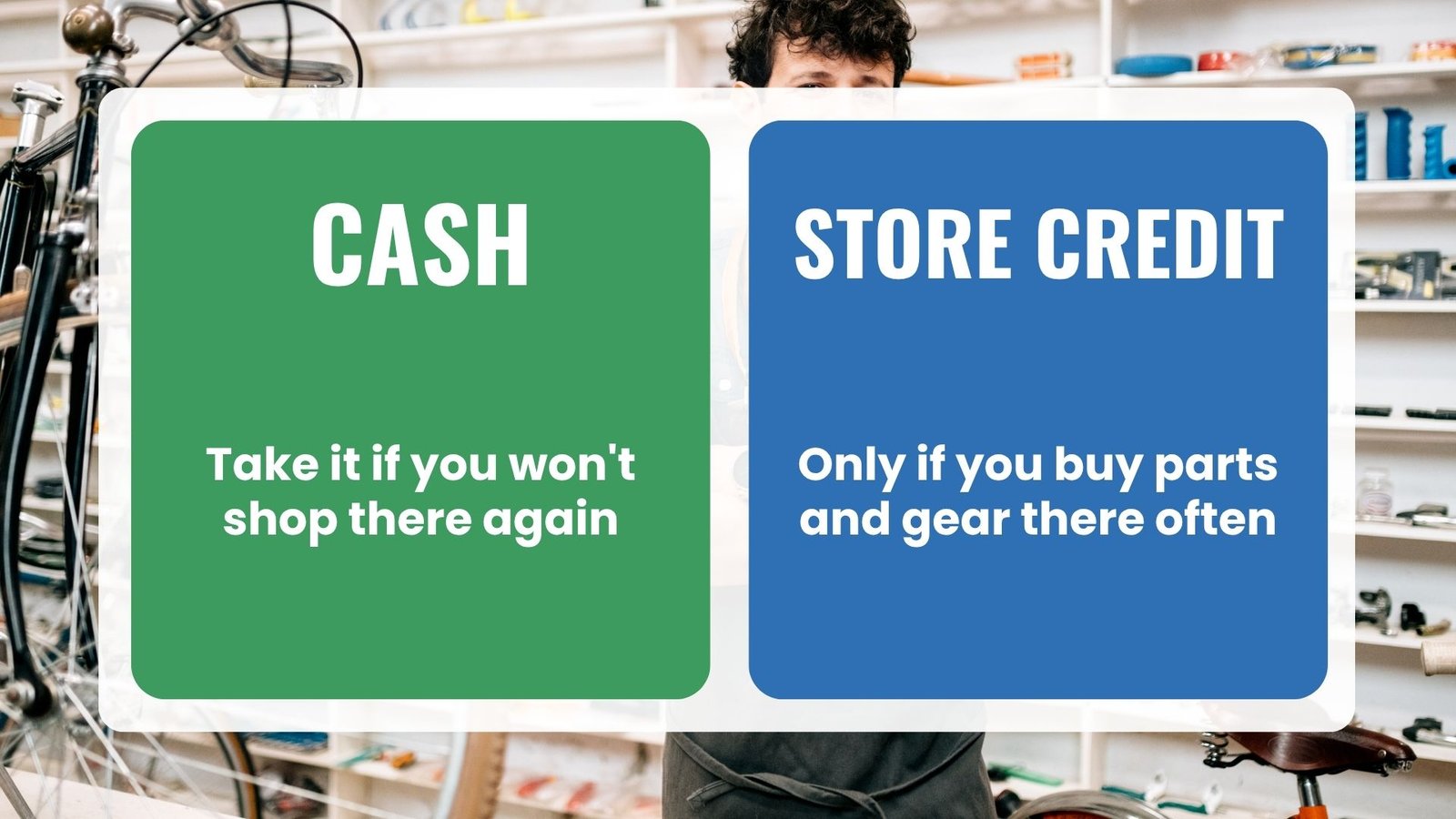
One important tip to remember is that you should only accept store credit if you regularly buy accessories or something else from that shop.
Otherwise, just take cash, because if you’re not going to buy anything, what’s the point of getting store credit?
Small MTB Shops vs Big Chains
If you go to a big chain, they won’t offer you as much value as a small MTB shop might, because smaller MTB shops understand mountain bike values better.
Whether it’s a mid-range bike, a high-end bike, or something else, general cycling chains don’t understand these bikes as well.
Even if they do, they won’t give them that much attention.
Smaller shops know the local demand well.
The disadvantage I see with both is that large chains have greater buying power and more flexibility, while smaller MTB-focused shops are more agile.
In my opinion, my first recommendation would be a small MTB shop. I’d check there first, then I might also visit a larger chain.
After confirming the offers from both, I’d sell the bike wherever I felt I was getting the best deal.
Common Trade-In Mistakes That Cost Riders Money
Walking In Blind, Without a Private Baseline
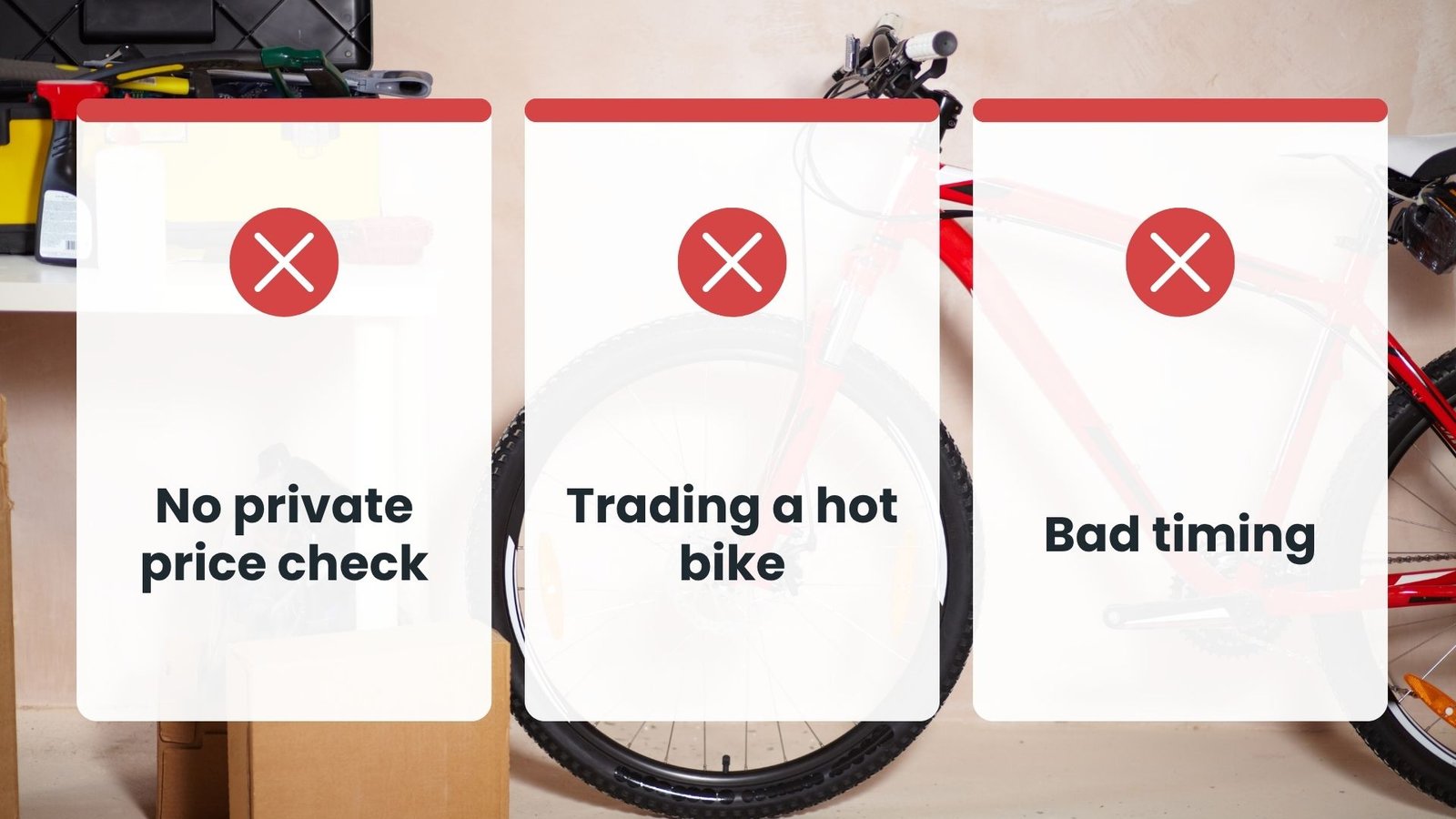
The biggest mistake a mountain biker can make is going to a nearby shop to sell their bike without even knowing what the bike is actually worth at the current time.
So, what I’d recommend is that you first use the Mountain Bike Estimator to find out your bike’s value.
Apart from that, check listings on different platforms as well.
Although there are many best ways to sell a mountain bike, you can check some major platforms like eBay, Facebook Marketplace, and other places for the same bike you’re planning to sell.
This will give you an idea of its price, and then you can proceed accordingly.
Otherwise, if your bike’s baseline value is $700 and a shop offers you $200 for a trade-in, you might accept it, or at most, negotiate an extra $50 and trade it in for $250.
You might feel that you’ve done really well, even though better options were available.
But you didn’t figure that out because you hadn’t done your research, so you ended up taking a loss.
That’s why you should first have complete information about how much your bike is worth and how much you want to sell it for.
Trading In a Desirable Bike Just for Convenience
Whenever you’re planning to sell your bike, list it online well in advance, one, two, or even three months beforehand.
And when you get a good offer, sell it. If your deadline is approaching, lower the price.
Initially, you can also set a higher price.
Let’s say your bike is worth $700, so you list it for $800, If it sells, great, If not, that’s fine, you can reduce the price later.
Don’t ignore Timing and Market Conditions
If you don’t sell your bike at the right time, meaning when there’s demand in the market, then you’ll miss out on a better price.
If you sell your bike during early summer or spring, you’ll get a good price.
But if you try to sell it in late fall or during the winter season, shops will already have a good amount of stock, so they might not offer you as good a price because they’ll already have plenty of bikes sitting in their inventory.
You can check out one of my guides on this. I’ve discussed the best time to sell a mountain bike in it.
I’ve explained everything properly, and if you follow the guide, you’ll definitely make more money.
FAQs: Mountain Bike Trade-In Value
How much is my used mountain bike worth?
To find out what your mountain bike is worth, use the Mountain Bike Estimator.
Just keep in mind that the trade-in value will always be lower than the private sale value, and the exact value of your bike will depend mostly on its condition, model, brand, and market demand.
Depending on the bike’s original price, it might sell for 30%, 40% or 50% of that price, or some other amount.
I can’t tell you an exact amount, but this is a rough idea: the older the bike is and the worse its condition, the cheaper it will sell for.
Where is the best place to sell my mountain bike?
In my opinion, the best way to sell your bike is through a private sale on Pinkbike, local MTB Facebook groups, or Facebook Marketplace. You’ll get a good price there.
Apart from that, if money doesn’t matter much to you and you just want to get rid of your bike, you can also go for a trade-in.
You’ll get the money quickly, but the amount will be lower.
However, you’ll get something for it.
Local classifieds are also a good option, you can try selling your bike the ass we well.
But in my opinion, selling online is the best option.
How to determine the value of a mountain bike?
To determine your mountain bike’s value, you can start with its original MSRP and deduct around 40% to 60%.
It also depends on the condition, as I’ve mentioned several times before.
The older the bike is and the worse its condition, the more its value will decrease.
The better its condition, the higher its value will be. Keep market demand in mind as well.
How to check how much a bike is worth?
To check how much your mountain bike is worth, you can check the Mountain Bike Estimator, Mountain Bike Value Estimator, Pinkbike, and so on.
If you use an estimator, you’ll need to provide details about your bike’s condition, year, model, timing, and so on, and you’ll get an estimated value.