If you can park your car in the garage, that’s good. If not, you know there is something that has to change.
My aunt has a two-car garage, and she keeps both cars in it.
That sounds obvious, but it is genuinely impressive because the garage also holds her daughters’ old toys, old boxes, tools, sports stuff, and some things that belong to my cousins.
So there is plenty of accumulated stuff. And the garage still does not feel too.
And what she did was cheaper and more practical than most of the advice you will find online.
This article covers how garage organization on a budget actually works, starting with the part everyone wants to skip.
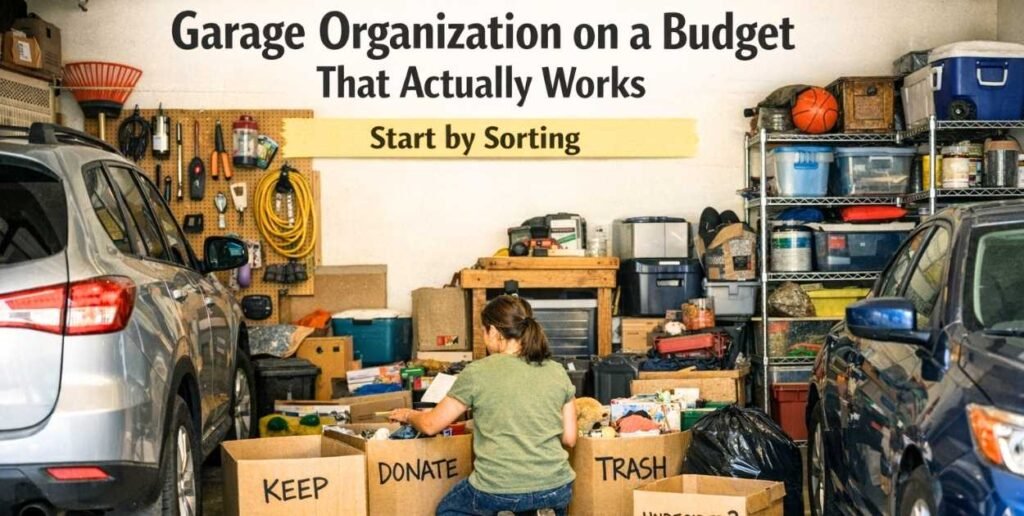
Start by Sorting

The biggest mistake people make is buying storage before they know what they are storing.
You end up with bins that are the wrong size, shelves that do not fit the wall, and hooks that have nothing to hang.
My aunt figured this out. The first time she tried to organize the garage, she bought a bunch of stuff and then realized half of it did not work for what she actually had.
So the real first step is sorting, and the classic four-category method works:
- Keep: things you use, things you know you will use
- Donate or sell: things that are in good shape but not yours to keep
- Trash: things that are broken, rusted, or expired
- Undecided: a small pile you will come back to in 30 days if you need to
The undecided pile has to stay small. If half your garage is undecided, that is just keeping with extra steps.
My aunt’s rule for her daughters’ old toys is simple: if the eight-year-old has not touched it in a year, it goes.
You can adjust that timeline, but you do need one; things just sit forever.
Do not try to sort the whole garage in one afternoon if it is very full.
Do it in sections, like one wall or one corner at a time.
Use the Wall Space You Already Have
Floor space in a garage fills up fast; it’s a place where cars go, where you walk, where things get dropped.
The wall is where you get your space back, and it does not cost much to use it.
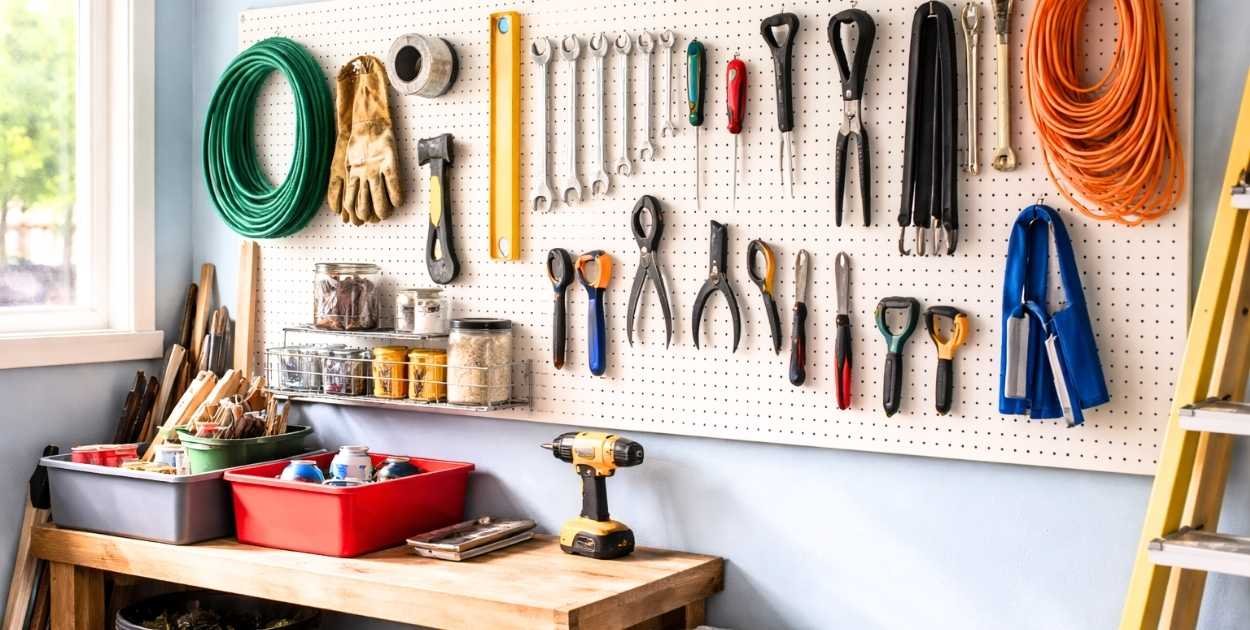
My aunt put up a pegboard on one wall. It was not a fancy kit.
She found an inexpensive one and got her husband to mount it over the weekend.
On it she hung garden tools, extension cords, her kids’ jump ropes, and a small basket for random items that kept ending up on the floor.
Everything visible, everything reachable, nothing taking up floor space.
If you do not want to drill into walls, there are still options.
Freestanding shelving units from discount stores can be set against a wall without any installation.
They are not as sturdy as mounted shelves, but they work for lighter items like bins of seasonal decorations, sports equipment, or camping gear.
You can also find these secondhand on Facebook Marketplace or Craigslist for almost nothing if you are patient.
A few wall storage ideas that stay cheap:
- A single row of heavy-duty hooks for bikes, hoses, or tools
- A pegboard section for hand tools and cords
- Wire shelving mounted at head height for things you do not access often
- Magnetic strips for small metal tools like screwdrivers
You do not need all of these. Pick what matches what you actually have too much of.
Create Zones So the Clutter Has Somewhere to Land
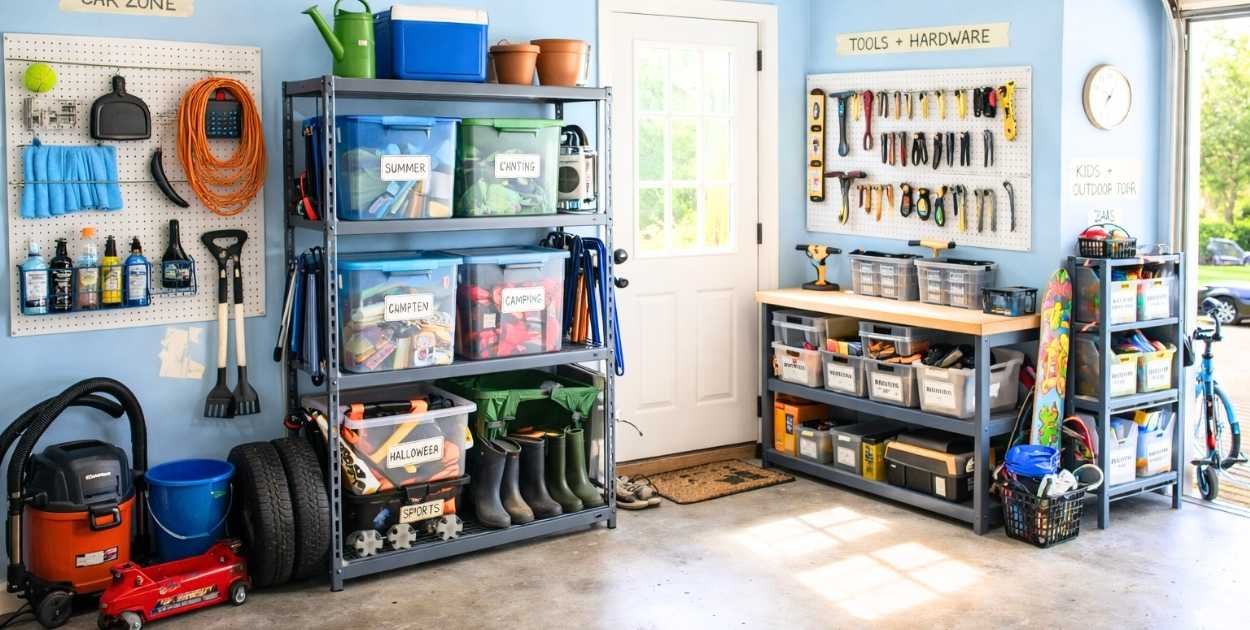
One thing my aunt does that I did not fully understand until she explained it: she has zones. The left wall near the door is car stuff, the back wall is tools and hardware, and the shelving unit near the side door is seasonal and kids’ outdoor things.
Also, she keeps changing it.
Why does zoning matter on a budget?
Because without it, things go back in random spots, and the whole thing falls apart within a month.
Zoning gives every item a destination. When my younger cousin tosses something into the garage, at least it goes near the right zone.
You do not need to buy anything to create zones; you can use:
- Painter’s tape on the floor to mark off areas while you figure out what works
- Different colored bins for different categories
- Simple handwritten labels on whatever containers you already have
The zones should reflect how your household actually uses the garage, not some ideal version of it.
If your kids always drop sports stuff near the door, make that the sports zone, work with the habits, not against them.
Cheap Storage That Actually Works
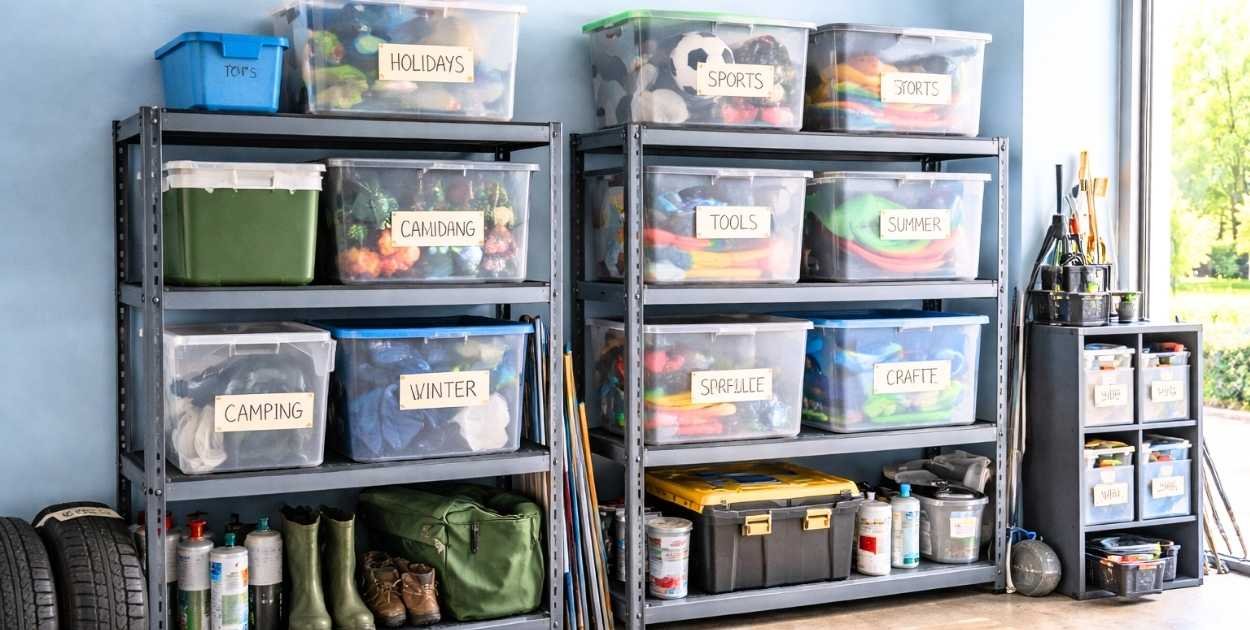
You do not need to spend a hundred dollars or more on garage storage systems. Here is what works at a low cost:
Plastic bins with lids
These are the workhorses of any garage.
The dollar store and discount stores sell them cheaply; you can label the outside with masking tape and a marker and stack them on shelves.
The lid matters because garages get dusty and sometimes damp.
My aunt keeps bins of seasonal stuff (winter items stored in summer, summer items stored in winter) stacked in the back and just swaps them out twice a year.
Repurposed containers
Coffee cans and glass jars for screws, nails, and small hardware.
Old magazine holders mounted sideways for storing spray cans upright.
Shoe organizers hung on a wall for smaller items.
These cost nothing if you already have them.
Free shelving
It takes patience, but it is real; people give away shelving units regularly on Facebook Marketplace, Nextdoor, and Craigslist.
However, the catch is transport.
If you do not have a truck or a large vehicle, you may need to recruit someone.
But the shelves themselves are often free and sturdy.
Dollar store baskets and bins
For smaller zones, dollar store wire baskets or bins work fine.
They are not going to last forever, but they last long enough to be worth the price.
Use them for gloves, rags, extension cords, or any category of small things that tend to pile up.
The Stuff That Keeps Coming Back In
The garage gets re-cluttered because you keep adding to it without removing anything.
My aunt deals with this because her household is big.
She has her own family, my cousins visit and leave things, her daughters grow out of toys and equipment, and many things from the house shift into the garage.
Her approach is not a strict rule, but it is more of a habit.
A couple of times a year, usually before winter and before summer, she spends an hour or two going through the undecided things and the zones that have gotten loose.
She does not do a full reorganize every time.
She just clears out the obvious stuff that does not belong anymore and puts things back where they go.
That is what keeps a garage from getting back to square one.
If Your Garage Is Very Small or You Have No Wall Space
A lot of the advice out there assumes a two-car American garage with high ceilings and bare walls.
That is not everyone’s situation; if your garage is small, shared, or has pipes or windows breaking up the wall space, adjust accordingly.
For a small garage, your goal is floor clearance above everything else.
You want to be able to walk through it and, if you have a car, get in and out of the car without squeezing.
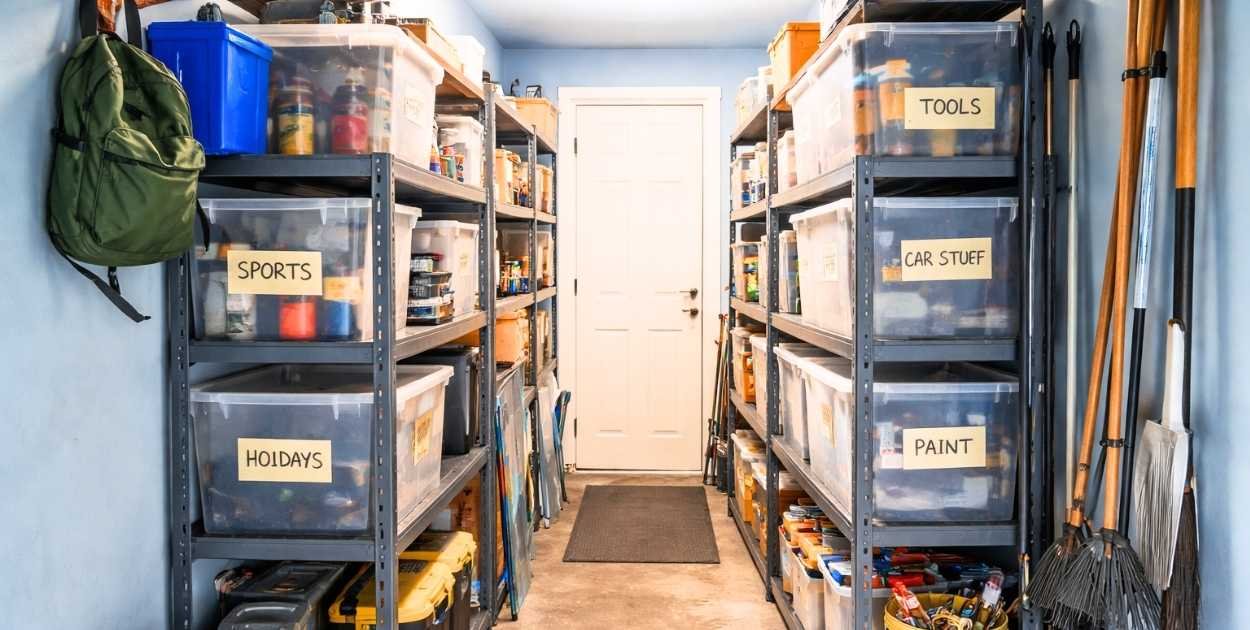
That means anything that can go vertical should go vertical.
Tall freestanding shelves over wide ones.
If you cannot mount anything on the walls at all, whether because you rent or the walls are cinder block or the landlord says no, a good freestanding shelving unit on casters is worth buying.
You can move it when you need to; it does not require tools to install, and it gets a significant amount of stuff off the floor.
For renters specifically, Adhesive hooks rated for heavier weights have gotten better, and they are removable.
They will not hold a bike, but they can hold a coiled garden hose, lightweight bags, or small tools.
Wrapping Up
A garage that works does not have to be a showpiece. My aunt’s garage will never be on a home organization blog with perfect lighting and coordinated bins.
But both cars fit in it; you can find the tools when you need them, and the kids’ stuff has a place.
Start with sorting, use the walls, and create rough zones that match how your household actually behaves.
Spend a little on bins and hooks where it helps, and find the rest secondhand or repurpose what you have.
And revisit and fix it twice a year before it gets completely out of hand again.
Few Questions with Answers
How do I organize my garage without spending any money at all?
Honestly, the sorting step alone will help you a lot. You can get rid of what you do not need, move things into rough zones using what you already have as containers, and put the most-used things at eye level or near the door.
You can label existing bins with masking tape.
That costs nothing, and the results will not look like a magazine, but the garage will be easier to use.
Can I store a car in a cluttered garage?
Maybe, depending on how cluttered. But if you have to suck in your breath and squeeze past stuff to get in and out of the car, that is going to wear on you.
The zone approach helps the most here because you are specifically protecting the area the car needs.
Clear the car zone first and work outward from there.
What if someone in the household keeps adding clutter no matter what?
This is real, and it happens in most households, not just ones with kids.
The best partial fix is giving that person or those people a zone.
Not the whole garage, but a shelf or a corner that is theirs.
People are slightly more organized with their own designated spot than with a general shared space.
Do I need a label maker?
No. Masking tape and a marker do the same thing.
The label maker just makes it look cleaner. The function is the same.

Abraham is the creator of Mountain Bike Insider. He is a writer and researcher who enjoys mountain biking, working on DIY projects, organizing spaces, and testing ideas in real life. He focuses on clear and honest explanations based on experience and research, without pretending to be a professional expert.