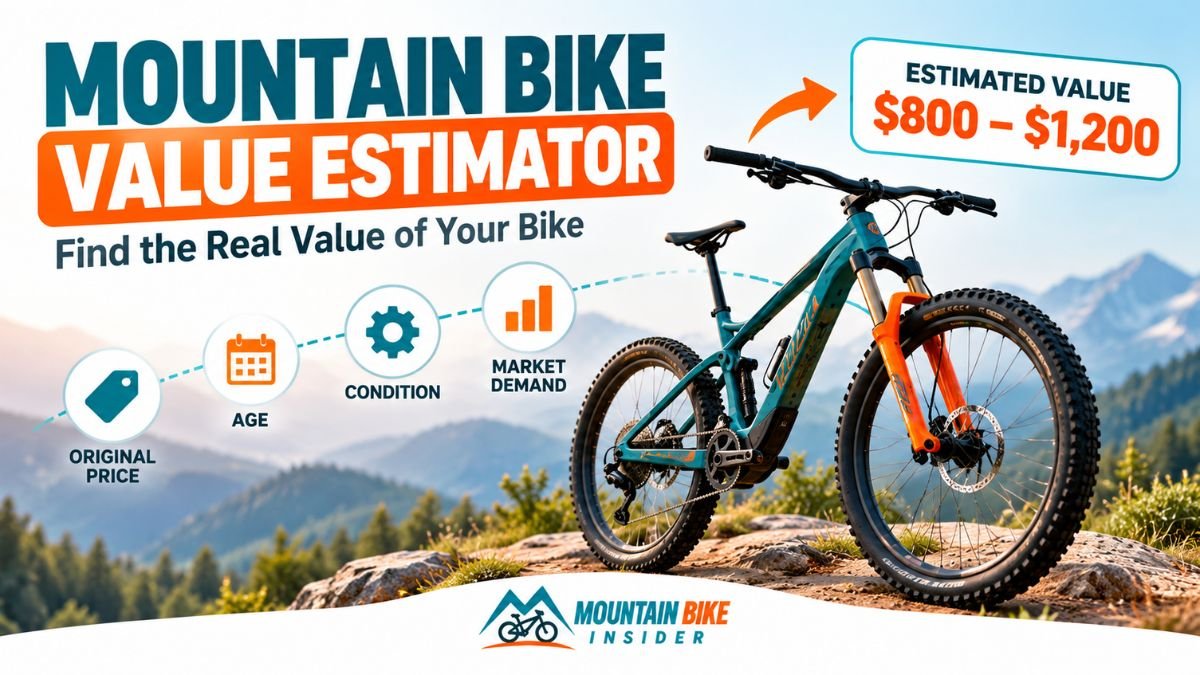
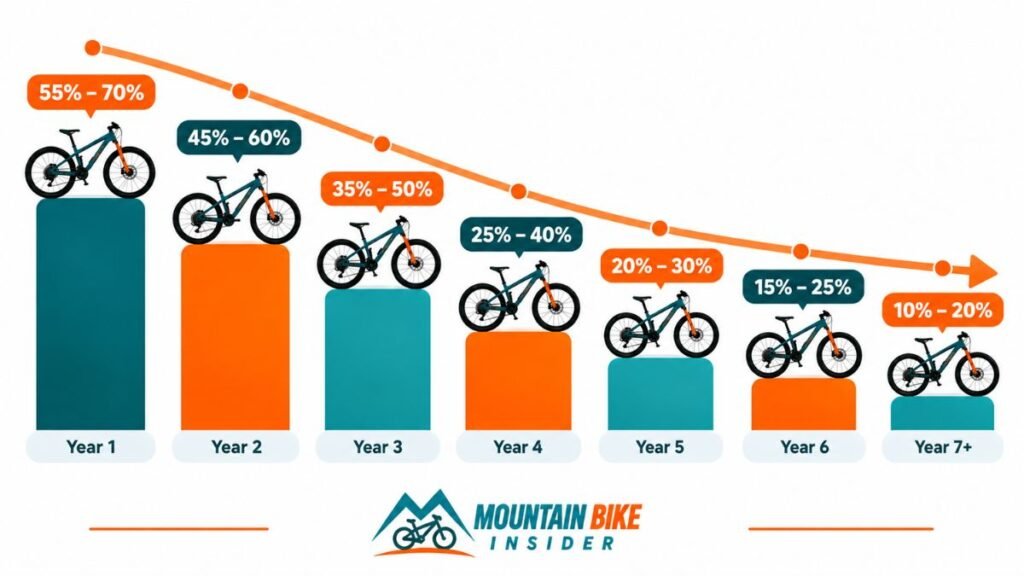
Your mountain bike’s value is roughly 55 to 70% of what you paid for it if it is 1 to 2 years old and in excellent condition.
By 3 to 4 years old in good condition, an MTB drops to 40 to 55% of its value, while at 5 to 6 years, you are looking at 25 to 40%.
And after 7 years, the worth of your mountain bike depends on the brand, condition, and the current market prices.
However, these percentages are the starting point; the exact number depends on your specific bike, what you have upgraded, and when you are selling.
Use the used mountain bike value estimator below to get a more accurate estimate for your situation when you check how much is my mountain bike worth.
What Is My Mountain Bike Worth Right Now
If you want a quick number before the details, here is a simple guide by age and condition for used mountain bike value:
- 0 to 1 year old, excellent condition: around 55 to 70% of original price
- 2 to 3 years old, good condition: around 40 to 55%
- 4 to 6 years old, fair to good condition: around 25 to 40%
- 7 years and older or poor condition: often under 20%, unless it is a premium or collectible model
Four things adjust these numbers up or down:
- Brand and model
- Specifications Level
- Upgrades that you’ve made
- Age of your MTB
How a Used Mountain Bike Value Calculator Works

Most online bike calculators are too simple, and they’re not dedicated to MTB; instead, they’re for motorbikes, bicycles, etc.
They ask for your bike’s age and original price, apply a flat depreciation percentage, and give you a single number, and the problem with it is that flat depreciation ignores too much.
Reality: A 3-year-old Santa Cruz Hightower and a 3-year-old entry-level hardtail are not worth the same percentage of their original price, even though both are 3 years old.
But a good used mountain bike price estimator, like the one you’re using by Mountain Bike Insider, accounts for more:
- Original price
- Age
- Brand tier
- Spec level
- Condition grade
- Meaningful upgrades.
- And many other factors
Even with all that, the result is a range, not a precise figure; your actual selling price will also depend on your local market, the platform you use, and the buyer you find.
So use the estimator as your anchor, then cross-check with sold listings for your MTB’s specific model to get a precise number when you check how much is my mountain bike worth.
How to Price a Used Mountain Bike Step by Step (MTB Resale Value)
Find the bike’s original price
Start with the manufacturer’s suggested retail price, not what you personally paid.
Buyers use MSRP as their reference when they research the model, so that is the anchor for depreciation.
If you do not have the receipt, check the brand’s product archive or search for old reviews of that exact model and year.
You can use Pinkbike, Vital MTB, and other major retailer archives; they often have historical pricing.
A 2021 Trek Fuel EX 7 at $2,799 and a 2021 Trek Fuel EX 9.8 at $6,799 are completely different starting points, even though they are the same bike family; that’s why I recommend you always start with MSRP when estimating used mountain bike value.
Use your MTB’s age Factor
Bikes age in two ways: physically through wear and tear, and technically through changing standards.
If your bike has a wheel size, axle standard, or geometry the market has moved away from, buyers factor that in.
A 2020 bike with current geometry can be worth more than a 2022 bike built on a platform the brand has since redesigned.
Buyers are thinking about what they will be working with for the next few years, not what you paid when you bought it.
Categories: bike’s condition
It’s hard to look at your own bike without some bias; consider these factors when judging your MTB resale value:
- A Mountain Bike is considered new if it’s 6 months old with minimal use and components barely touched, which is rare.
- Excellent is clearly ridden but well-maintained, with no frame damage, and suspension in good health.
- Good is normal ride wear, small scratches, chain at 40 to 60% life, and tires usable but showing hours.
- Fair is visible wear across most components, with tires or drivetrain approaching end of life. Poor needs work before it rides properly.
So, before you list:
- Check the frame for cracks or dent damage
- Use a chain checker on the drivetrain
- Inspect brake pad thickness and rotor condition
- Check tire tread and sidewall wear
- And test for play in the headset or pivot bearings.
See the brand reputation and components.
Quality components push the number up:
- Shimano XT or XTR, SRAM GX Eagle or higher
- Fox or RockShox mid-to-high forks
- Four-piston brakes
- A dropper post
- Quality wheels
These are all things experienced buyers look for.
Besides this, entry-level components across the board, outdated geometry, an unpopular wheel size, or a brand without an active used market push the number down.
So, you want to be honest with yourself about which side your bike is on before setting a price.
See if you had upgrades
You can expect to recover 30 to 50% of what you spent on major upgrades like wheels, fork, rear shock, or brakes, and only when those parts are quality options in good condition.
For a dropper post on a bike that did not originally come with one, you might recover 25 to 40%.
For handlebars, stems, saddles, pedals, and grips, you’ll recover basically nothing because buyers treat those as personal preference items.
The smartest move if you have upgraded your bike is to reinstall the original stock parts before selling and sell the aftermarket parts separately; by doing so, you’ll make more money when you sell your used MTB.
Cross-check the asking price against the market
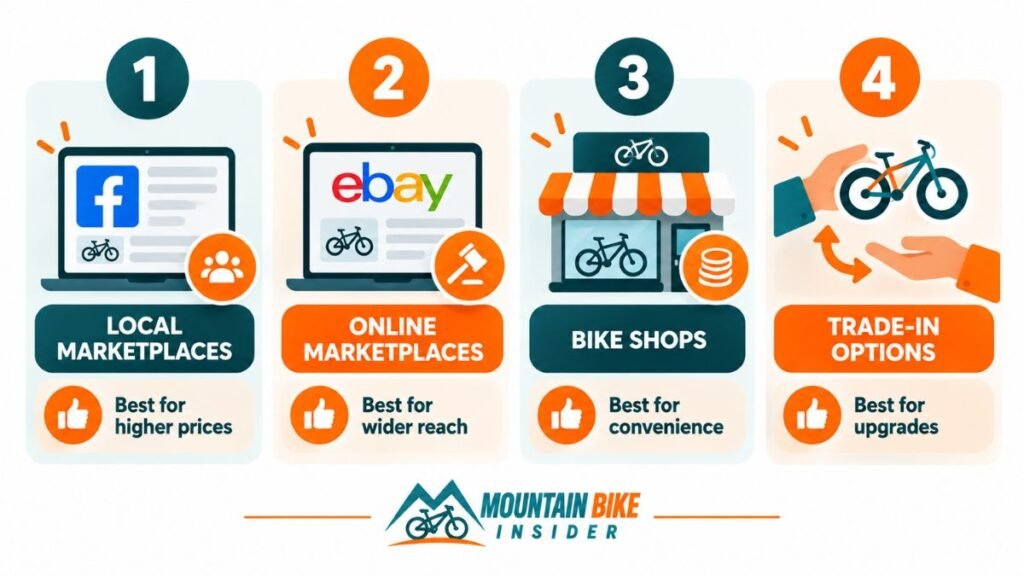
Look up your mountain bike model and year on Pinkbike Buy/Sell, eBay with the sold listings filter on, and local Facebook MTB groups.
Find 3 to 5 comparable bikes in similar condition and spec.
Drop the obvious outliers:
- The one priced too high that has sat unsold for months
- The suspiciously cheap one that probably has something wrong
And then price in the middle of what remains.
Tip: Sold listings on eBay are useful because they show what buyers paid, not what sellers hoped for.
Mountain Bike Depreciation Explained
Mountain bike loss of value in the first year
In the first year, most mountain bikes lose 25 to 45% of their original value, even in excellent condition.
Buyers want a discount for taking on the second-hand bike uncertainty, and a fresh used bike competes directly against new bike deals.
So if a bike that cost $2,000 new is typically worth $1,100 to $1,500 in year one.
From year two to year three, depreciation slows to around 10 to 20% per year on top of where the bike landed after year one.
High-end bikes above $4,000 often retain a slightly higher percentage because their component quality is better and the premium used market is active.
On the other hand, entry-level bikes under $1,000 can go the other direction.
By year four or five, buyers in that price range often just buy a cheap new bike instead of dealing with the unknowns of an older used one, which collapses demand.
Depreciation after year four
After year four, the depreciation rate slows and condition starts to matter more than age.
A well-maintained 5-year-old enduro bike from a reputable brand will be worth more than a poorly maintained 3-year-old bike from the same brand.
That’s why documented maintenance history makes a difference at this age.
Buyers ask about suspension service dates, pivot bearing condition, and component life remaining.
By year seven and beyond, most bikes are in budget-beater territory, except for certain steel hardtails or limited-edition models that hold value for other reasons.
What makes a bike depreciate faster than it should
- Frame impact damage is the biggest factor; even if the bike was repaired and rides fine, buyers won’t pay full price for structural uncertainty.
- Suspension that has not been serviced is another red flag, because the buyer knows they are inheriting that cost.
- Obsolete wheel standards like 26-inch limit the buyer pool to very specific niches.
- For e-MTBs, aging batteries are a major issue because replacement can run $500 to $1,000 or more, and buyers subtract that from their offer immediately.
Mountain Bike Resale Value by Brand and Type
Mountain bike brands that hold their value best in 2026?
Premium brands with strong trail and enduro reputations hold value best, such as Santa Cruz, Yeti, Ibis, high-spec Specialized, and performance-oriented Trek and Giant models.
But the model and specific tier matter more than the brand name; for example, a Trek Marlin and a Trek Slash are both Trek bikes, but they sell very differently.
Plus, popular mid-range models from well-known brands sell faster than obscure high-end bikes, because if buyers cannot research the model easily, they hesitate and either disappear or lowball you.
Used Hardtail or full-suspension bikes sell better
Hardtails sell well at the entry level because buyers feel less risk, as they don’t care a lot about rear suspension pivots, shock service, extra complication, etc., so these things make them an easier sell.
Full suspension bikes hold higher value because of the original price, but they depend much more on service history and suspension condition.
A full-suspension bike with neglected suspension is harder to sell than a clean hardtail at the same asking price, because the buyer knows what they are taking on.
Is an e-MTB harder to sell second-hand?
Yes, mainly because of the battery: how degraded is it, what range does it still have, and what will be the cost of replacement?
For e-MTBs over 4 years old, the battery is always a negotiating point, and you should be ready to discuss it.
Besides this, motor system support also matters.
Bosch, Shimano EP8, and Brose have wider support networks than smaller proprietary systems, and buyers factor that into their offer when the motor brand is less known.
Do Mountain Bike Upgrades Really Increase Resale Value
Upgrades that Increase the selling price
- Wheels increase the value most, especially when the originals were the weak point when you bought that bike.
- Fork and shock upgrades help when the quality jump is obvious, like moving from a basic SR Suntour to a Fox 36 or RockShox Lyrik.
- A dropper post helps when the bike did not have one, because buyers expect it on any modern trail or enduro bike.
- Four-piston brakes, because the bike had entry two-piston units, so it adds something.
For all of these, you can recover 30 to 50% of what you spent, not 100%.
Upgrades that do not increase used MTB price?
- Handlebars
- Stems
- Saddles
- Pedals
- Grips
Buyers treat these as personal preference, so they won’t like paying extra for your choices.
Plus, cosmetic work like fresh decals or paint touch-ups adds nothing either; buyers will mostly pay for performance and reliability, not aesthetics.
Do maintenance before listing
New tires, if the old ones are visibly worn, give you the highest return, as the bike with fresh tires reads as well-maintained in photos and in person.
Have a new chain and cassette if the drivetrain is stretched; it’ll send the same signal.
Besides this, a proper clean and detail so the bike looks cared-for when someone comes to see it makes a difference.
If suspension is overdue for service, either get it done before listing and mention it in the ad, or knock the cost off your asking price before a buyer does it for you.
The Best Time to Sell Your Mountain Bike
Spring, when people want to explore MTB
Spring, roughly February through April in most of the US and Europe, is when buyer demand peaks.
Riders who are getting serious about the coming season start browsing at this point, and they are motivated.
So the sweet spot is listing 4 to 8 weeks before your local peak riding season, and if you miss that period, the next opportunity is before the secondary fall peak in many regions, though demand is lower than spring.
See new model releases (it can impact price)
When a brand releases a new generation of the exact model you are selling, used prices for the previous generation drop.
If you know a new generation is coming, check Pinkbike news and brand social media, and try to list before the announcement.
After a new model drops, expect buyers to use it as leverage on your price.
End-of-season shop sales in the fall also pull some used buyers toward discounted new inventory, so consider selling before those events to get a better price for used MTB.
Mountain Bike Trade-In Value vs Selling Privately
Trade-in at a bike shop
A shop trade-in will give you 20 to 35% less than a private sale in most cases, but if you’re buying a new bike at the same shop, store credit often comes out better than cash because shops give more to keep you as a customer.
In my opinion, if the trade-in offer is within 15 to 20% of your private-sale price, it is worth considering, especially if you want to skip the hassle of listing and dealing with buyers.
If the gap is 30% or more, I recommend you sell privately to maximize your used mountain bike value.
Get a better trade-in offer
Bring documentation: service records, upgrade receipts, and your original purchase receipt if you have it.
Print out comparable sold listings from Pinkbike and eBay as your negotiation reference.
And if you are buying a new bike at the same shop, negotiate the trade-in and the new bike price together as one deal, not separately.
Some shops will move on either number to close the transaction overall.
Example Valuations: What Common Bikes Are Worth in 2026
What is a 2-year-old mid-range trail bike worth?
A 2024 mid-range trail bike from Trek, Giant, or Specialized with an original price around $2,200, in good condition with no major upgrades, is worth $1,000 to $1,350 today.
Year one knocked off 30 to 35%, and year two took another 12 to 18%, so good condition and a reliable brand keep it toward the upper end of that range.
What is a 5-year-old high-end enduro bike worth?
A well-maintained 2021 Specialized Enduro, Santa Cruz, or similar premium enduro with a price around $5,500, excellent condition, serviced annually, and quality aftermarket wheels will be sold for $1,900 to $2,700 today.
Base depreciation over 5 years lands around $1,650 to $2,200, and the aftermarket wheels in good condition will add another $200 to $400 on top.
What is a 7-year-old entry-level hardtail worth?
A 2019 entry-level hardtail that cost $550, in fair condition with worn tires and a stretched drivetrain, can be sold for $75 to $175 today.
Buyers in this price range are comparing it to cheap new bikes at $400 to $500.
It will find a buyer as a first MTB or trail basher, but not at a price that reflects what the owner paid for it.
Common Mistakes When Pricing a Used Mountain Bike
There are mainly three mistakes that sellers make:
Wrong Pricing:
Pricing based on what you paid instead of what the market says is the most common and biggest mistake.
What you spent is not relevant to the buyer; they’ll pay the price they see in front of them today.
That’s why bikes priced on personal cost sit unsold for months.
Comparison with active listings instead of sold listings
Many mountain bikes are listed at prices that are not justified, and because of that, they’ve been sitting unsold for six months.
To avoid that and sell used MTB faster, you need to filter for completed and sold listings on eBay, and ask on forums what similar bikes have changed hands for.
Most sellers also rate their condition too high.
If your asking price assumes excellent but the bike rides like good, you will either lose the sale or negotiate down to where it should have been anyway.
Listing upgrade costs at face value also costs sellers money
An $800 fork upgrade won’t add $800 to the price; the fork has also depreciated, and buyers apply their own discount to it as part of the package.
Besides this, not accounting for your local market will hurt you too; a quality used enduro bike might sell on a weekend in a city with active trails and a strong MTB community.
The same bike in an area with fewer riders might sit for two months at the same price, so if your local market is thin, list on Pinkbike or eBay and plan to ship.
FAQs
What is my mountain bike worth after 3 years?
At 3 years old in good condition, most trail and enduro bikes are worth around 40 to 55% of their original MSRP.
For example, a $3,000 bike from a popular brand in good shape can be sold for $1,200 to $1,650.
On the other hand, an entry-level $800 bike at the same age might be worth $200 to $350.
How much do mountain bikes depreciate in the first year?
Most mountain bikes lose 25 to 45% of their value in the first year, even in excellent condition.
If you paid close to MSRP and want to sell 8 to 10 months later, expect to recover 55 to 70% of what you paid.
Do mountain bike upgrades increase resale value?
Yes, but only partially, so you have to plan to recover 30 to 50% of what you spent on major component upgrades like wheels, fork, shock, or brakes.
For personal preference items like bars, saddles, or pedals, you won’t recover much.
How can I increase my mountain bike’s trade-in value?
Bring service records and upgrade receipts, and show the dealer comparable sold listings.
Ask for store credit rather than cash if you are buying at the same shop because it often comes out better.
Have a recently serviced bike with documented history; it’ll always get a better offer.
Is a used mountain bike value calculator accurate enough to trust?
A good calculator, like the mountain bike value estimator by Mountain Bike Insider, gives you a solid starting range.
Use it as your anchor, then cross-check with real-time sold listings for your specific model to get to a precise number.
The mtb price calculator or estimator gets you to the right neighborhood.